
Developers•Jul 13, 12:55 AM
Kiponos Java SDK 5.0 Delivers State Pattern, Folder API
Kiponos releases Java SDK 5.0 with a focus on state management and configuration loading, offering developers cleaner code and improved flexibility.
Share:
Five shifts. Five minutes. No noise.
No spam. Unsubscribe anytime. Powered by Beehiiv.
AI agents often fail in production despite passing all tests because validation methods designed for deterministic systems don't apply to probabilistic AI.
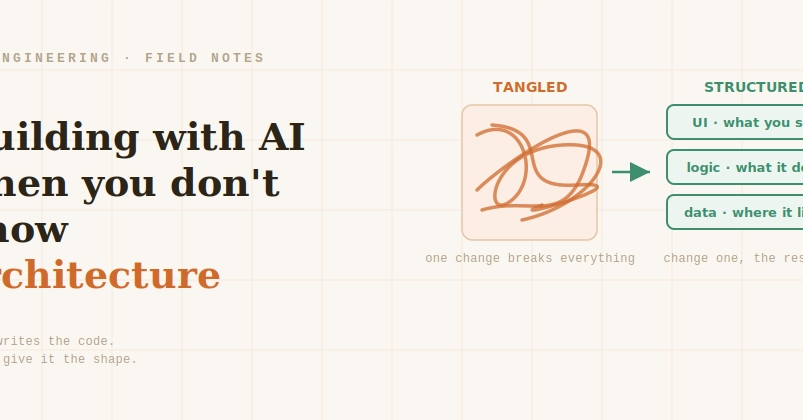
AI can write code, but it can't yet build a robust application. Developers face a new challenge: structuring their AI-generated projects.
NocoBase's latest alpha releases quietly introduce a powerful AI Builder, signaling a strategic shift towards AI-assisted development.

This week's tech news highlights the growing pains of AI agents, critical security vulnerabilities, and a renewed focus on efficiency and cost optimization across the industry.
Kiponos releases Java SDK 5.0 with a focus on state management and configuration loading, offering developers cleaner code and improved flexibility.

SQL uses Data Manipulation Language (DML) for daily operations and Data Definition Language (DDL) for structural changes. Know the difference.

New tool audits AI-predicted 3D RNA structures against experimental data, preventing costly synthesis failures.

Static Open Graph images are a missed opportunity. Learn how to generate dynamic previews for richer social sharing.

New app aggregates websites, blogs, newsletters, and podcasts into a single, scrollable feed.

AI talent marketplace Mercor is reportedly nearing a significant funding round that would double its last valuation.

A 25-minute INSERT into a PostgreSQL e-commerce data warehouse wasn't data size, but a subtle database configuration issue.

New service ZedGi allows serverless and edge runtimes to connect to Redis, Postgres, and MySQL over HTTPS, bypassing TCP limitations.

A production AI agent saw dramatic performance and cost improvements after a strategic migration to OpenAI's latest model.

Beyond basic vector similarity, metadata filtering and reranking significantly speed up and refine Retrieval Augmented Generation responses.