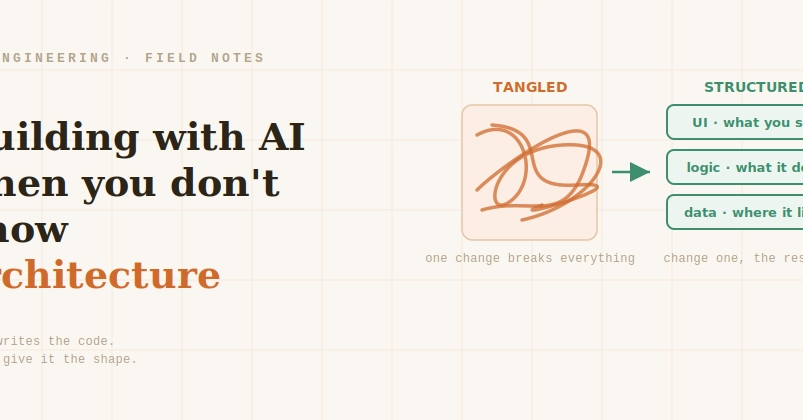
The AI Code Mirage
You’ve likely experienced it. The spark of an idea for an app, a quick chat with an AI, and suddenly, working code appears. You run it, and it functions. This feels like magic, a shortcut to creation that bypasses the steep learning curve of traditional development. What once took weeks of learning and iteration now seems achievable in hours. This accessibility is AI’s undeniable gift to the aspiring builder.
But this initial success is often a mirage. As you add features, the magic fades. One fix breaks two other parts. Explaining the problem to the AI becomes impossible because you no longer grasp the project's internal logic. Each modification feels like a blindfolded attempt at bomb disposal. This is the point where most AI-assisted projects stall, not because of coding limitations, but because of a lack of architectural understanding.
The critical insight here is that AI has democratized the act of writing code, but it hasn't removed the barrier to structuring it. These are fundamentally different skills. Writing code is about syntax and immediate functionality. Architecture is about long-term maintainability, scalability, and the holistic design of a system. AI can generate lines of code, but it struggles to build the scaffolding that holds them together reliably.
Bridging the Gap: From Snippets to Systems
The challenge for developers and creators leveraging AI is to recognize that the AI is a powerful tool, not a complete solution. It excels at generating discrete components or boilerplate code. It can translate a natural language description into a functional module. However, it doesn't inherently understand the trade-offs involved in choosing a database schema, designing an API, or implementing a caching strategy that will impact performance months down the line.
This is where human expertise in architecture becomes indispensable. It’s the difference between having a pile of bricks and having a blueprint for a house. The bricks are functional, but without a plan, they remain just a pile. An architect understands how to arrange those bricks, ensuring the structure is sound, meets the inhabitants’ needs, and can withstand the elements. Similarly, an application architect ensures that AI-generated code modules integrate seamlessly, that data flows efficiently, and that the system can grow without collapsing under its own weight.
Consider the analogy of a chef and a recipe generator. An AI can generate a recipe, listing ingredients and steps. A skilled chef, however, understands flavor profiles, cooking techniques, and how to adapt a recipe based on available ingredients or dietary needs. They can troubleshoot why a dish isn’t turning out right, not by following the recipe verbatim, but by understanding the underlying culinary principles. The AI-generated recipe is the code; the chef’s expertise is the architecture.
The Skills You Actually Need
So, what does this mean for someone building with AI? It means shifting focus from solely prompt engineering to understanding fundamental software design principles. Developers need to learn how to:
- Deconstruct Problems: Break down a large application idea into smaller, manageable modules. Understand the responsibilities of each module.
- Define Interfaces: Clearly specify how different modules will communicate with each other. This involves understanding APIs, data structures, and contracts.
- Manage State: Comprehend how data flows through the application and how it is stored and retrieved.
- Consider Scalability and Performance: Think about how the application will handle increased load and what architectural choices might impact speed and efficiency.
- Implement Error Handling and Resilience: Design systems that can gracefully handle failures and unexpected conditions.
These are not skills AI currently possesses in a way that allows for autonomous application building. They require judgment, foresight, and an understanding of system dynamics that goes beyond pattern matching in code.
The AI as a Co-Pilot, Not the Pilot
The most effective way to build with AI, especially without a deep architectural background, is to treat the AI as a highly capable co-pilot. You, the developer, remain the pilot. You set the destination, chart the course, and make the critical decisions. The AI handles much of the routine flying, generating the flight controls, engine components, and navigation data, but you are the one interpreting the instruments and guiding the aircraft.
This means you need to develop a critical eye for the code the AI produces. You must understand enough about architecture to evaluate its suggestions. For instance, if an AI suggests a particular database for a task, you should be able to ask: 'Is this database suitable for the expected volume of data? Does it support the types of queries we'll need? What are the scaling implications?' Without this understanding, you’re merely assembling AI-generated parts without a clear vision of the final structure, leading inevitably to the 'wall' described earlier.
Looking Ahead: The Evolving Developer Role
The advent of powerful AI code generators doesn't eliminate the need for skilled developers; it redefines their role. The emphasis shifts from rote coding to higher-level design, system thinking, and architectural decision-making. Developers who can effectively guide AI, understand the implications of its output, and architect robust systems will be in high demand.
What remains unanswered is how AI development tools will evolve to assist more directly with architectural challenges. Will future AI agents be able to propose architectural patterns, identify design flaws in existing codebases, or even generate comprehensive system designs based on high-level requirements? The current landscape suggests that while AI can accelerate the coding process dramatically, the human element of architectural design and strategic thinking is, and will remain, critical for building anything of lasting value and complexity.