The Design-Centric IDE Emerges
The software development landscape, often hyper-focused on code execution and rapid iteration, is seeing a new entrant that pulls the focus back to the fundamental architecture and design phase. Whiteboard, a YC W26 startup, has launched its open-source Integrated Development Environment (IDE) with a clear mission: to foster more thoughtful software design before a single line of production code is written. This move challenges the conventional IDE paradigm, which typically prioritizes code editing, debugging, and deployment.
Whiteboard positions itself as a tool for the entire development lifecycle, but with a distinct emphasis on the upstream activities that often get compressed or overlooked in fast-paced projects. The founders, who have not been individually named in the initial announcement, are clearly targeting a pain point experienced by many engineering teams: the disconnect between high-level design and low-level implementation, and the subsequent ripple effects on maintainability, scalability, and team understanding.
The core idea behind Whiteboard is to provide a structured environment for conceptualizing software. This isn't just about drawing boxes and arrows; it's about creating a living, interactive blueprint that can inform and guide the coding process. Think of it less like a static diagramming tool and more like a collaborative sketchpad that understands the relationships between components, their responsibilities, and their potential interactions. This approach aims to make the design phase a more integral and less ephemeral part of the development workflow.
Key Features and Design Philosophy
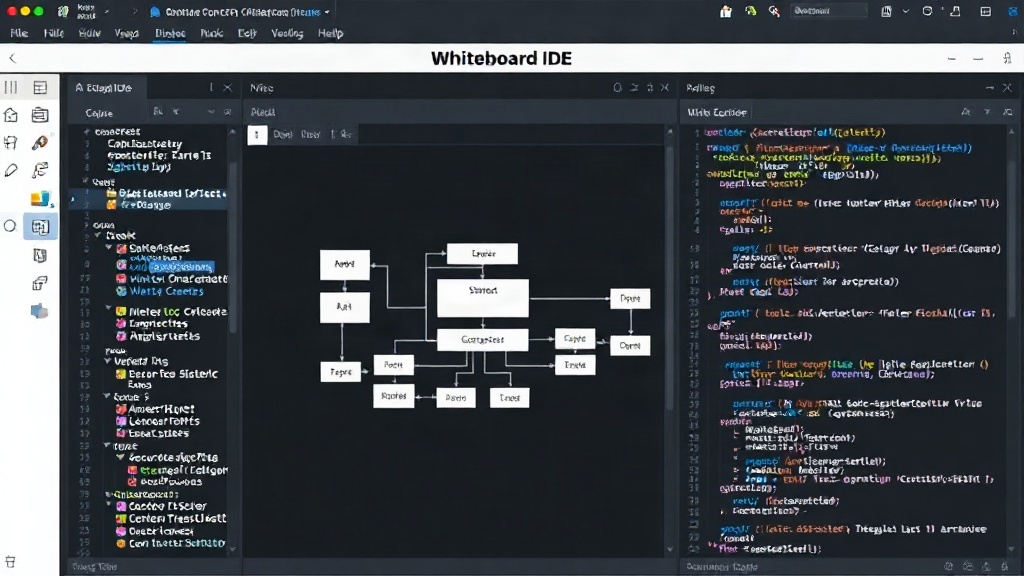
Whiteboard's open-source nature is a significant aspect, signaling a commitment to community involvement and transparency. This allows developers to inspect, modify, and contribute to the tool's evolution, a stark contrast to many proprietary IDEs. The platform is built around a visual-first approach. Users can define components, services, data models, and user flows using a rich set of visual elements. These elements are not merely decorative; they are intended to be semantically meaningful, allowing the IDE to understand the structure and intent behind the design.
One of the key differentiators is Whiteboard's focus on generating foundational code structures or configurations directly from the design. While not a full code generator in the traditional sense, it aims to translate the visual architecture into starting points for actual code. This could manifest as boilerplate code for services, data schema definitions, or API endpoints. The goal is to reduce the manual drudgery of setting up projects based on a design, ensuring that the implemented code faithfully reflects the intended architecture. This direct link between design and initial code implementation is crucial for maintaining design integrity throughout the project lifecycle.
Collaboration is another central pillar. The IDE is designed to facilitate team discussions and reviews directly within the design environment. This could include features for commenting on specific components, versioning designs, and tracking changes. By bringing these discussions into the same space where the architecture is defined, Whiteboard aims to minimize misinterpretations and ensure that all team members are aligned on the system's structure and purpose. This is particularly valuable for distributed teams or projects with complex interdependencies.
Addressing the 'Thoughtful Design' Gap
The phrase 'thoughtful software design' in Whiteboard's description is a deliberate nod to the challenges of modern software development. In many agile environments, the pressure to deliver features quickly can lead to compromises in architectural planning. This often results in technical debt, difficulty in scaling, and increased maintenance overhead down the line. Whiteboard seeks to counteract this by providing a dedicated space and set of tools specifically for deliberate, detailed design work.
The IDE's functionality is intended to support various design methodologies, from domain-driven design (DDD) to microservices architecture. By offering flexible visual primitives and the ability to define custom relationships and properties, it can adapt to different architectural patterns. This adaptability is key, as no single design approach fits every problem. The open-source model further supports this, allowing the community to develop extensions and integrations tailored to specific domains or methodologies.
What remains to be seen is how effectively Whiteboard can bridge the gap between its visual design environment and the actual implementation languages and frameworks developers use daily. While generating boilerplate code is a promising start, the true test will be in the fidelity and usefulness of these generated artifacts. The success of such an IDE hinges on its ability to seamlessly integrate into existing development workflows without introducing significant friction. If developers find it easier to design thoughtfully and have that design translate accurately into code, Whiteboard could become an indispensable tool for engineering teams striving for architectural excellence.
Implications for the Development Toolchain
The launch of Whiteboard as an open-source IDE signals a potential shift in the tooling priorities for software development. For years, the focus has been on optimizing the coding and deployment phases. Whiteboard's emergence suggests a growing recognition that the upstream design and architecture phases are equally, if not more, critical for long-term project success. This could encourage other tool providers to re-evaluate their offerings and consider how they can better support the entire software development lifecycle, from conception to deployment and maintenance.
Competitors in the diagramming and modeling space, such as Lucidchart or Draw.io, might find themselves challenged if Whiteboard can effectively demonstrate a tangible return on investment through improved code quality and reduced development friction. However, Whiteboard's focus on being an IDE—implying deeper integration with code and development workflows—sets it apart from pure diagramming tools. The challenge for Whiteboard will be to achieve a level of sophistication and usability that makes it compelling enough to adopt over established, albeit less design-centric, IDEs like VS Code or JetBrains products, especially for teams already heavily invested in those ecosystems.
The open-source nature of Whiteboard is a strategic advantage. It lowers the barrier to entry for adoption and fosters a collaborative development model. This community-driven approach could lead to rapid feature development and widespread adoption if the core product proves valuable. As more teams grapple with the complexities of distributed systems, microservices, and ever-evolving technology stacks, tools that help manage this complexity systematically, starting from the design phase, are likely to gain traction.