
The Problem: Inefficient Data Fetching in a React App
A common challenge in modern web development is efficiently fetching data for complex user interfaces. In one specific instance, a React application faced significant performance bottlenecks because its frontend directly queried multiple backend endpoints for a single data view. The bills worklist table, for example, required three separate network calls for each row to retrieve the bill details, its summary, and pending approvers. This resulted in a cascade of requests: one initial call for every bill without any pagination, followed by additional calls for each bill's summary and approvers. This inefficient pattern led to an excessive number of network requests and unnecessarily large data payloads being transferred to the browser, directly impacting load times and user experience.
The original architecture followed a standard pattern: a React frontend, integrated with React Query for state management and a generated API client, communicated directly with backend services. While this approach is straightforward for simpler applications, it quickly becomes unwieldy as complexity grows. The direct coupling meant that any change in backend API structure or data requirements necessitated frontend modifications, increasing development overhead and the risk of introducing bugs. The application was essentially pulling all necessary data for the bills worklist, including every bill and its associated details, directly into the browser, bypassing any server-side aggregation or optimization.
The Solution: Implementing a Backend-for-Frontend (BFF) Layer
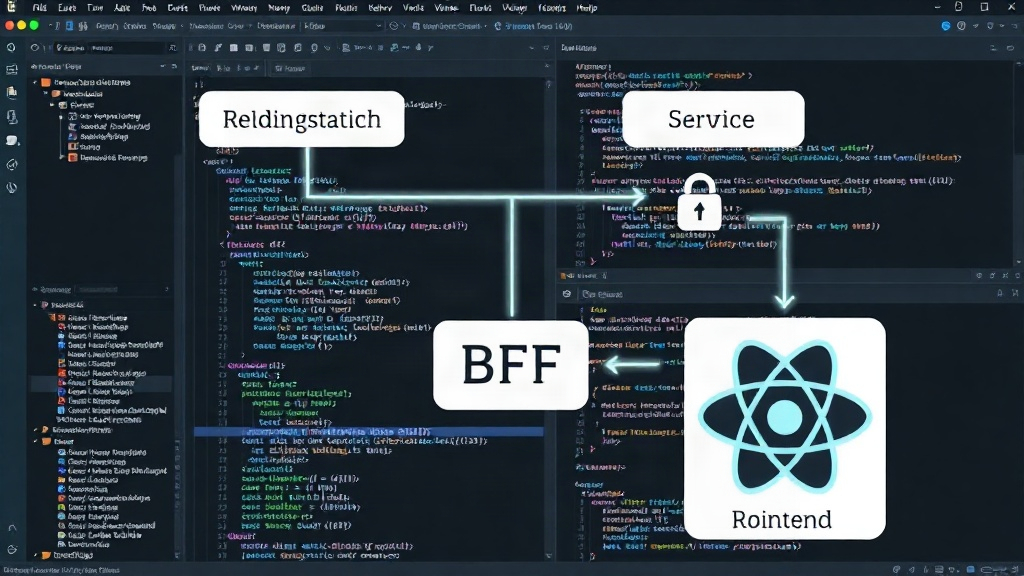
To address these issues, the development team introduced a Backend-for-Frontend (BFF) layer. This architectural pattern involves creating a dedicated API layer that sits between the frontend application and the backend microservices. The BFF acts as an intermediary, tailored to the specific needs of a single frontend application or even a specific screen within an application. Instead of the React app making multiple calls to different backend services, it now makes a single call to the BFF. The BFF then orchestrates the necessary calls to the underlying backend services, aggregates the data, and returns a response optimized for the frontend's requirements.
In this case, the BFF was designed to speak the language of the specific screen it served. For the bills worklist, the BFF would handle the complexity of fetching all the required data—bill details, summaries, and approvers—from their respective backend endpoints. It then combined this information into a single, coherent response that the React frontend could consume directly. This eliminated the need for the frontend to manage multiple disparate API calls, drastically reducing network overhead and simplifying frontend logic. This approach is akin to having a personal assistant for your application's data needs; instead of you asking multiple people for information, your assistant gathers it all and presents it to you in one neat package.
Tangible Benefits: Performance and Security
The implementation of the BFF layer yielded significant and immediate benefits. Performance saw a dramatic improvement. The number of network calls per page decreased from the initial 1 + 1 + N (where N was the number of bills, each requiring separate calls for summary and approvers) to a single call. This reduction in network chatter, combined with the elimination of large, unpagmented data pulls into the browser, led to faster load times and a more responsive user interface. The application's ability to handle larger datasets without performance degradation was a key outcome.
Beyond performance, the BFF layer also introduced a critical security enhancement. During its operation, the BFF identified and prevented a cross-user data leak before it could be deployed. This type of vulnerability, where one user can inadvertently access another user's sensitive data, is particularly insidious. By centralizing data access and transformation within the BFF, the team gained a single point of control to implement robust security checks. The BFF could validate user permissions and data access rules more effectively than if these checks were scattered across multiple backend services or left solely to the frontend. This proactive detection and mitigation of a serious security flaw underscored the value of the BFF not just for performance, but for overall application robustness and security.
Scaling the BFF Architecture
What began as a solution for a single problematic page evolved into a core architectural component. Three months after its initial implementation, the BFF layer was successfully managing 80 different routes across 9 distinct features of the application. This demonstrates the scalability and adaptability of the BFF pattern. It proved to be a flexible solution that could accommodate the growing complexity and breadth of the application's functionality. The team found that the BFF not only solved the initial performance issues but also provided a more maintainable and secure way to manage frontend-backend communication as the application matured.
The success of this single-screen BFF led to its adoption as a pattern for other features. Each new feature or complex screen could benefit from a dedicated BFF, ensuring that data fetching remained optimized and secure. This modular approach allows teams to tailor API responses precisely to the needs of each frontend component, reducing frontend complexity and improving developer productivity. The experience highlights how a targeted architectural change, like introducing a BFF, can have far-reaching positive impacts on application performance, security, and maintainability.
The Question of GraphQL
Interestingly, the article mentions that the team reached for a BFF *before* considering GraphQL. GraphQL is often touted as a solution for over-fetching and under-fetching, allowing clients to request exactly the data they need. However, implementing a full GraphQL layer can introduce significant complexity, including schema management, resolver implementation, and performance tuning at the GraphQL server level. In this scenario, the team found that a simpler BFF layer, essentially a thin server that speaks the language of one screen at a time, provided a more pragmatic and effective solution to their immediate problems. This raises an important question: when is a BFF layer sufficient, and when does the added complexity of GraphQL become necessary? The success of this BFF implementation suggests that for many common data aggregation and performance optimization tasks, a well-designed BFF can offer a compelling alternative to a full GraphQL adoption, providing many of the benefits with less overhead.