Why WhatsApp is a Unique Channel
While many platforms showcase AI chatbots, few successfully deploy them for continuous, real-world customer service. WhatsApp, with over 2 billion monthly active users, presents a compelling channel for business communication. A staggering 60% of small and medium-sized business customers prefer messaging over calling, and WhatsApp boasts a near-perfect 98% open rate, dwarfing email's 20%. However, this massive user base comes with unique constraints that can break simplistic chatbot implementations. It's not just another chat interface; its specific protocols and user expectations demand a robust, purpose-built architecture.
Core Architecture for Production WhatsApp AI
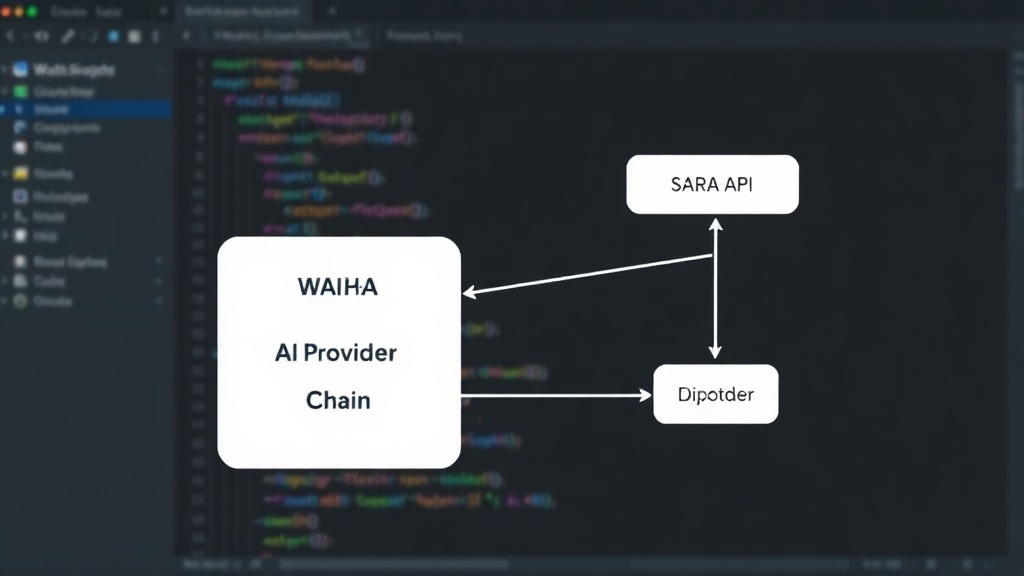
After 18 months of operating SARA, an open-source WhatsApp AI agent serving businesses across 20 industries, a clear architectural pattern has emerged. The system begins with the WhatsApp Business API (WAHA), which communicates with a 'Bridge' service. This bridge, typically running on port 3008, acts as the initial gateway, translating WAHA's messages into a format understandable by the main SARA API, usually exposed on port 3006.
The SARA API then orchestrates the AI provider chain. This isn't a single AI model but a sequence or selection of models designed to handle different aspects of the user's request. The sources mention specialized AI hardware providers like Groq, Cerebras, and SambaNova, suggesting a sophisticated setup where specific tasks might be offloaded to hardware optimized for certain computations. This multi-provider approach allows for flexibility and performance tuning. Following the AI provider chain, a 'Tool Dispatcher' takes over. This component is critical for enabling the AI agent to perform actions beyond simple text generation, such as querying databases, sending emails, or interacting with other business systems.
The Peril of AI Agent Configuration Changes
A significant challenge in running AI agents in production, especially those that can interact with external systems, is managing configuration changes. Unlike traditional software, where a code rollback might suffice, an AI agent's configuration is deeply intertwined with its capabilities and potential impact. A configuration change can alter an agent's tool permissions, model routing, retry logic, queue limits, or even browser profiles. If an agent is actively processing requests or has ongoing tasks, simply restoring an old configuration file doesn't undo already-executed side effects. Worse, it can make reconciling past actions with the current state impossible.
Consider an agent that can edit code repositories. If its configuration is updated to grant it broader access, and it makes a change, rolling back the configuration file alone won't revert the code commit. The system needs to track not just the configuration itself, but the *intent* and *actions* taken under each configuration. This means treating configuration as an immutable revision, not a mutable state.
Immutable Revisions and Rollback Control
The solution involves a control plane that treats each configuration change as a new, immutable revision. Each revision should be stored with its content digest, schema version, creator, the reason for the change, and its validation result. Never mutate the active configuration in place. This approach ensures that every state of the agent's configuration is versioned and auditable. When a rollback is necessary, the system can revert to a specific, known-good revision. However, it's crucial to understand that 'rollback' in this context doesn't magically undo past actions. Instead, it means stopping the agent from using the problematic configuration and potentially initiating corrective actions based on the state recorded during the problematic configuration's active period.
This robust configuration management is vital for production AI agents. It ensures that changes are traceable, reversible in terms of agent behavior, and that the system can maintain a consistent operational state even when adjustments are made. The complexity arises when an agent has already performed an action under the new configuration. Restoring the old configuration file is the first step, but the system must also account for the impact of the actions taken. This might involve logging, manual intervention, or automated remediation steps designed to undo the side effects of the problematic configuration. The goal is not to pretend the change never happened, but to manage the transition safely and reversibly.
Integrating AI with Business Tools
The 'Tool Dispatcher' component is the bridge between the AI's decision-making and concrete business actions. For a WhatsApp AI agent, this means connecting the language model's understanding of a customer's query to specific backend systems. For example, if a customer asks about their order status, the AI identifies the intent and extracts the order ID. The Tool Dispatcher then calls an internal order management API, retrieves the status, and feeds it back to the AI to formulate a response. This requires a well-defined interface for tools, allowing the AI to discover available actions, understand their parameters, and interpret their results.
The architecture must also handle the potential for AI hallucinations or misinterpretations when interacting with tools. Mechanisms like confirmation steps before executing critical actions (e.g., 'Are you sure you want to cancel this order?') or strict validation of tool outputs are essential. The ability to route requests through multiple AI providers or specialized hardware also plays into this. If a complex query requires nuanced understanding, it might be routed to a larger, more capable model. If a simple, repetitive task is identified, it could be sent to a faster, cheaper model or even a rule-based system. This layered approach ensures efficiency and accuracy.
The Human Element in AI Operations
Even with sophisticated architecture, human oversight remains critical. The configuration revision system should include creator and reason fields precisely for this reason. Auditing who made what change, and why, is fundamental for accountability. Furthermore, the ability to pause or halt an agent's operations, and the mechanisms for safely rolling back configurations, are designed to empower human operators. When an agent exhibits unexpected behavior, the ability to quickly revert its configuration and analyze the logs from the problematic period allows for rapid debugging and resolution. This creates a safety net, ensuring that the AI agent enhances, rather than disrupts, customer service operations.
Ultimately, building a production-grade WhatsApp AI agent is an exercise in systems engineering. It requires careful consideration of the channel's unique properties, a robust and flexible AI orchestration layer, and meticulous management of configuration changes to ensure safety and reversibility. The architecture described – WAHA → Bridge → SARA API → AI Provider Chain → Tool Dispatcher, coupled with immutable configuration revisions – provides a solid foundation for agents that can reliably serve real customers, 24/7.