Open Sourcing the JARVIS Experience
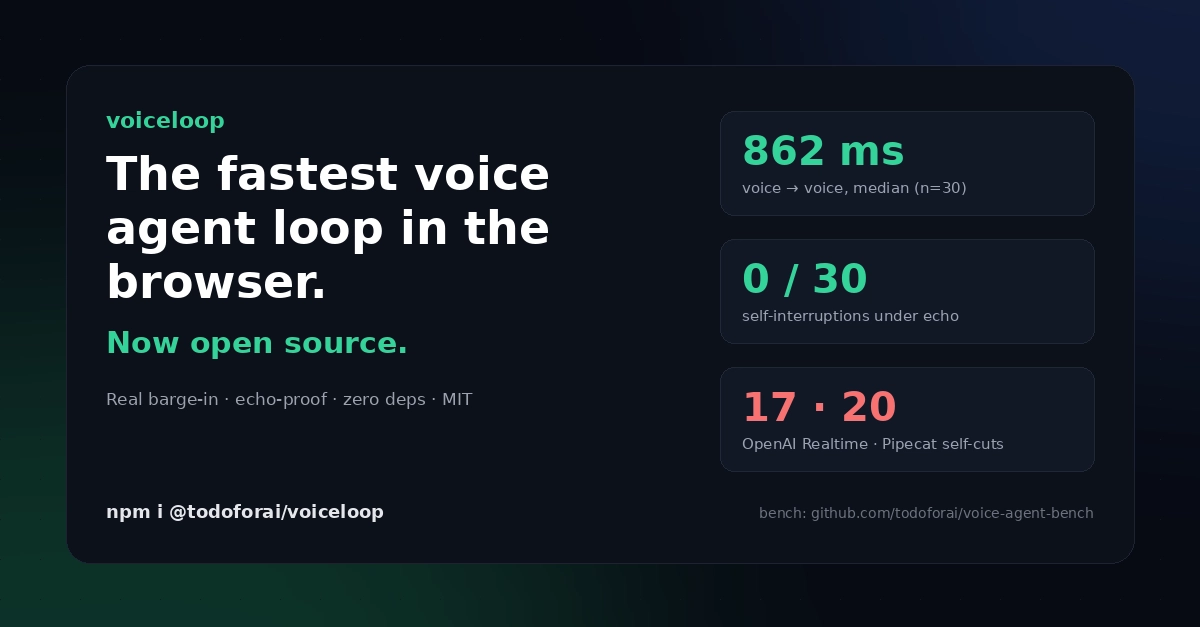
TODOforAI has open-sourced VoiceLoop, a JavaScript library designed to deliver a near real-time, fluid voice agent experience directly in the browser. The move aims to empower developers to integrate sophisticated voice interaction capabilities into their own products without relying on closed, often latency-prone, APIs. The team states that they could not find an existing stack that met their performance and responsiveness requirements for their own product, TODOforAI, which aims to provide a JARVIS-like interface. This led them to build VoiceLoop from the ground up.
VoiceLoop focuses on two critical aspects of voice agent interaction: low latency and the ability to interrupt. The goal is for the agent to respond within a second of user input and to stop processing immediately if the user speaks again mid-response. This level of responsiveness is crucial for creating a natural, conversational feel, akin to science fiction interfaces like JARVIS from Iron Man. By open-sourcing the library, TODOforAI is making this capability accessible to a wider developer community.
Performance Benchmarks and Technical Underpinnings
A key differentiator highlighted by TODOforAI is VoiceLoop's performance. They have released a public benchmark suite, accessible on GitHub, to validate their claims. This benchmark suite is designed to measure the performance of various voice agent stacks, positioning VoiceLoop as the fastest option available for in-browser implementations. While the specifics of the benchmark methodology are detailed in the linked repository, the core assertion is that VoiceLoop achieves superior speed and responsiveness compared to other solutions.
The library is built using JavaScript and is available as an npm package, making it easy for frontend developers to integrate. The architecture is designed for efficiency, minimizing overhead and processing steps to achieve the sub-second response times. This involves careful management of audio streams, speech-to-text (STT) processing, language model inference, and text-to-speech (TTS) synthesis, all orchestrated to work in concert with minimal delay. The interruptibility feature is particularly challenging, requiring precise timing and state management to halt ongoing processes the moment new audio input is detected.
Why This Matters for Developers
Previously, building such a fluid voice experience often meant relying on cloud-based APIs from providers like Google, Amazon, or OpenAI. While powerful, these services can introduce network latency, and their APIs might not always offer the granular control needed for instant interruption or the specific performance tuning required for a JARVIS-like feel. Furthermore, closed APIs can lead to vendor lock-in and unpredictable cost structures as usage scales.
VoiceLoop offers an alternative: a performant, open-source solution that runs entirely in the browser. This means developers can achieve lower latency, greater control over the user experience, and potentially lower operational costs. It opens the door for a new wave of interactive web applications where voice is a primary mode of interaction, rather than a secondary feature. Imagine customer support bots that feel genuinely conversational, in-browser coding assistants that respond instantly to spoken commands, or educational tools that adapt dynamically to a user's spoken input.
The library's open-source nature also fosters community contribution and transparency. Developers can inspect the code, understand its inner workings, and even contribute improvements. This contrasts sharply with proprietary solutions where the underlying mechanisms are hidden. The availability of the benchmark suite allows developers to objectively compare VoiceLoop against other tools and justify its adoption based on empirical data.
The Broader Implications for Voice AI
The release of VoiceLoop is significant for the broader landscape of voice AI development. It democratizes access to high-performance voice agent technology, lowering the barrier to entry for creating sophisticated voice-enabled applications. For startups and smaller companies, this can be a game-changer, enabling them to compete with larger players who might have had the resources to develop custom, low-latency solutions.
The focus on in-browser processing also has implications for privacy and data handling. By keeping audio processing and AI inference client-side, sensitive user data may not need to be transmitted to external servers, addressing some privacy concerns associated with cloud-based voice assistants. This client-side approach is particularly relevant for applications handling sensitive information.
However, running complex AI models client-side can be computationally intensive and may impact performance on lower-powered devices. The effectiveness of VoiceLoop will depend on the optimization of the underlying STT and language models, as well as the capabilities of the user's device. The benchmark results suggest TODOforAI has made significant strides in this area, but real-world performance will inevitably vary.
Looking Ahead
TODOforAI's decision to open-source VoiceLoop is a bold move that could accelerate innovation in voice-enabled web applications. The focus on speed and interruptibility addresses key pain points that have historically limited the naturalness of browser-based voice agents. As developers adopt and build upon VoiceLoop, we can expect to see more sophisticated and responsive voice interactions emerge across the web, bringing us closer to the seamless, AI-powered interfaces once confined to science fiction.