What is Vite+?
Vite+ represents an integrated JavaScript toolchain, built upon the foundation of Vite and other modern tools from the VoidZero ecosystem. It consolidates several powerful utilities into a single, cohesive development environment. At its core, Vite+ orchestrates a suite of tools including Vite itself for fast frontend development, Vitest for unit testing, Rolldown and tsdown for efficient compilation, and Oxlint alongside Oxfmt for code linting and formatting. The inclusion of Vite Task suggests a workflow automation layer. The fundamental question for developers is not whether Vite+ is powerful, but whether its specific capabilities align with the challenges and requirements of their current projects.
Vite+ is not a one-size-fits-all solution. Its value is realized when it addresses specific pain points within a development workflow. Understanding the problems it solves, the changes it introduces to development practices, and whether those problems are present in your project is crucial for a successful adoption. This chapter serves as a guide to making that informed decision.
The Vite+ Ecosystem Components
Vite+ integrates a carefully curated set of tools designed to streamline the JavaScript development lifecycle. Each component plays a distinct role:
Vite
The cornerstone of the toolchain, Vite provides an unparalleled development experience with its lightning-fast cold server start and Hot Module Replacement (HMR). It leverages native ES modules during development, drastically reducing startup times compared to traditional bundlers. For production, it uses Rollup for highly optimized builds.
Vitest
A unit testing framework built to be compatible with Vite. Vitest offers a fast and reliable testing environment, leveraging the same configuration and dependency pre-bundling as Vite. This ensures consistency between development and testing environments, simplifying setup and improving test execution speed.
Rolldown
A next-generation JavaScript bundler designed for extreme performance, built in Rust. Rolldown aims to be a faster alternative to Rollup, potentially offering significant build time improvements for large projects. Its integration into Vite+ suggests a future-proofing strategy for build performance.
tsdown
This tool likely handles TypeScript compilation, offering a potentially faster or more integrated approach than standard `tsc`. In an ecosystem focused on speed, tsdown would complement Vite's rapid development cycle by ensuring quick transpilation.
Oxlint
A fast and efficient linter for JavaScript and TypeScript, written in Rust. Oxlint aims to provide quick feedback on code quality and potential errors, integrating seamlessly into the development workflow to catch issues early.
Oxfmt
A code formatter, also likely implemented in Rust for performance. Oxfmt ensures consistent code style across a project, reducing cognitive load and preventing style-related merge conflicts. Its inclusion alongside Oxlint provides a comprehensive code quality solution.
Vite Task
This component likely serves as a task runner or script orchestrator within the Vite+ ecosystem. It could simplify the management of build scripts, development servers, testing commands, and other project-specific tasks, providing a unified interface for common operations.
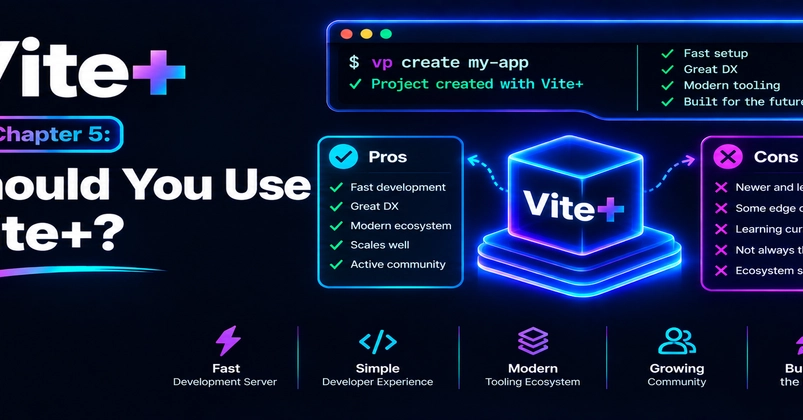
When to Consider Vite+
The decision to adopt Vite+ hinges on a practical assessment of your project's current state and future trajectory. Consider Vite+ if:
- You are starting a new project: For greenfield projects, Vite+ offers a modern, integrated toolchain from the outset. This avoids the common pain of stitching together disparate tools and configuring them to work harmoniously. You can leverage its speed and comprehensive features from day one.
- Your current build or test times are a bottleneck: If your development team spends significant time waiting for builds, tests, or code analysis, the performance gains offered by Rolldown, Oxlint, and Vitest could be substantial. Vite+ consolidates these performance-oriented tools.
- You value a unified development experience: The integrated nature of Vite+ means less time spent on configuration and debugging toolchain interactions. A single configuration philosophy, managed by VoidZero, can simplify maintenance and onboarding for new team members.
- You are already invested in the Vite ecosystem: If your team is already proficient with Vite and potentially Vitest, migrating to Vite+ represents a natural evolution. It extends the existing benefits with additional, complementary tools.
- You need robust code quality tools: The inclusion of Oxlint and Oxfmt provides a built-in, high-performance solution for maintaining code quality and consistency, reducing the need for external linters and formatters.
When to Reconsider Vite+
Conversely, Vite+ might not be the optimal choice if:
- You have a small, simple project with minimal build needs: For very small projects or static sites where build times are negligible and complex tooling is unnecessary, the overhead of integrating a full toolchain like Vite+ might be counterproductive. Standard Vite or even simpler build tools could suffice.
- You have a deeply entrenched, complex existing toolchain: Migrating a large, established project with a highly customized and integrated toolchain can be a significant undertaking. The potential benefits might not outweigh the cost and risk of migration.
- Your team lacks the expertise or time for adoption: While Vite+ aims for integration, adopting any new toolchain requires learning and adaptation. If your team is already stretched thin or lacks familiarity with the underlying technologies (like Rust-based tools), a phased approach or sticking with familiar tools might be wiser.
- Specific niche requirements are not met: While comprehensive, Vite+ may not cater to every possible edge case or highly specialized build process. It's essential to verify that all critical project requirements are supported.
The Decision Framework
The ultimate decision to use Vite+ should be based on a clear understanding of its value proposition relative to your project's specific context. It’s not about adopting the newest technology, but about solving problems effectively. Ask yourself:
- What are the most significant pain points in our current development workflow?
- Which of Vite+'s components directly address these pain points?
- What is the estimated cost (time, resources, risk) of adopting Vite+ versus the expected benefits?
- Does Vite+ align with our team's existing skill set and learning capacity?
By answering these questions, you can move beyond the general appeal of an integrated toolchain and make a data-driven decision that truly benefits your project. If Vite+ solves genuine problems for your team and aligns with your project's needs, it can significantly enhance productivity and developer experience. If not, other solutions may be more appropriate.
This concludes the Vite+ series. The power lies in choosing the right tools for the job.