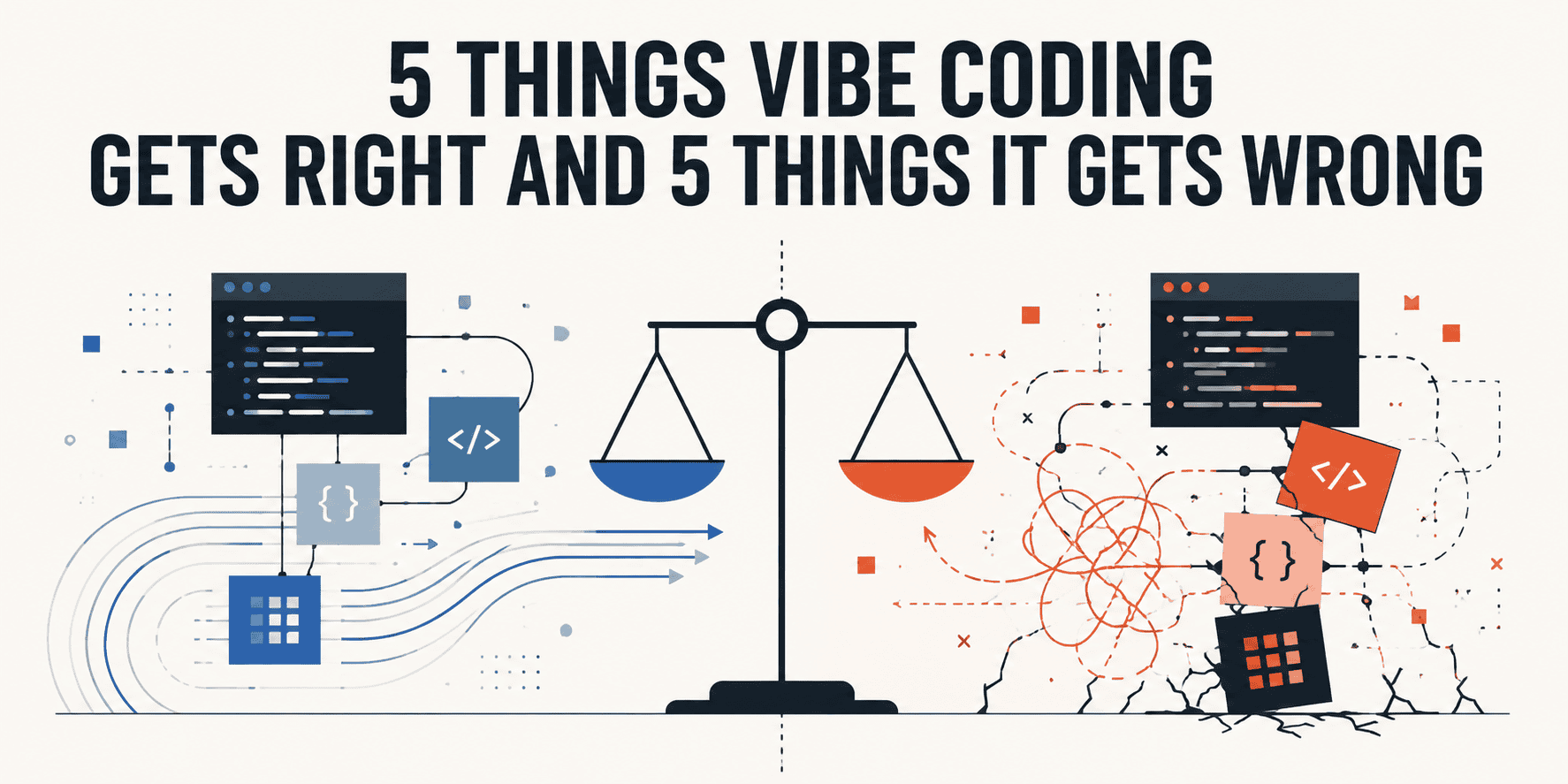
What is Vibe Coding?

Vibe coding, a term gaining traction in developer circles, describes a programming approach driven by intuition, aesthetics, and a strong sense of 'good feel' rather than strict adherence to established patterns, conventions, or even comprehensive documentation. It's less about following a predefined roadmap and more about navigating the coding landscape based on a developer's gut feeling and perceived elegance of the solution. This subjective approach prioritizes the developer's experience and the perceived 'rightness' of the code, often leading to rapid prototyping and a satisfying immediate development flow. However, it raises critical questions about maintainability, scalability, and collaboration in the long run.

The Strengths of Vibe Coding

1. Accelerated Prototyping and Idea Exploration

Vibe coding excels when speed is paramount. Developers can quickly translate ideas into functional code without getting bogged down by extensive planning or rigid architectural guidelines. This allows for rapid iteration and exploration of novel concepts. The immediate feedback loop, where the code 'feels' right as it's written, can be highly motivating and productive for individual developers or small, cohesive teams working on experimental projects.

2. Enhanced Developer Creativity and Expression

For many, coding is an art form. Vibe coding taps into this creative impulse, allowing developers to express their unique problem-solving styles. It encourages thinking outside the box and can lead to elegant, unconventional solutions that might not emerge from more dogmatic approaches. This freedom can be particularly appealing to developers who feel stifled by overly prescriptive methodologies.

3. Intuitive Problem Solving

Experienced developers often develop a strong intuition for how code should be structured and how systems should behave. Vibe coding leverages this expertise, allowing them to make sophisticated decisions based on years of accumulated knowledge and pattern recognition. When this intuition is well-honed, it can lead to surprisingly robust and efficient outcomes, as the developer is implicitly applying deep, internalized best practices.

4. Fostering a Strong Sense of Ownership

When developers have the autonomy to shape code based on their 'vibe,' they often develop a deeper sense of ownership and pride in their work. This can translate into higher engagement and a greater commitment to the project's success. The code becomes a personal expression, fostering a connection that goes beyond mere task completion.

5. Reduced Initial Cognitive Load

For certain types of problems, especially those that are ill-defined or rapidly evolving, a strict, upfront architectural design can be counterproductive. Vibe coding bypasses this, reducing the initial cognitive load and allowing developers to focus on getting something working. This can be a significant advantage in startup environments or when tackling R&D challenges where requirements are fluid.

The Weaknesses of Vibe Coding

1. The Peril of Technical Debt

The most significant drawback of vibe coding is its propensity to accumulate technical debt. Code written purely on 'vibe' may lack clear structure, consistent patterns, or adequate documentation. This makes it difficult for other developers (or even the original author, weeks later) to understand, modify, or debug. This debt can cripple a project's scalability and maintainability over time, turning a rapid start into a slow, painful grind.

2. Impaired Collaboration and Onboarding

Software development is rarely a solo endeavor. Vibe coding, by its nature, is highly individualistic. This makes it challenging for teams to collaborate effectively. New team members face a steep learning curve trying to decipher code that reflects one person's unique intuition rather than a shared, documented standard. Onboarding becomes a significant bottleneck.

3. Lack of Predictability and Testability

Code driven by subjective 'vibe' can be unpredictable. Without clear, established patterns, it's harder to write comprehensive automated tests. This reduces confidence in the codebase's stability and makes refactoring a high-risk activity. The lack of predictable behavior makes it difficult to reason about the system's overall state and performance.

4. Scalability Challenges

While vibe coding might work for small, self-contained projects, it often falters when systems need to scale. Solutions that felt 'right' at a small scale may not hold up under increased load or complexity. The absence of robust architectural planning means that scaling often requires significant, disruptive rewrites rather than incremental improvements.

5. Subjectivity and Inconsistency

What feels 'right' to one developer might feel completely wrong to another. This inherent subjectivity leads to inconsistencies across a codebase, even within the same project if multiple developers adopt a vibe coding approach. This lack of a unified standard makes the codebase feel disjointed and harder to manage, akin to building a house with different architects for each room, each with their own unique vision. The result is often a structurally unsound and aesthetically jarring final product.

Conclusion: A Tool, Not a Philosophy

Vibe coding is not inherently good or bad; it's a methodology with specific strengths and weaknesses. It can be a powerful tool for rapid prototyping, creative exploration, and individual expression when used judiciously. However, relying on it as a primary development philosophy, especially for larger, collaborative, or long-term projects, courts disaster in the form of unmanageable technical debt and collaboration breakdowns. The key lies in understanding when and how to apply it, balancing intuitive creativity with the essential discipline of structured, maintainable software engineering. The challenge for development teams is to harness the creative energy of vibe coding without sacrificing the stability and scalability that robust engineering demands.