
The Evolving Threat of Hardware Trojans
Hardware Trojans (HTs) represent a significant and growing threat to the integrity and security of integrated circuits (ICs). Unlike software Trojans, which reside in code, hardware Trojans are malicious modifications embedded directly into the silicon during the design or manufacturing process. These can range from subtle logic alterations that cause occasional errors to critical backdoors that compromise sensitive data or system functionality. The increasing complexity of modern System-on-Chips (SoCs) and the reliance on third-party intellectual property (IP) blocks and foundries create ample opportunities for attackers to insert these malicious elements.
Traditionally, detecting hardware Trojans has been a challenging endeavor. Many existing methods rely on generic machine learning (ML) techniques that require extensive training data and can be computationally expensive. These approaches often treat the synthesized gate-level netlist—the structural description of a digital circuit after logic synthesis—as a black box, learning patterns without a deep understanding of the underlying circuit behavior. This can lead to high false positive rates or missed detections, especially as Trojan designs become more sophisticated.
The vulnerability of synthesized netlists is particularly concerning. The process of logic synthesis transforms a high-level Register-Transfer Level (RTL) description into a gate-level netlist, optimizing for performance, area, and power. This transformation can obscure or alter the original structural and signal-flow patterns of an RTL Trojan, making it harder for detection tools to identify. Attackers can leverage this synthesis process to obfuscate their malicious modifications, making them appear as normal circuit behavior or optimization artifacts.
Introducing LoRD: A Heuristic-Based Solution
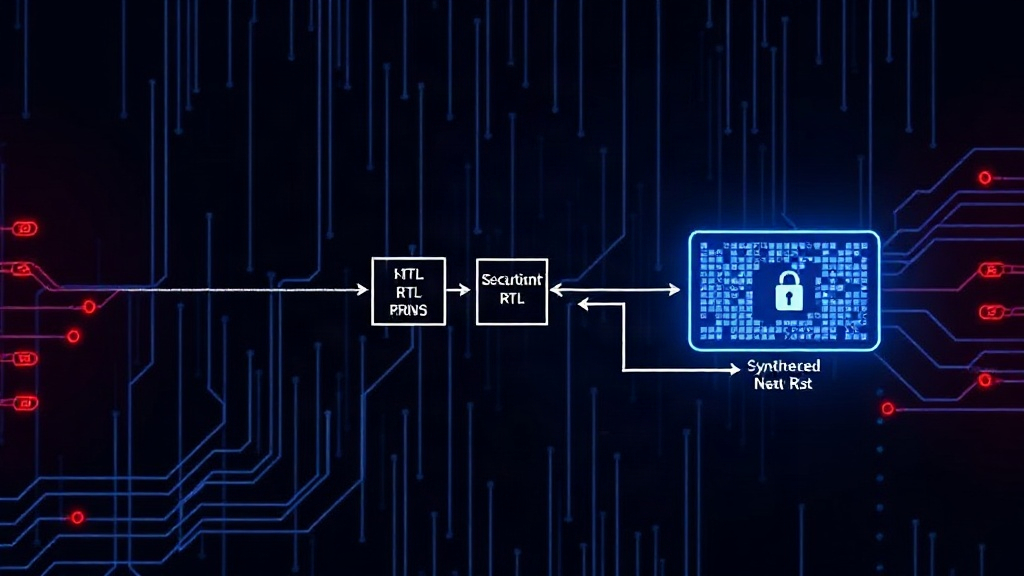
Researchers from the University of Wisconsin–Madison and Marist University have introduced a novel approach to tackle this problem. Their technical paper, “Demystifying Gate-Level Localization of RTL Trojans,” presents a new detection method called LoRD (Localization of RTL Trojans). Unlike generic ML approaches, LoRD leverages targeted heuristics specifically designed to exploit stable patterns exhibited by RTL Trojans after they have been synthesized into a gate-level netlist.
The core insight behind LoRD is that even after synthesis, RTL Trojans often maintain recognizable structural and signal-flow characteristics. These Trojans, when designed in RTL, typically involve specific trigger conditions and payload actions. The synthesis process, while optimizing the circuit, tends to preserve these fundamental relationships, albeit in a transformed gate-level representation. LoRD aims to identify these preserved patterns directly within the synthesized netlist.
The researchers found that RTL Trojans exhibit stable structural and signal-flow patterns post-synthesis. This stability is key. It means that instead of trying to learn a vast, generalized set of features that might apply to any circuit, LoRD focuses on identifying specific, predictable anomalies that are characteristic of Trojan behavior injected at the RTL stage. This targeted approach allows for more accurate and efficient detection.
How LoRD Works: Targeted Heuristics
LoRD employs a suite of carefully crafted heuristics. These heuristics are not based on brute-force ML model training but on a deep understanding of how RTL Trojans manifest in synthesized logic. The process can be broadly understood as follows:
- Structural Analysis: LoRD examines the connectivity and structure of the gate-level netlist. It looks for unusual or unexpected connections, redundant logic introduced maliciously, or specific gate types being used in non-standard ways that are indicative of a Trojan. For instance, a Trojan might introduce a small, complex logic block that is difficult to optimize away and has a peculiar fan-in/fan-out relationship.
- Signal-Flow Monitoring: The method also analyzes signal propagation paths. Trojans often rely on specific input conditions to activate their malicious payload. LoRD attempts to identify logic paths that are unusually long, have unexpected delays, or are designed to capture specific signal combinations that deviate from normal circuit operation. This could involve tracing signals that seem to lead to nowhere or are only activated under rare, specific input sequences.
- Heuristic Rule Sets: The system uses predefined rules derived from the observed stable patterns of synthesized RTL Trojans. These rules act as filters, flagging suspicious sub-circuits or logic blocks that match known Trojan archetypes. The advantage here is that these heuristics are lightweight and do not require extensive training data, making the detection process faster and less resource-intensive.
By combining these structural and signal-flow analyses with specific heuristic rules, LoRD can effectively pinpoint the location of embedded RTL Trojans within the synthesized netlist. This offers a significant advantage over generic ML approaches that might struggle to differentiate between genuine Trojan behavior and normal, albeit complex, circuit optimizations.
Performance and Advantages
The effectiveness of LoRD was demonstrated through experiments where it was applied to various synthesized netlists containing known RTL Trojans. The results indicate that LoRD achieves high detection rates while maintaining a low false positive rate. Its heuristic-based nature makes it particularly efficient.
One of the primary advantages of LoRD is its lightweight nature. Traditional ML-based detection methods often require significant computational resources for training and inference. LoRD, by contrast, relies on targeted analysis and predefined rules. This makes it practical for deployment in scenarios where computational power is limited or where rapid detection is crucial, such as during post-synthesis verification or pre-silicon validation stages.
Furthermore, LoRD's ability to pinpoint the location of the Trojan (gate-level localization) is invaluable. Knowing the precise location of a malicious modification allows designers and security professionals to better understand its potential impact and to develop targeted countermeasures. This is a critical step in mitigating the threat posed by hardware Trojans.
The surprising detail here is not that a new method for detecting hardware Trojans has been developed, but that it moves away from the prevailing trend of complex, data-hungry ML models towards a more fundamental, heuristic-driven approach. This suggests a potential paradigm shift in hardware security, prioritizing targeted analysis informed by domain expertise over generalized pattern recognition.
Implications for the Semiconductor Industry
The development of LoRD has significant implications for the semiconductor industry. As the supply chain becomes more distributed and reliance on third-party IP increases, the risk of hardware Trojan insertion escalates. Tools like LoRD are essential for ensuring the trustworthiness of the hardware that powers everything from consumer electronics to critical infrastructure.
For design teams, LoRD offers a more practical and efficient way to verify the security of their synthesized netlists. It can be integrated into existing verification flows, providing an additional layer of assurance against malicious modifications. This is crucial for meeting stringent security requirements in sectors like defense, aerospace, and automotive.
The research also highlights the importance of understanding the post-synthesis behavior of RTL designs. It underscores that security considerations must extend beyond the initial RTL design phase and encompass the entire design flow, including synthesis and physical implementation. What remains to be fully explored is how attackers might adapt their Trojan designs to specifically evade heuristic-based detection methods like LoRD, and what counter-countermeasures might be needed.