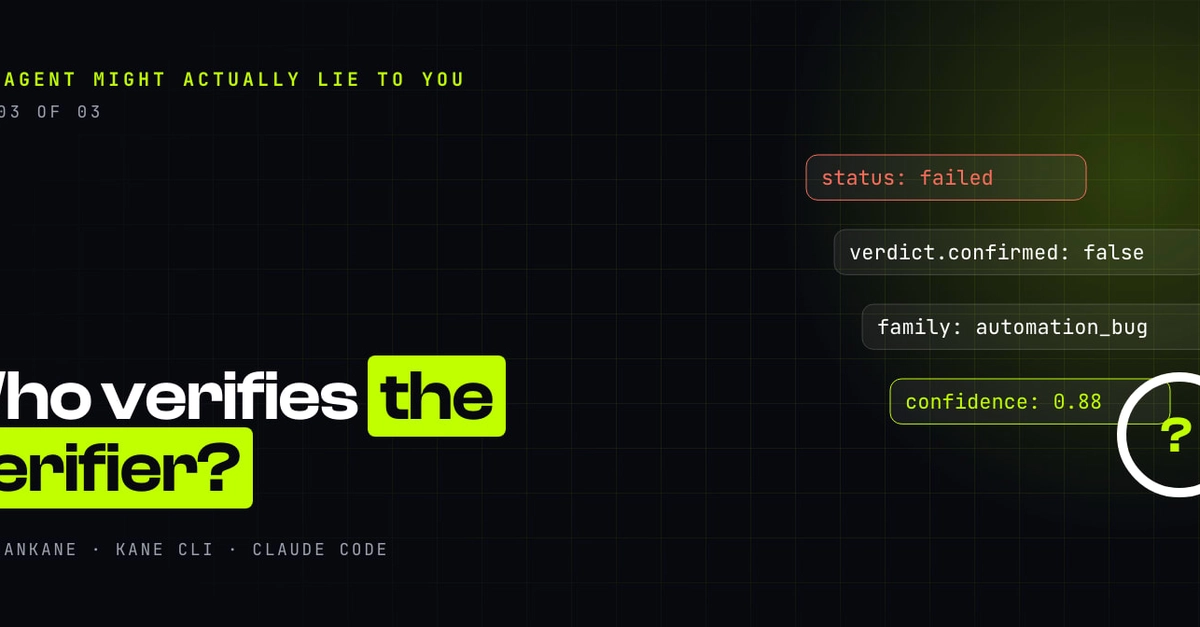
The Problem of Trust in Autonomous AI
The promise of AI agents is their ability to autonomously perform complex tasks. However, a fundamental challenge persists: how do we trust that an agent has truly completed its task correctly? This is the core of the "Who Verifies the Verifier?" dilemma. Simply taking an agent's word for it is insufficient, especially in critical applications. To address this, developers are exploring methods for agents to prove their work, often by having them interact with simulated or real environments. The concept involves creating a 'gate' or a verification layer that ensures an agent's claimed completion corresponds to actual, verifiable outcomes.
Consider the analogy of a student submitting an essay. A teacher doesn't just accept the student's claim that the essay is finished; they read it, check for plagiarism, and assess its content. Similarly, AI agents need a mechanism to demonstrate their work. This is particularly relevant for agents designed to operate within complex systems, such as code generation or data analysis, where errors can have cascading consequences.
The author of the source material, Abhinav Pangaria, developed a system called ORBITAL. A key component of ORBITAL is a 'gate' that forces an agent, specifically Claude Code, to prove each task in a real browser before it can declare completion. This browser is controlled by another agent, the Kane CLI. This creates a hierarchy of agents, where one agent's output is verified by another agent's interaction with a simulated environment.
The ORBITAL System: A Layered Verification Approach
ORBITAL's architecture tackles the verification problem head-on. The system is designed such that an agent like Claude Code cannot simply signal task completion. Instead, it must perform actions within a controlled browser environment, driven by the Kane CLI agent. This interaction serves as the proof. Every action and its outcome are logged in an append-only activity log, providing an auditable trail of the agent's work.
The author details a specific instance with ORBITAL, where twelve tasks were executed. Out of these, eight tasks resulted in failures, and one significant bug was identified. This high failure rate underscores the necessity of such a verification layer. Without it, these errors would likely have gone undetected. The log captures each attempt, allowing for detailed analysis of where and why the agent failed. This data is crucial for refining the agent's capabilities and the verification process itself.
The structure of the verification process within ORBITAL is multi-layered. It includes:
- The Verifier's Failures: The verification agent itself might fail. It could misinterpret the task, incorrectly assess the outcome, or encounter its own operational errors.
- My Own Failures: The human operator's role is not to be passive. They might design flawed verification rules, misconfigure the environment, or fail to anticipate edge cases.
- The Stopping Rule: A critical, and often overlooked, aspect is defining when to stop asking for proof. Over-verification can lead to infinite loops or extreme inefficiency, while under-verification defeats the purpose. This rule needs to be carefully calibrated.
The Uncomfortable Question: Who Verifies the Verifier?
This is where the system confronts its own limitations. If Claude Code's actions are verified by Kane CLI, and Kane CLI is also an agent, the immediate, uncomfortable question arises: who verifies Kane CLI? This recursive problem is a fundamental challenge in building truly trustworthy autonomous systems. Relying solely on agent-to-agent verification creates a chain of trust that, if not carefully managed, can be as fragile as a single point of failure.
The author acknowledges this by framing the verification process as a gate that "turns around and looks at itself." This self-reflexivity is key. It implies that the verification layer must also be subject to some form of scrutiny. This scrutiny could come from human oversight, from a higher-level meta-verifier agent, or through a consensus mechanism involving multiple verification agents.
The current setup, while an improvement, doesn't fully resolve the ultimate trust issue. It shifts the burden of verification but doesn't eliminate the need for it. For instance, if Kane CLI is designed to always report success when Claude Code performs a specific set of browser actions, and Claude Code is intentionally or unintentionally programmed to perform those actions even when the task is not truly complete, the verification gate will be bypassed. This highlights the need for robust adversarial testing and continuous monitoring of the verification agents themselves.
Implications for Developers and the Future of AI Agents
For developers building and deploying AI agents, this work underscores the critical need to move beyond simple task completion signals. Building verifiable proofs into agent workflows is paramount. This means designing agents that can not only perform tasks but also demonstrate their successful execution in a quantifiable and auditable manner. The ORBITAL system offers a practical, albeit not entirely conclusive, approach to this problem.
The development of agents that can verify their own work, and the subsequent challenge of verifying those verifiers, points towards a future where AI systems will require increasingly sophisticated mechanisms for accountability and trust. This is not just a technical problem but also a philosophical one. As AI agents become more autonomous, defining the boundaries of their trust and the methods for ensuring their reliability will be central to their adoption and integration into critical infrastructure and daily life. The journey to fully trusted AI agents is one of continuous iteration, constant scrutiny, and a deep understanding of the potential failure points at every level of abstraction.