The Hidden Costs in Your S3 Bill
Many organizations operate under the assumption that their AWS S3 storage costs are accurate and optimized. However, a deep dive into common billing statements reveals a pervasive problem: S3 bills are frequently inflated, not due to architectural complexity, but due to a series of preventable oversights. The most common culprits include data residing in the most expensive storage class (S3 Standard), a lack of lifecycle policies to manage data aging, incomplete multipart uploads consuming invisible storage, and inefficient data retrieval patterns that route traffic unnecessarily through costly NAT Gateways.
These issues are rarely indicative of fundamental design flaws. Instead, they point to a need for a systematic checklist approach, executed in the correct order, to identify and rectify these cost drains. The potential savings are directly tied to your specific access patterns, but the mistakes themselves are so widespread that the question is almost always how much can be saved, rather than if savings are possible.
Understanding S3 Storage Classes and Lifecycle Policies
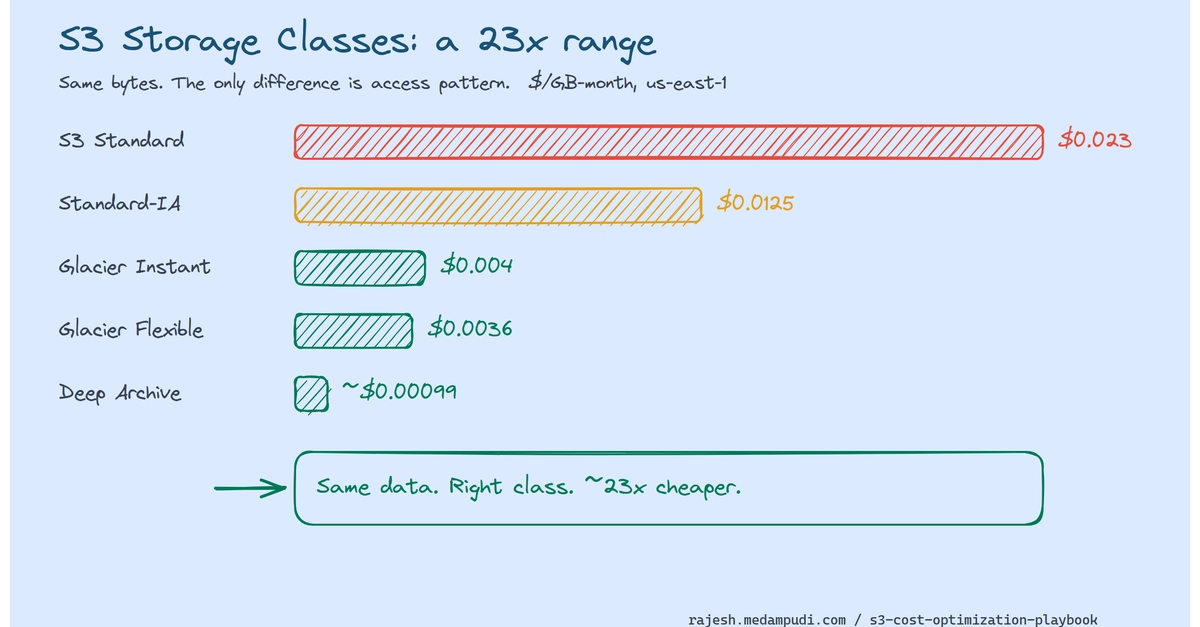
AWS offers a tiered approach to S3 storage, with S3 Standard being the most accessible and also the most expensive at $0.023 per GB-month. For data that is accessed infrequently but must be readily available, S3 Standard-Infrequent Access (S3 Standard-IA) and S3 One Zone-IA offer lower storage costs with retrieval fees. For long-term archival, S3 Glacier Instant Retrieval, S3 Glacier Flexible Retrieval, and S3 Glacier Deep Archive provide progressively lower storage costs, with corresponding increases in retrieval time and potential fees.
The critical tool for managing these tiers is the S3 Lifecycle Policy. This feature allows you to automatically transition objects to different storage classes or expire them after a specified period. For instance, logs generated by applications might be transitioned from S3 Standard to S3 Standard-IA after 30 days, then to S3 Glacier Flexible Retrieval after 90 days, and finally expire after a year. Implementing such policies is paramount for optimizing costs associated with data that has a declining access frequency over time. Without them, data that could be stored for pennies per gigabyte per month remains in the most expensive tier indefinitely.
The Problem of Incomplete Multipart Uploads
A less obvious, yet significant, cost contributor is the existence of incomplete multipart uploads. When large files are uploaded to S3 using the multipart upload API, the upload is broken down into parts. If an upload is initiated but never completed (due to network interruptions, application errors, or simply being abandoned), the uploaded parts remain in S3. Crucially, these parts consume storage space and incur charges, even though the object is not fully assembled and therefore not visible in the S3 console as a usable object. AWS charges for the storage of these parts.
The challenge here is visibility. These orphaned parts do not appear as complete objects. Identifying and cleaning them up requires specific actions within S3. AWS provides mechanisms to list and abort incomplete multipart uploads. Regularly running a process to identify and abort these uploads is essential. A common strategy is to set a lifecycle rule to abort incomplete multipart uploads after a certain number of days (e.g., 3 or 7 days). This prevents orphaned parts from accumulating and incurring unnecessary storage fees. This is akin to leaving partially packed boxes in a storage unit; you're paying for the space they occupy, but they don't contain anything useful and are just taking up room.
Optimizing Data Retrieval with VPC Gateway Endpoints
Another significant, often overlooked, cost center relates to how data is retrieved from S3, particularly by EC2 instances within a Virtual Private Cloud (VPC). By default, traffic from an EC2 instance to an S3 bucket is routed over the public internet, even if the EC2 instance is within the same AWS region as the S3 bucket. This traffic egresses the VPC through a NAT Gateway, which incurs charges based on data processed and hourly usage. For high-volume data transfers, these NAT Gateway costs can become substantial.
The solution is to implement VPC Gateway Endpoints for S3. A gateway endpoint provides a direct, private connection from your VPC to S3 without requiring a NAT Gateway or traversing the public internet. Traffic directed to S3 via the gateway endpoint stays entirely within the AWS network. The most compelling aspect of this solution is that AWS does not charge for data processed through S3 gateway endpoints. This makes it a zero-cost optimization for data retrieval. Configuring a gateway endpoint is a straightforward process within the VPC console. Once configured, you can optionally apply endpoint policies to further control access to specific S3 buckets.
A Systematic Approach to Savings
The key to unlocking these savings is a structured, ordered approach. Attempting these optimizations in a haphazard manner can be inefficient or even counterproductive. A recommended order of operations:
- Audit Storage Classes: Analyze your S3 bucket inventory to identify objects or prefixes stored in S3 Standard that have infrequent access patterns.
- Implement Lifecycle Policies: Configure policies to transition data to cheaper storage classes (e.g., S3 Standard-IA, Glacier Deep Archive) based on age and access frequency. Set policies to expire data that is no longer needed.
- Clean Up Incomplete Uploads: Set lifecycle rules to abort incomplete multipart uploads after a reasonable period (e.g., 3-7 days) to prevent orphaned parts from accumulating storage costs.
- Configure VPC Gateway Endpoints: For EC2 instances that frequently access S3 data, create and configure S3 gateway endpoints within your VPC to eliminate NAT Gateway egress charges.
- Review Access Logs: Regularly analyze S3 access logs to understand data access patterns, identify potential security issues, and refine lifecycle policies.
By systematically applying these steps, organizations can significantly reduce their S3 storage and data transfer costs without requiring complex architectural changes. The savings are often immediate and directly attributable to addressing these common, yet critical, operational oversights.