The Hidden Cost of Cloud Ownership
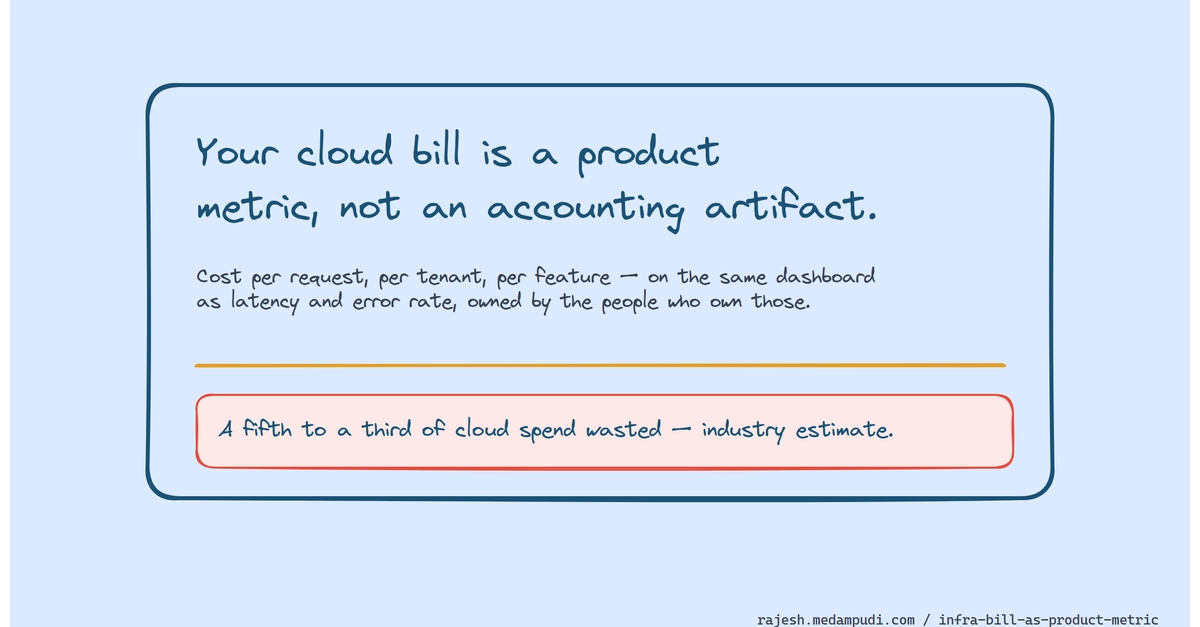
The cloud bill is the single largest financial artifact in most technology companies, yet it often falls into a dangerous ownership vacuum. Engineering teams focus on latency, error rates, and uptime, while finance departments manage the invoice. This chasm, wide enough to swallow a third of cloud spend, is a systemic problem across the industry. The solution isn't more sophisticated spreadsheets at month's end; it's a fundamental shift in perspective. Real cloud cost management is not an accounting function. It requires treating the cloud bill as a product metric, integrating metrics like cost per request, cost per tenant, or cost per feature directly onto the same dashboards as latency and error rates, and assigning ownership to the same teams responsible for those performance indicators.
This approach moves cost from a lagging accounting artifact to a proactive product metric. Instead of reacting to an inflated bill after the fact, teams can monitor and optimize costs in real-time, making informed decisions that directly impact both product performance and financial health. This integration is not just about saving money; it's about building more efficient, sustainable, and ultimately more valuable products.
Identifying Where Cloud Spend Hides
For a mid-sized AWS account, particularly one with a monthly spend of $50,000 or more, significant cost savings are almost always found in predictable areas. An audit, conducted with read-only access, can often pinpoint 20-30% of wasted spend within a single day. This isn't about massive architectural overhauls. It’s about meticulous attention to detail and understanding where cloud providers, like AWS, bury their metering. The most common culprits, in order of typical impact, are:
- Unseen Data Transfer: Costs associated with data moving in and out of services or regions that don't immediately jump out in standard console views.
- Oversized, Stale Instances: Compute instances provisioned for temporary load testing or development environments that were never decommissioned, running at full capacity long after their need has passed.
- On-Demand Pricing for Baseline Workloads: Paying premium on-demand rates for resources that operate at a constant baseline load, when reserved instances or savings plans would offer substantial discounts.
- Stale, Expensive Storage: Data residing in the most costly storage tiers (e.g., S3 Standard) that could be migrated to cheaper, archival, or infrequent access tiers without impacting performance or availability.
These are not edge cases; they are systemic inefficiencies that accrue significant costs. The key takeaway is that the biggest gains in cost optimization often come from simple, low-risk adjustments rather than complex re-architectures. The discipline that ties these actions together is known as FinOps.
FinOps: A Playbook for Startups and Beyond
Cloud spending is projected to exceed a trillion dollars annually, with a substantial portion – estimated at 25% to 35% of the average bill – being wasted on idle resources, over-provisioned instances, and missed commitment discounts. For early-stage companies, where hosting costs can consume 6% to 12% of revenue, this waste directly impacts runway and survival. Fortunately, achieving significant cloud cost optimization rarely demands painful, time-consuming re-architectures. The most impactful strategies involve straightforward, low-risk actions:
- Decommissioning Unused Resources: Identifying and shutting down any resources that are no longer actively used or monitored. This includes development environments, staging servers, and dormant databases.
- Rightsizing Instances: Analyzing actual resource utilization (CPU, memory, network I/O) of running instances and adjusting their sizes to match demand. Over-provisioned instances are a constant source of unnecessary expense.
- Leveraging Commitments: Purchasing Reserved Instances (RIs) or Savings Plans for baseline workloads that are predictable and stable. These commitments offer significant discounts compared to on-demand pricing.
The practice of FinOps brings these actions together under a unified discipline. It doesn't necessarily require a dedicated team, especially in smaller organizations. What it does require is threefold: deep visibility into where money is being spent, a prioritized list of high-leverage optimization actions, and the consistent habit of reviewing and acting upon cloud spend before it becomes a critical issue. This proactive approach ensures that cloud costs are continuously managed and aligned with business objectives, effectively turning a financial liability into a manageable operational metric.
The Engineering-Finance Bridge
The core challenge lies in bridging the gap between engineering's focus on performance and finance's focus on the invoice. By reframing the cloud bill not as a static accounting report but as a dynamic product metric, this gap can be closed. Imagine dashboards where engineers can see not just the latency of an API call, but also its cost. This direct correlation allows engineers to make trade-offs that consider both speed and efficiency. For instance, an engineer might choose a slightly less performant but significantly cheaper algorithm if the cost per request is a key metric they are accountable for. This transforms cost management from a finance-led audit into an engineering-led optimization process. It empowers development teams to innovate responsibly, understanding the immediate financial implications of their architectural and coding decisions. The goal is to make cost as visible and actionable as any other critical product KPI.
Actionable Steps for Optimization
Implementing effective cloud cost management requires a systematic approach. For any team managing a cloud bill, especially those with significant spend, the following steps are crucial:
- Establish Visibility: Utilize cloud provider tools (AWS Cost Explorer, Azure Cost Management, GCP Billing reports) and third-party FinOps platforms to gain granular visibility into spending by service, tag, project, or team. Tagging resources diligently is paramount for accurate allocation and analysis.
- Identify Low-Hanging Fruit: Conduct an initial audit focusing on the common areas of waste: unused resources, over-provisioned instances, and expensive storage tiers for infrequently accessed data. Automate the identification and alerting for these issues.
- Rightsizing Strategy: Implement continuous monitoring of instance and service utilization. Use historical data to rightsize resources, adjusting compute, memory, and storage to match actual demand. Tools that recommend optimal instance types based on workload patterns are invaluable.
- Commitment Optimization: For stable, baseline workloads, leverage Reserved Instances or Savings Plans. Analyze usage patterns to determine the optimal commitment level, balancing discount potential with flexibility.
- Data Transfer Awareness: Scrutinize data transfer costs, especially inter-region or egress traffic. Architect applications to minimize unnecessary data movement and consider using Content Delivery Networks (CDNs) where appropriate.
- Integrate Cost into Engineering Workflows: Embed cost metrics into development pipelines and team dashboards. Encourage engineers to consider cost implications during design and implementation phases. Foster a culture where cost efficiency is a shared responsibility.
By adopting these practices, organizations can move beyond reactive cost control to proactive cost optimization, ensuring that their cloud investments are efficient and directly contribute to business goals rather than draining valuable runway.