The Birth of the Credit Card Network
In September 1958, Bank of America mailed sixty thousand credit cards to the residents of Fresno, California. This wasn't a response to applications; nobody had asked for one, and crucially, nobody had been credit-checked. The cards simply arrived in envelopes, fully activated, with a spending limit attached, addressed to strangers. This bold, almost reckless, experiment was the genesis of what would become the modern credit card network.
The initiative, part of Bank of America’s ambitious plan to create a nationwide, real-time transaction system, quickly earned the moniker "The Fresno Drop." It went about as well as one might expect given the lack of due diligence. Fraud was immediate and widespread. Delinquency rates climbed past twenty percent. The program hemorrhaged money and became known internally with considerable embarrassment.
Yet, beneath the initial chaos and financial losses, the experiment held a crucial insight: the problem wasn't the card itself, but the underlying network that would give it value. A card is merely a piece of plastic. Its worth is derived entirely from the ability of a merchant, a stranger to the cardholder, to accept it in under two seconds. And a merchant would only agree to this if they trusted the issuer of the card – a trust that Bank of America was attempting to build through sheer scale and a leap of faith in future infrastructure.
Building the Infrastructure: The Unseen Network
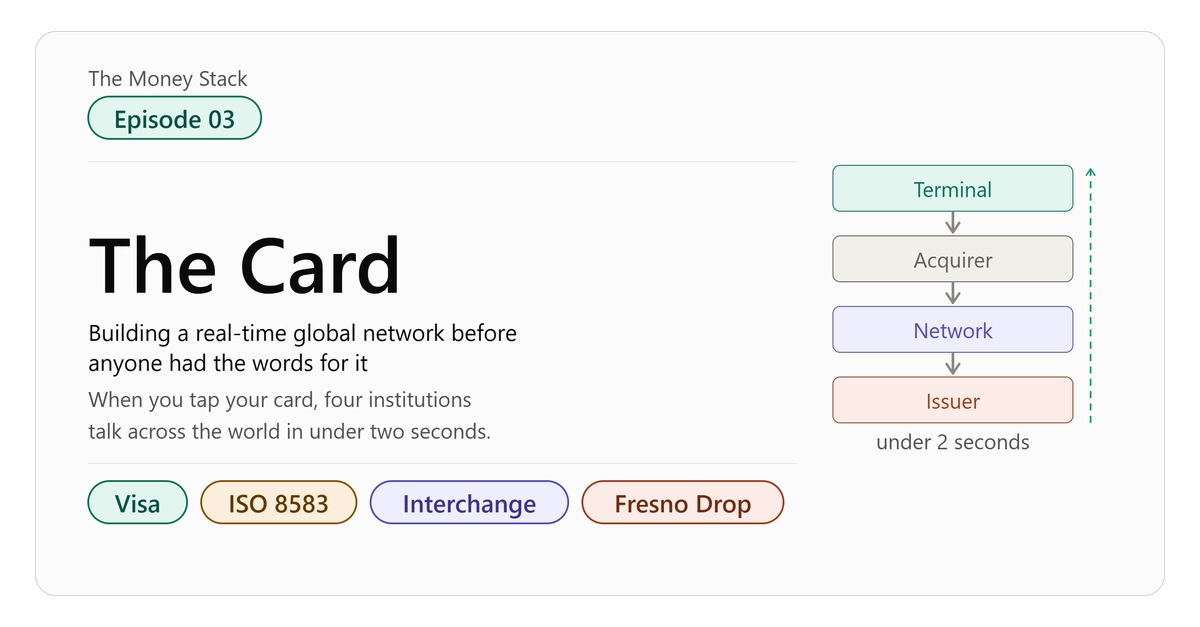
The success of a credit card hinges on a complex, invisible web of interconnected systems and agreements. For a transaction to occur, several parties must communicate seamlessly and instantaneously:
- The cardholder presents the card to the merchant.
- The merchant's point-of-sale (POS) terminal, or a manual imprinter, captures the card details.
- This information is sent to the merchant's acquiring bank (the bank that processes credit card transactions for the merchant).
- The acquiring bank routes the transaction through a card network (like Visa or Mastercard, though in 1958 these were nascent or non-existent in their current form).
- The card network forwards the request to the cardholder's issuing bank (Bank of America in this case).
- The issuing bank verifies the cardholder's account, checks for sufficient credit, and approves or declines the transaction.
- This authorization signal travels back through the network to the merchant's POS terminal, all within seconds.
In 1958, this level of real-time communication and data processing was science fiction for most of the world. Bank of America was not just distributing plastic cards; it was attempting to build the digital rails upon which these transactions would run. The Fresno Drop was, in essence, a massive beta test for a future financial ecosystem.
The immediate challenges were immense. Fraudsters quickly exploited the lack of verification, using stolen or fake cards. The high delinquency rate meant the bank was lending money to people who had no intention or ability to repay. The operational costs of managing such a high failure rate, coupled with the manual processes required for verification and reconciliation, were staggering. It was a financial black hole.
Lessons from the Drop: The Long Game
Despite the staggering losses – estimated to be in the millions of dollars in today's terms – Bank of America did not abandon the concept. The leadership recognized that the failure was not in the idea of a universal payment card, but in the premature rollout without adequate supporting infrastructure and risk management. The key takeaway was that building a robust, fraud-resistant network required significant investment in technology, data analysis, and customer vetting processes.
The Fresno Drop served as an invaluable, albeit expensive, lesson. It highlighted the critical need for:
- Identity Verification: Robust methods to confirm the identity of cardholders before issuing credit.
- Credit Scoring: Systems to assess the creditworthiness of applicants and set appropriate spending limits.
- Fraud Detection: Real-time monitoring and algorithms to identify and flag suspicious transactions.
- Interoperability: Standards and agreements between banks, merchants, and network processors to ensure seamless transactions.
- Technological Advancement: Investment in telecommunications, computing power, and data security to support a high-volume, real-time network.
The lessons learned from the Fresno Drop informed the development of future credit card systems. It underscored that a payment network is not just about the physical card, but about the trust, security, and efficiency of the entire transaction lifecycle. It was a painful, but necessary, step towards the ubiquitous payment systems we rely on today. The true innovation wasn't the plastic in the mail; it was the audacious vision to build the digital infrastructure that would eventually make that plastic valuable worldwide.