Understanding Telegram Channel Engagement
For years, platforms like Twitter, Facebook, and Instagram have guarded their engagement metrics, leaving creators and analysts to infer audience reach. Telegram, however, offers a unique advantage: a public view count on every post. This feature allows for a direct calculation of post reach relative to a channel's subscriber base. A recent analysis, covering 3,205,346 public Telegram channels, has quantified this reach, revealing a significant trend: larger channels see a disproportionately smaller percentage of their subscribers viewing each post.
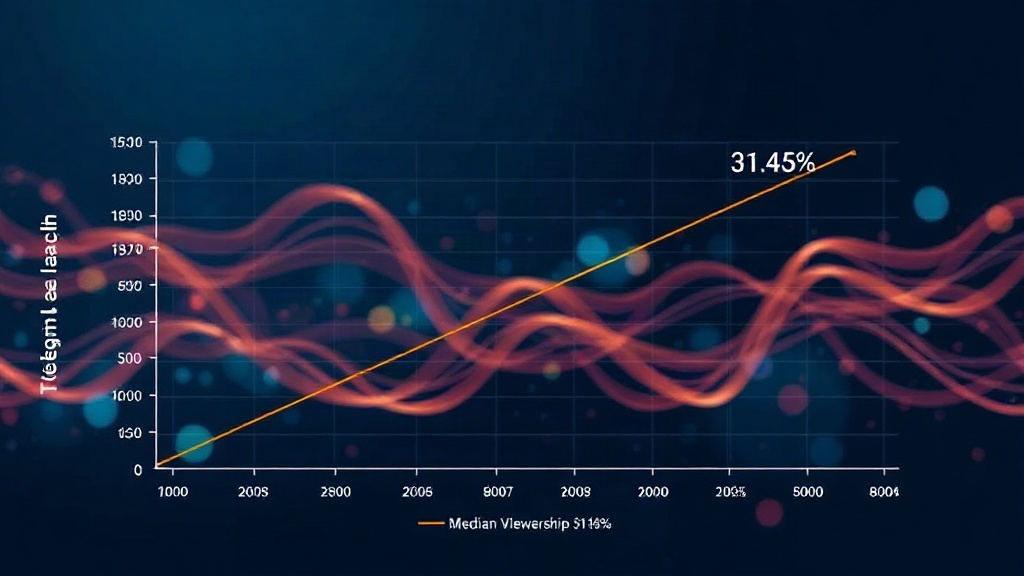
The headline finding is stark. For channels with 1,000 to 5,000 subscribers, the median post reaches 31.4% of the audience. This figure plummets to just 3.3% for channels exceeding 500,000 subscribers. This data, published as open data, provides a crucial benchmark for understanding audience engagement dynamics on the platform. The methodology, while seemingly straightforward, involved careful consideration of how to represent this data accurately, leading to the decision to use the median rather than the mean.
Defining and Calculating Reach
The core metric used in the analysis is straightforward: channel reach is defined as the average number of views per post divided by the total number of subscribers. Mathematically, this is expressed as:
reach = average views per post / subscribers
This ratio provides a percentage of subscribers who, on average, see a given post. For instance, a channel with 10,000 subscribers where posts average 1,500 views would have a reach of 15% (1,500 / 10,000). The challenge then becomes aggregating this metric across millions of channels and presenting a meaningful figure that reflects the overall health of engagement.
Why the Median Matters More Than the Mean
When analyzing a dataset as large and diverse as 3.2 million Telegram channels, the choice of statistical measure is critical. The analysis opted for the median instead of the mean (average) for a crucial reason: to mitigate the impact of outliers. Telegram, like any platform, hosts channels with highly unusual engagement patterns. Some channels might have a small subscriber base but an exceptionally viral post that garners hundreds of thousands of views, artificially inflating the mean. Conversely, a large, established channel might have a few posts with very low viewership, dragging the mean down.
The median, which represents the middle value in a sorted dataset, provides a more robust picture of typical engagement. It is less sensitive to extreme values, offering a clearer indication of what a channel of a certain size can realistically expect in terms of viewership. This is particularly important for channel administrators and advertisers trying to gauge the actual audience penetration of posts. Using the median ensures that the reported reach figures are representative of the majority of channels within each subscriber band, rather than being skewed by a few exceptional cases.
Segmentation by Channel Size
The analysis segmented channels into distinct subscriber bands to observe how reach changes with scale. This segmentation is key to understanding the nuanced performance across the platform. The bands used were:
- 1,000 - 5,000 subscribers
- 5,000 - 10,000 subscribers
- 10,000 - 50,000 subscribers
- 50,000 - 100,000 subscribers
- 100,000 - 500,000 subscribers
- 500,000+ subscribers
The results across these bands demonstrate a consistent downward trend in median reach. While the 1,000-5,000 subscriber group enjoys a median reach of 31.4%, the numbers decrease progressively. This pattern suggests that as channels grow, maintaining a high percentage of subscriber engagement becomes increasingly challenging. Factors such as notification fatigue, the sheer volume of content in larger channels, and potentially a higher proportion of inactive subscribers in older, larger channels likely contribute to this decline.
Limitations and Future Considerations
While the view count on Telegram posts is a valuable, freely available metric, it is not without its limitations. The primary assumption is that the view count accurately reflects unique viewership. It's possible that a single subscriber viewing a post multiple times, or bots within the channel, could inflate these numbers. Furthermore, the analysis relies on publicly available data, meaning private channels, which may have different engagement dynamics, are not included.
The data also doesn't account for the timing of posts or the specific content shared. A highly engaging piece of content will naturally perform better than a less compelling one, regardless of channel size. However, by averaging views across all posts within a channel and then taking the median across similar-sized channels, the analysis aims to smooth out these content-specific variations to reveal a broader trend. The open publication of this data invites further research and analysis, potentially leading to more sophisticated models of audience engagement on Telegram and other platforms that might one day offer similar transparency.