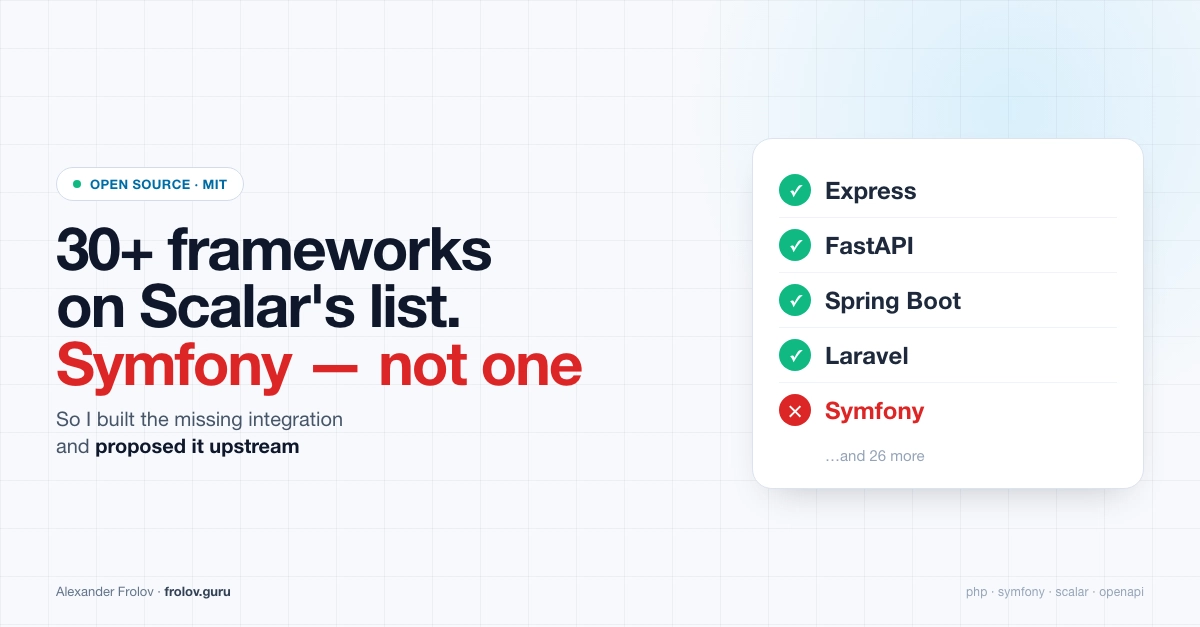
Symfony Lags Behind in API Reference Tools
For years, the Symfony PHP framework has lacked an official integration with Scalar, an open-source API reference renderer that significantly enhances the developer experience compared to Swagger UI. While competitors like Laravel secured official support early in 2024, with the scalar/laravel package boasting over 231,862 installs on Packagist, Symfony remained untouched. This left Symfony developers without a streamlined way to present their API documentation in a modern, interactive format.
Recognizing this gap, developer Aleksander Frolov has released the alex-frolov/scalar-symfony bundle. This new integration aims to bridge the functionality gap, providing Symfony projects with the same advanced API referencing capabilities that other popular frameworks already enjoy.
Introducing the Scalar Symfony Bundle
The core function of the alex-frolov/scalar-symfony bundle is to render an API Reference using Scalar from any OpenAPI document. Crucially, it achieves this with zero coupling to the method used for generating the specification. This means it works seamlessly whether your OpenAPI document is a static openapi.yaml file, generated by tools like swagger-php, or produced by popular Symfony bundles such as NelmioApiDocBundle or API Platform. The bundle's architecture ensures it never parses or proxies the document itself; instead, the Scalar UI loads the specification directly client-side, offering a fast and efficient experience.
Installation and configuration are designed to be straightforward, requiring modifications to just two files. This ease of integration lowers the barrier to entry for developers looking to adopt Scalar for their Symfony APIs.
Seamless Integration and Configuration
To integrate the bundle, developers need to perform minimal steps. First, they must add the bundle to their project's dependencies using Composer:
composer require alex-frolov/scalar-symfony
Following the installation, the bundle needs to be registered within the project's configuration. This typically involves adding it to the config/bundles.php file:
return [
    // ...
    AlexFrolov\ScalarSymfonyBundle\ScalarSymfonyBundle::class => ['all' => true],
];
The bundle then relies on the framework's routing to expose the Scalar API reference. By default, it registers a route at /api-docs. This route serves the Scalar UI, which dynamically loads the OpenAPI specification from a configured path. The bundle allows for customization of this path, enabling developers to point it to their specific OpenAPI document, whether it's located in the project's root directory or generated by another bundle.
Why Scalar Over Swagger UI?
Scalar offers several advantages over the more established Swagger UI. Its primary appeal lies in its modern design and superior user experience. Scalar's interface is cleaner, more intuitive, and generally more pleasant to navigate, which can significantly improve how developers interact with and understand an API. The emphasis is on making API documentation not just a technical requirement, but a useful tool for exploration and integration.
Scalar's client-side rendering approach means that the API reference page loads quickly. Once loaded, it fetches the OpenAPI document directly, reducing server load and improving perceived performance. This is a subtle but important distinction for applications that might experience high traffic or have large API specifications.
The bundle's architecture, which decouples the rendering from the specification generation, is a key design choice. This flexibility means that developers are not locked into a specific method of creating their OpenAPI documents. They can continue using their preferred tools and workflows, as long as they produce a valid OpenAPI 3.x specification. This adaptability is crucial for large, complex projects or teams with established development practices.
The Impact on Symfony Development
The introduction of the alex-frolov/scalar-symfony bundle addresses a long-standing deficiency in the Symfony ecosystem. Developers can now easily equip their Symfony-based APIs with documentation that is not only technically accurate but also a pleasure to use. This can lead to faster integration times for consumers of the API, fewer support requests related to API usage, and an overall more professional presentation of the API.
For teams already using Symfony, adopting Scalar is now a matter of installing a bundle and a minimal configuration. The bundle's broad compatibility with various OpenAPI generation methods ensures that most Symfony projects can benefit without significant refactoring. This makes it an attractive option for both new projects and those looking to upgrade their existing API documentation.
The broader implication is that Symfony developers now have access to a tool that can elevate the perceived quality and usability of their APIs. In a competitive landscape where API design and documentation play a crucial role in adoption, this bundle provides a much-needed upgrade.
Future Considerations
While the bundle offers a robust solution, the question remains about official adoption and community support. Will this bundle become the de facto standard for Scalar integration within the Symfony community? Its success will likely depend on its continued maintenance, performance under load, and how well it integrates with future Symfony versions and related API development tools. Developers adopting this bundle should monitor its development and contribution channels for updates and potential enhancements.