The Problem: AI Agents Want Content, Not Markup
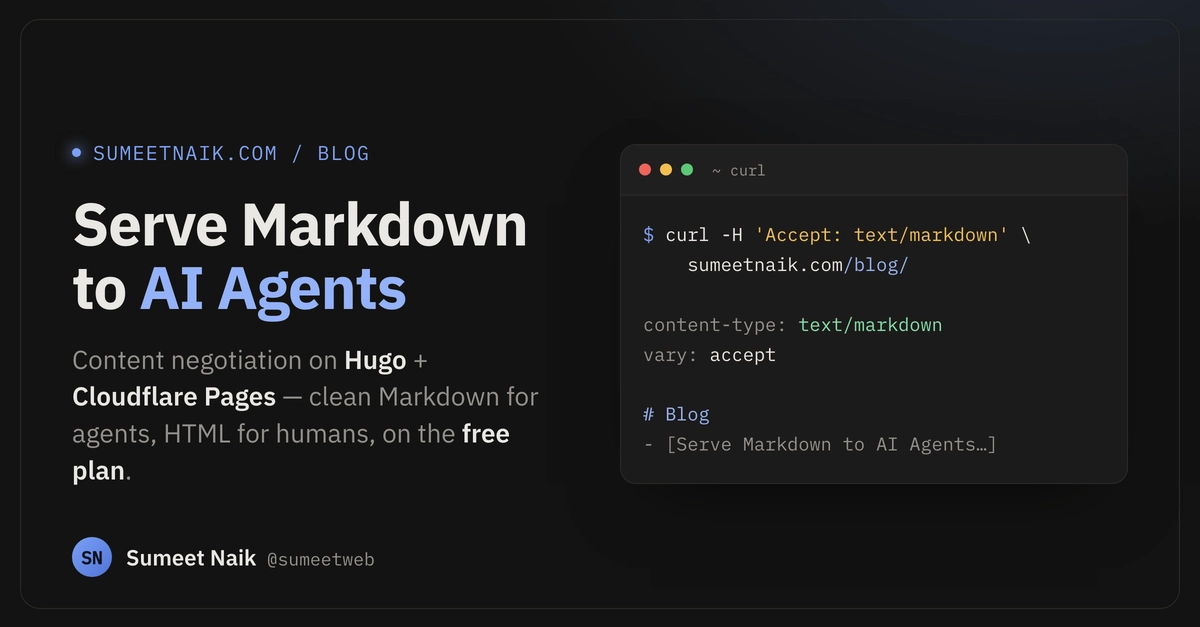
Modern AI agents and LLM crawlers are sophisticated. They don't want your beautifully rendered HTML pages, complete with navigation bars, theme toggles, and thousands of bytes of markup. They want the raw content: the headings, the lists, the links, the core information. The polite and efficient way for a server to provide this is through HTTP Content Negotiation. When a client sends an Accept: text/markdown header, the server should respond with the content in Markdown format. Otherwise, it serves the standard HTML.
The challenge for static site generators and static hosting platforms like Cloudflare Pages is that content negotiation relies on inspecting request headers. Static hosts typically only allow setting response headers based on file path, not on incoming request details. This limitation has historically meant that serving Markdown dynamically based on client requests required a full-fledged server, not a static hosting solution.
Cloudflare's Solution: Workers and toMarkdown
Cloudflare Pages, a platform built on Cloudflare's global network, offers a compelling solution for this problem by leveraging Cloudflare Workers. Workers are serverless functions that run on Cloudflare's edge network, allowing for dynamic request handling even on a static hosting platform. The key here is Cloudflare's built-in toMarkdown conversion utility, available within Workers.
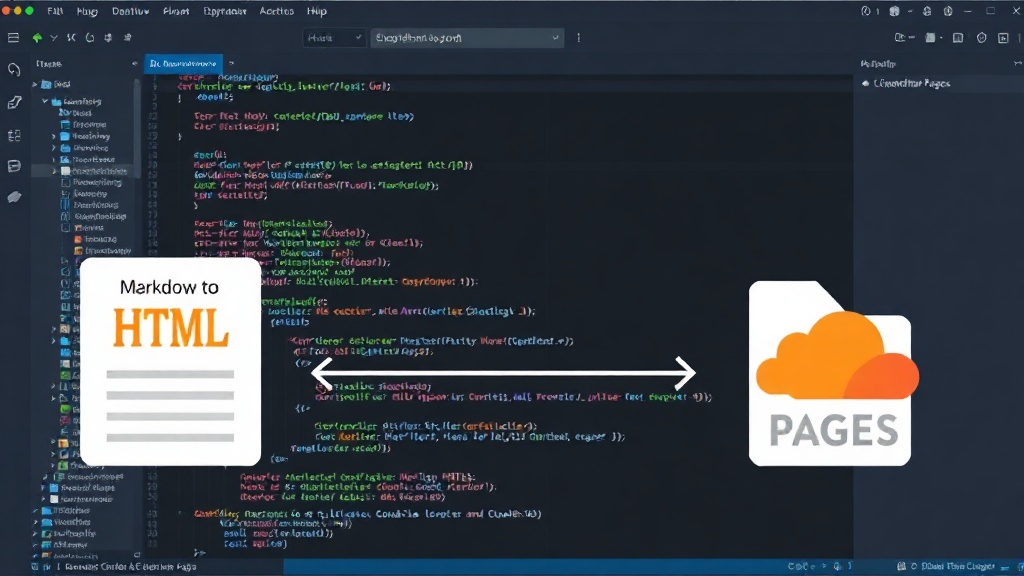
This utility transforms HTML into Markdown. By integrating this into a Cloudflare Worker script deployed alongside your Hugo site on Pages, you can intercept incoming requests. If a request includes the Accept: text/markdown header, the Worker can fetch the HTML content, pass it to toMarkdown, and return the resulting Markdown. For all other requests, the Worker can simply pass the request through to serve the standard HTML file.
This approach effectively bridges the gap between static hosting and dynamic content negotiation, allowing developers to serve content in multiple formats without managing traditional servers.
Hugo: Your Static Site Generator of Choice
Hugo is a popular choice for building fast static websites. Its speed, flexibility, and extensive theme ecosystem make it ideal for generating content that can be served in various formats. When using Hugo, your content is typically written in Markdown. Hugo then processes these Markdown files, along with templates, to generate static HTML files.
The workflow involves writing your content in Markdown, building your site with Hugo, and deploying the resulting static files to Cloudflare Pages. The addition of a Cloudflare Worker allows you to layer dynamic content negotiation on top of this static foundation. This means your Hugo site can cater to both human users browsing the web and AI agents or crawlers requesting raw content.
Implementing the Solution on Cloudflare Pages
The implementation involves a few key steps:
- Set up your Hugo site: Ensure your content is structured and built correctly with Hugo.
- Deploy to Cloudflare Pages: Connect your Git repository to Cloudflare Pages for automatic builds and deployments.
- Create a Cloudflare Worker: Write a Worker script that handles the content negotiation logic.
The Worker script needs to check the incoming request's Accept header. If it finds text/markdown, it should:
- Identify the requested URL.
- Fetch the corresponding HTML file from the static site.
- Use the
toMarkdownutility to convert the HTML response body to Markdown. - Return the Markdown content with the correct
Content-Type: text/markdownheader.
If the Accept header does not indicate a request for Markdown, the Worker should simply allow the request to proceed as normal, serving the static HTML file.
This setup is particularly powerful because Cloudflare Pages supports deploying Workers directly alongside your static assets. This means you don't need a separate service to host your Worker; it's managed as part of your Pages project. The free tier of Cloudflare Pages and Workers is often sufficient for many use cases, making this an accessible solution for developers and small teams.
Benefits and Use Cases
Serving Markdown directly offers several advantages:
- Improved SEO for AI: AI-powered search engines and recommendation systems can more easily index and understand your content.
- Efficient Data Extraction: Developers building AI applications can directly consume your content without needing to parse HTML, saving processing time and resources.
- Reduced Bandwidth: Markdown files are typically much smaller than their HTML counterparts, reducing bandwidth consumption for clients that request them.
- Content Versatility: Your content can now serve a dual purpose – rich HTML for human readers and clean Markdown for machine consumption.
This approach is ideal for technical documentation, blog posts, or any content where structured text is paramount. It allows platforms like AI agents that ingest web content to process information more effectively, leading to better-trained models and more accurate information retrieval.
Considerations and Limitations
While powerful, this method has considerations:
- Worker Execution Limits: Cloudflare Workers have free tier limits on execution time and requests. For extremely high-traffic sites or very large pages, you might need to consider paid plans.
toMarkdownUtility Capabilities: The fidelity of the HTML-to-Markdown conversion depends on the complexity of your HTML and the capabilities of thetoMarkdownutility. Highly complex layouts or embedded non-textual content might not convert perfectly.- Caching: Ensuring proper caching for both HTML and Markdown responses requires careful configuration of Cloudflare's caching mechanisms.
The surprising detail here is not that Cloudflare offers a solution, but how seamlessly it integrates into their existing static hosting product. Historically, such dynamic routing based on request headers would necessitate a more complex backend infrastructure. Cloudflare's approach makes sophisticated content negotiation accessible on a free, globally distributed static platform.
The Future of Content Delivery
As AI agents become more prevalent in web crawling, content analysis, and information synthesis, the ability to serve content in machine-readable formats like Markdown will become increasingly important. This strategy, enabled by static hosts like Cloudflare Pages with integrated serverless functions, represents a shift towards more versatile and intelligent content delivery. Developers can now build websites that cater to both human and AI audiences with a single, cost-effective deployment.