The Problem with Current Coding Agent Memory
Coding agents, designed to assist developers, face a fundamental challenge in retaining and accessing project context. Traditionally, this context is managed in one of two primary ways, each with significant drawbacks:
- Replaying Project History: This involves feeding the agent a long transcript or the entire project history. While comprehensive, this method is computationally expensive, generates a lot of noisy data that can obscure relevant information, and is difficult for developers to manage or audit effectively. The sheer volume of data can overwhelm the agent and lead to suboptimal performance.
- Short Summaries: Alternatively, agents can be provided with a concise summary of the project history. This approach is compact and efficient in terms of computational resources. However, these summaries are inherently lossy and lack auditability. Developers cannot easily trace the origin of the agent's understanding or verify the accuracy of the information presented. This makes debugging and ensuring the reliability of the agent's output challenging.
These existing methods create a trade-off between comprehensiveness and efficiency, often leading to agents that are either too slow and unwieldy or too unreliable and opaque.
A Third Way: Evidence-Linked Memory
A more effective design emerges by treating retained project activity not as the prompt itself, but as source material. This approach, exemplified by the open-source implementation Qarinah, establishes an authoritative local record. From this record, searchable views are derived, and a small, task-specific context pack is compiled. Crucially, the claims within this context pack point back to exact evidence within the authoritative record.
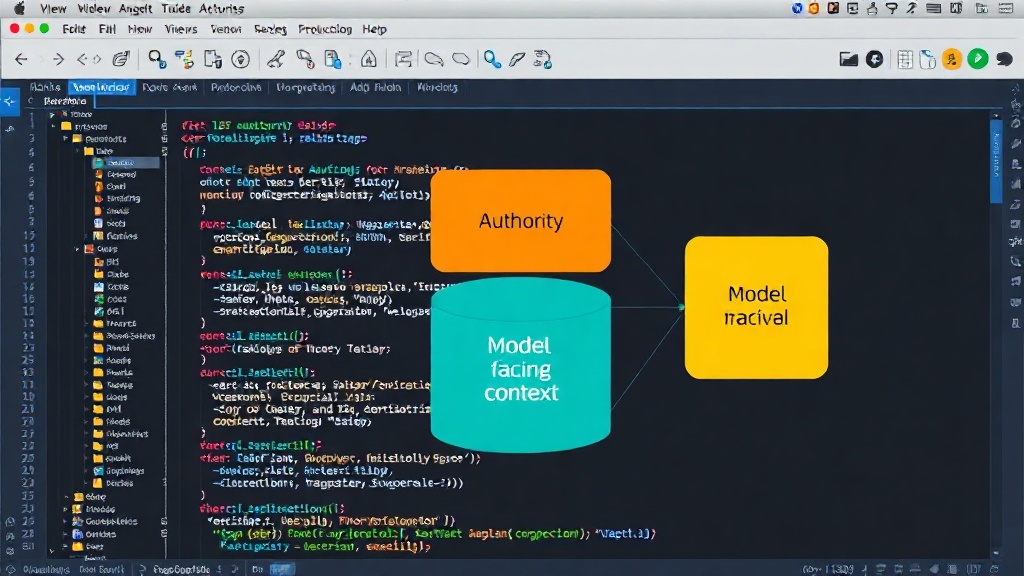
This pattern separates three critical components:
- Authority: The single source of truth for project information. This is the definitive, local record that is maintained and trusted.
- Retrieval: The mechanism for searching and extracting relevant information from the authoritative record. This layer is responsible for efficiently finding the pieces of evidence needed for a given task.
- Model-Facing Context: The curated, task-specific set of information presented to the coding agent. This context is minimal, focused, and always linked back to its origin in the authoritative record.
Think of this less like a rambling conversation transcript and more like a meticulously organized research paper. The paper (context pack) contains concise arguments (claims), but each argument is rigorously footnoted, pointing directly to the original source documents (evidence) for verification and deeper understanding.
Memory as a Compiler, Not a Transcript
The core innovation lies in conceptualizing memory as a compiler rather than a transcript. A transcript is a raw, sequential record of events. A compiler, on the other hand, processes source material, transforms it, and produces a specific output based on defined rules and evidence. In this model, project history is the source code. The Qarinah system acts as the compiler, processing this source code to generate focused, verifiable context for the coding agent.
This compiler-like approach offers several advantages:
- Reproducibility: Because every piece of information presented to the agent is linked to its original source, the agent's reasoning process becomes auditable and reproducible. If an agent makes a mistake, developers can trace the faulty information back to its origin and correct it.
- Efficiency: Instead of processing massive transcripts, the agent receives only the necessary, distilled information. This significantly reduces computational load and speeds up response times.
- Auditability: The explicit linking of claims to evidence makes it straightforward to audit the agent's knowledge base and ensure accuracy. This is crucial for professional software development environments where reliability is paramount.
- Modularity: The separation of concerns allows for independent improvement of each component. The retrieval system can be optimized without affecting how context is presented to the model, and vice-versa.
Qarinah.io: An Open-Source Implementation
Qarinah.io provides a concrete implementation of this evidence-linked memory pattern for software projects. It offers an open-source framework that developers can integrate into their workflows. While the specific CLI tools are secondary, the underlying architecture is what matters. This architecture emphasizes the distinct roles of:
- Storing authoritative project data: This could include code files, commit logs, issue tracker data, documentation, and build outputs.
- Indexing and retrieving relevant data points: Employing techniques like vector embeddings for semantic search, keyword matching, and structured queries to find specific pieces of evidence.
- Constructing context packs: Dynamically assembling a concise set of evidence relevant to the current task, ensuring each piece is traceable.
This separation allows for a more robust and scalable system. For instance, a developer might update a piece of documentation. This update is recorded in the authoritative store. When a coding agent needs to understand that part of the system, the retrieval mechanism finds the updated documentation, and the context pack includes it, linked back to the new version of the document. This ensures the agent always works with the most current and accurate information.
Implications for the Future of Coding Agents
The evidence-linked memory approach represents a significant step forward for coding agents. By moving beyond noisy transcripts and opaque summaries, it promises more reliable, auditable, and efficient AI assistance. This is particularly important for complex software development where subtle errors can have cascading effects.
For developers, this means agents that are not just tools for generating code, but trustworthy partners that can be reasoned with and whose outputs can be verified. The ability to audit and reproduce an agent's context is paramount for adoption in regulated industries or safety-critical applications.
What remains to be seen is how widely this pattern will be adopted and whether it becomes the de facto standard for managing agent memory. The success of Qarinah.io and similar projects will depend on their ability to integrate seamlessly into existing developer workflows and demonstrate tangible improvements in agent performance and reliability.