The Allure of Insider Data
Company insiders—officers, directors, and major shareholders—are often perceived to have an informational edge when trading their company's stock. The Securities and Exchange Commission (SEC) mandates that these individuals file a Form 4 within two business days of any purchase or sale of their company's securities. These filings are publicly accessible and machine-readable on the SEC's EDGAR system, presenting an apparent opportunity for developers to build sophisticated insider trading alert services. The premise seems simple: poll a feed, parse the data, and notify subscribers. However, as one day of intensive parsing revealed, the reality is far more complex.
One developer's experiment in parsing every Form 4 filing for a single day yielded a substantial dataset: 334 filings, encompassing 1,220 individual transactions across 151 distinct companies. This volume alone suggests a rich source of information, but the process of extracting and interpreting this data uncovered several critical challenges that move it beyond a simple weekend project.
Real-Time Feed Limitations
The SEC's EDGAR system provides a real-time Atom feed for new filings. This feed is designed to offer immediate updates, but it has a significant limitation: it only retains approximately the last 100 entries. On a high-volume trading day, filings can scroll off the feed before a poller has a chance to capture them. This was a hard lesson learned by one developer who, despite running their polling script continuously from Sunday, only managed to capture 44 out of 334 Form 4 filings in a busy period. The real-time feed, therefore, should be treated as a supplementary, fast-path ingestion method, not the sole source of truth for comprehensive data capture.
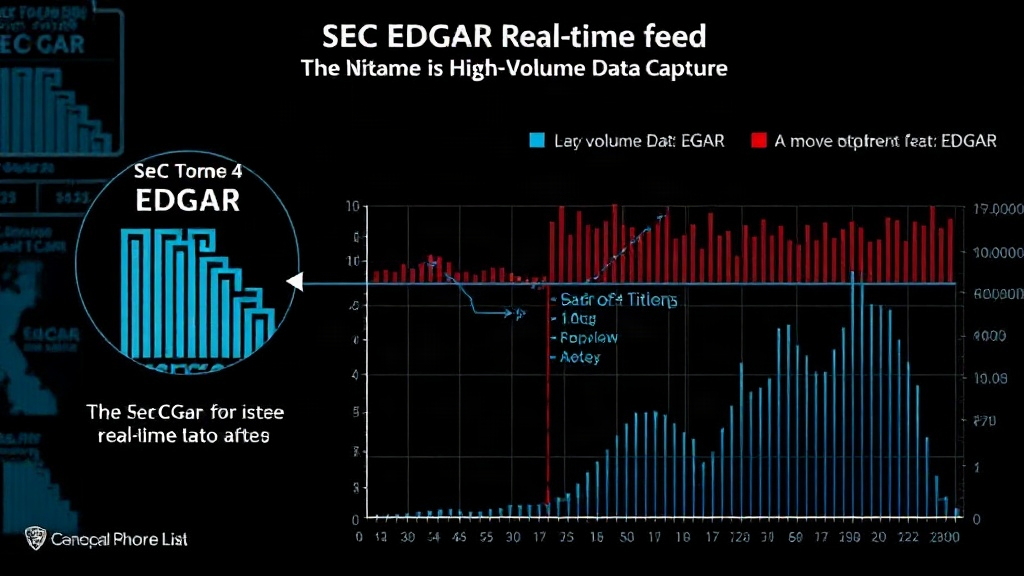
To reliably capture all filings, a more robust approach is necessary, likely involving direct queries to the EDGAR database or utilizing a third-party data provider that handles archival and retrieval. Relying solely on the Atom feed is akin to trying to drink from a firehose that only shows the last few seconds of water—you miss most of what's flowing.
The Nuance of Transaction Context
Beyond the challenge of data acquisition, interpreting the data itself presents significant hurdles. A single Form 4 filing can contain multiple transactions, and simply aggregating dollar amounts can be misleading. For instance, a director might buy $101,760 of Tenax Therapeutics stock, while another buys $500,000 of Inhibrx Biosciences. On the surface, the latter is a larger purchase. However, this dollar value alone doesn't reveal the significance of the transaction relative to the insider's existing holdings.
One transaction might represent a 2330.7% increase in the insider's stake, while another, despite being a larger dollar amount, might only be a 1.2% increase. Both figures can be reported in the same API field, yet they answer fundamentally different questions about the insider's conviction and potential market impact. The raw dollar amount tells you how much cash changed hands; the percentage change relative to holdings tells you about the insider's commitment and belief in the company's future.
Building a useful insider-buying screener requires capturing and presenting this contextual information. This involves not just extracting the transaction details but also correlating them with the insider's previously reported holdings to calculate meaningful metrics like percentage change. Tools that provide this richer context are essential for moving beyond superficial observations and towards actionable insights. The repository for one such screener includes the script and saved runs, allowing users to reproduce tables and analyze data without needing direct API access, highlighting the value of shared tools and reproducible research in this domain.
Broader Implications for Data Services
The complexities encountered in parsing Form 4 filings are not unique to this specific data set. They are symptomatic of broader challenges in financial data acquisition and analysis. Real-time feeds can be ephemeral, historical data requires careful extraction and cleaning, and raw numbers often lack the context needed for genuine insight. For developers aiming to build services around public financial data, a deep understanding of these nuances is critical.
This experience underscores that while public data is available, transforming it into reliable, actionable intelligence demands significant engineering effort. It requires not only technical skill in data scraping and parsing but also a domain-specific understanding of what makes the data meaningful. The gap between raw data availability and useful insight represents a significant opportunity for specialized data providers and analytical tools that can abstract away this complexity for end-users.
For founders looking to build services in this space, the lesson is clear: plan for data acquisition robustness, invest in data cleaning and contextualization, and consider how to present information in a way that goes beyond simple metrics. The success of an insider trading alert service, or any financial data product, hinges on the quality and interpretability of the underlying data. What remains to be seen is how effectively new AI-driven tools can automate the process of adding this crucial context, moving beyond percentage changes to predicting potential market impact.