The Testing Bottleneck in Rust Development
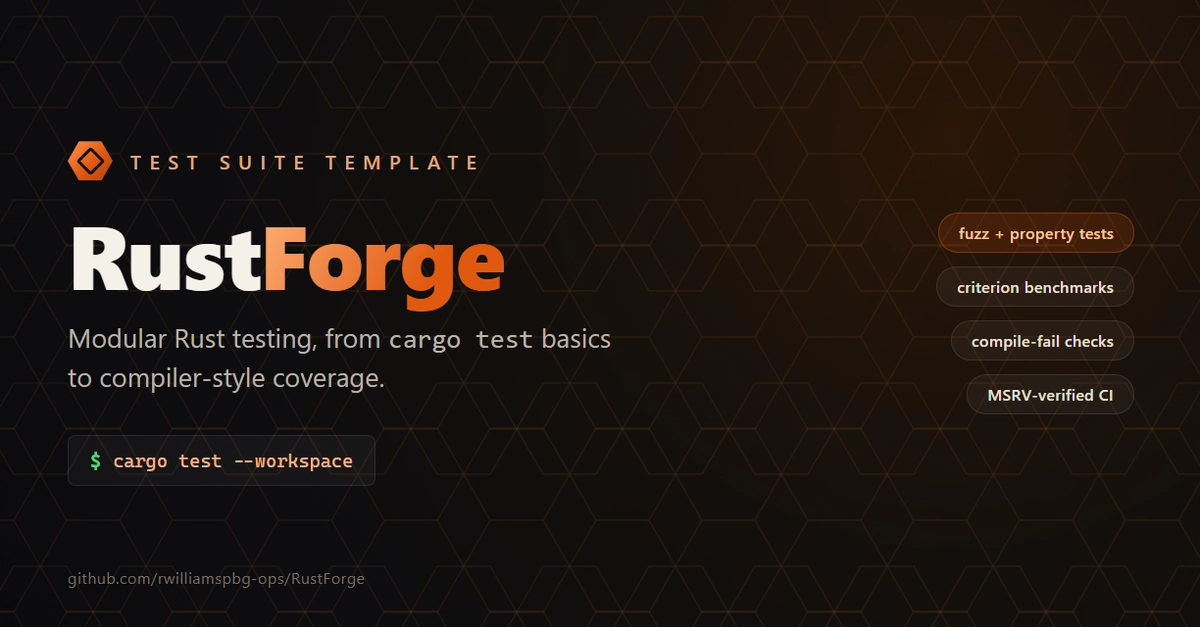
Scaling Rust services often reveals a common pain point: testing complexity. Developers frequently find themselves managing basic cargo test unit checks, building custom integration scripts, and manually configuring coverage tools on a per-project basis. This repetitive setup diverts valuable time and effort from core development tasks. Recognizing this recurring challenge, a new template called RustForge has emerged to provide a standardized, zero-bloat solution.
RustForge is designed to address this fragmentation. It offers a cohesive starting point for Rust projects, enabling developers to move seamlessly from fundamental unit tests to more advanced scenarios like compiler-style UI snapshot testing and integrated coverage tracking. The goal is to eliminate the need to build a testing harness from scratch for each new service or protocol.
Modular Design for Adaptability
The core principle behind RustForge is modularity. This approach allows developers to adopt only the testing components they need, preventing unnecessary bloat and maintaining a lean project structure. Whether a project requires basic unit tests, comprehensive integration tests, or advanced snapshot comparisons, RustForge provides a framework that can be tailored accordingly. This flexibility is crucial for diverse Rust projects, from small utility services to large-scale protocols.
The template encourages a clear separation of concerns within the testing architecture. This makes it easier to understand, maintain, and extend the test suite as the project evolves. By providing pre-configured setups for various testing methodologies, RustForge significantly reduces the initial configuration overhead. Developers can focus on writing effective tests rather than wrestling with setup scripts and tooling integration.
From Unit Tests to Snapshotting
RustForge supports a spectrum of testing needs. At its foundation, it integrates robust support for standard unit tests, ensuring that individual components of the service function as expected. Beyond this, the template extends to facilitate integration testing, allowing developers to verify the interactions between different modules or services. This is critical for confirming that disparate parts of a system work harmoniously together.
A standout feature is its support for compiler-style UI snapshot testing. This advanced technique is particularly valuable for projects with user interfaces or structured output, such as CLIs or API responses. Snapshot tests capture the expected output of a component and compare it against subsequent runs. Any deviation triggers a failure, alerting developers to unintended changes. This is analogous to how compilers detect regressions by comparing current output against a known good baseline. This feature alone can save significant debugging time when dealing with complex data structures or UI elements.
Integrated Coverage and Continuous Improvement
Beyond functional correctness, RustForge emphasizes code quality and maintainability through integrated test coverage tracking. The template is pre-configured to work with standard Rust coverage tools, providing developers with clear metrics on which parts of their codebase are adequately tested. This visibility helps identify gaps in testing and guides efforts to improve test suite comprehensiveness.
The template's design philosophy is one of continuous improvement and community contribution. It is presented as an open-source project, inviting feedback and enhancements from the Rust community. The creator, William P. G., has made the template available on GitHub, encouraging developers to fork, adapt, and contribute back. This collaborative model ensures that RustForge can evolve to meet the ever-changing demands of Rust development and testing best practices.
The overarching aim of RustForge is to democratize robust testing practices within the Rust ecosystem. By offering a readily adoptable, modular, and feature-rich template, it empowers developers to build more reliable and maintainable Rust services with less friction. This initiative addresses a tangible need, providing a practical solution that can save developers considerable time and reduce the common frustration associated with setting up comprehensive test suites.