The High-Stakes World of Google Workspace Migrations
Google Workspace tenant-to-tenant migrations, often called Domain Swaps or Cutovers, are complex operations. Think of planning one like preparing for a deep-sea technical dive: the environment is unforgiving, the window for action is narrow, and any equipment failure or miscalculation can immediately impact business continuity. For too long, engineering teams have relied on a patchwork of PowerShell scripts. These scripts typically demanded static credentials, lacked robust logging, and required significant manual oversight – a far cry from the precision needed for such critical operations.
The traditional approach is akin to diving with an unserviced, tangled regulator. It’s prone to errors, security vulnerabilities, and operational friction. As a GCP Workspace engineer, the need for a more structured, secure, and automated solution became apparent. This is where a Zero-Persistence architecture, integrated with MCP (Migration Center Platform) and a multi-agent AI workflow, offers a significant upgrade.
Introducing Zero-Persistence Architecture for Migrations
Zero-Persistence, in this context, means minimizing or eliminating the need for long-lived, static credentials and sensitive data storage. Instead of storing user credentials, API keys, or migration state information directly on persistent storage, the system operates with ephemeral, session-based access. This drastically reduces the attack surface. If a system component is compromised, there’s no sensitive data left behind for an attacker to exploit. This is crucial for migrations involving potentially thousands of user accounts and terabytes of data.
The core idea is to leverage temporary, role-based access controls and secure, in-memory processing. When a migration task needs to access a Google Workspace tenant, it authenticates using short-lived tokens. These tokens are generated on-demand and automatically revoked once the task is complete or the session times out. This contrasts sharply with older methods that might store service account keys or user passwords in plaintext files or insecure databases.
Leveraging Google's Migration Center Platform (MCP)
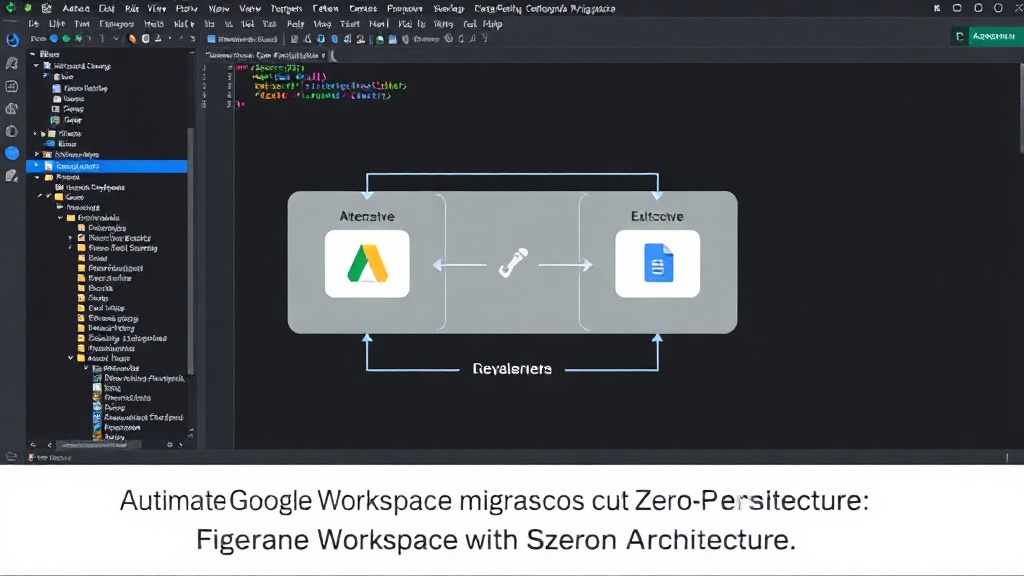
Google’s own Migration Center Platform (MCP) provides a set of APIs and tools designed to streamline Workspace migrations. However, MCP itself often requires orchestration and intelligent decision-making, especially for complex scenarios. Integrating MCP with a Zero-Persistence architecture means using its capabilities for data transfer and user provisioning, but managing the process with an AI layer that adheres to strict security principles. MCP handles the heavy lifting of data movement, but the AI workflow dictates the sequence, error handling, and security protocols.
MCP offers features like pre-migration assessments, data transfer scheduling, and user account synchronization. By building on top of MCP, the Zero-Persistence approach ensures that the orchestration layer is secure. Instead of direct, broad API access with static credentials, the AI agents interact with MCP via secure, token-based authentication for specific, time-bound tasks. This allows for granular control over what data is accessed and when, minimizing risk.
The Multi-Agent AI Workflow
The real innovation lies in the multi-agent AI workflow. Instead of a single monolithic script, the migration is broken down into specialized agents. Each agent is responsible for a distinct part of the migration process:
- Discovery Agent: Scans both source and target tenants to identify users, groups, organizational units, and existing configurations. It also assesses data volume and potential migration blockers.
- Planning Agent: Uses the data from the Discovery Agent to create an optimized migration plan, including sequencing, bandwidth allocation, and scheduling of cutover windows.
- Execution Agent: Interacts with MCP and tenant APIs to perform the actual data migration, user provisioning, and configuration synchronization. This agent operates with temporary credentials and adheres to the Zero-Persistence model.
- Validation Agent: Verifies that data has been migrated accurately and completely. It checks user access, group memberships, and critical application configurations.
- Rollback Agent: In case of critical failure, this agent is responsible for reverting changes to maintain business continuity. It operates under strict protocols to ensure a safe and controlled rollback.
- Reporting Agent: Compiles detailed logs and status reports throughout the migration process, providing visibility and audit trails.
These agents communicate securely, often via an ephemeral message queue or an API gateway that enforces strict authentication and authorization. The AI component comes into play through the planning, error handling, and optimization logic. For instance, the Planning Agent might use machine learning to predict migration bottlenecks based on historical data from previous migrations. The Execution Agent could dynamically adjust migration speeds based on real-time network performance and tenant load, all while maintaining the Zero-Persistence security posture.
Security and Operational Advantages
The benefits of this approach are manifold:
- Enhanced Security: The elimination of static credentials and persistent sensitive data storage significantly reduces the risk of breaches. Temporary, role-based access tokens are inherently more secure.
- Improved Reliability: The modular, agent-based design allows for better fault isolation. If one agent fails, it doesn't necessarily halt the entire migration, and the rollback agent can be invoked more effectively.
- Reduced Manual Effort: Automation powered by AI minimizes the need for human intervention, reducing the potential for human error and freeing up valuable engineering time.
- Auditability: Structured logging and reporting from each agent provide a clear, auditable trail of all migration activities, essential for compliance and troubleshooting.
- Scalability: The agent-based architecture can be scaled horizontally by deploying more instances of specific agents to handle larger migrations or concurrent tasks.
This methodology transforms Google Workspace migrations from a high-anxiety, error-prone manual process into a controlled, secure, and automated operation. It’s the difference between navigating treacherous waters with a sextant and using a modern, AI-assisted navigation system.
The Future of Workspace Migrations
As organizations increasingly rely on cloud-based productivity suites, the frequency and complexity of tenant-to-tenant migrations will only grow. The need for secure, efficient, and automated solutions is paramount. This Zero-Persistence, AI-driven approach sets a new standard, moving beyond brittle scripts to a robust, intelligent system capable of handling the most demanding migration challenges. It allows businesses to perform these critical operations with confidence, knowing that business continuity and data security are prioritized throughout the process.