The Fragmentation Problem in AI Model Integration
The rapid expansion of AI models presents a double-edged sword for developers. While the sheer volume of choices is unprecedented, integrating these diverse models into applications has become a significant hurdle. Developers often find themselves juggling multiple API keys, navigating different API endpoints, managing separate accounts, and adapting to inconsistent request parameters, streaming responses, and error formats. This complexity is particularly acute when developers outside China wish to leverage powerful models from Chinese providers like DeepSeek, Qwen, GLM, MiniMax, Doubao, and Hunyuan. Discovering, comparing, and integrating these models becomes a time-consuming and technically challenging endeavor.
This is the exact problem ApiHub is designed to solve. The platform aims to act as a unified gateway, abstracting away the underlying complexities of interacting with various Chinese AI models. Instead of each model requiring its own set of credentials and integration logic, ApiHub provides a single API key and a standardized interface for developers to access a diverse range of leading AI capabilities originating from China.
Introducing ApiHub: A Unified Gateway
ApiHub is an emerging platform focused on simplifying the developer experience for accessing and integrating cutting-edge AI models. At its core, ApiHub offers a single point of access, meaning developers only need one API key to interact with multiple AI models from different providers. This dramatically reduces the overhead associated with managing credentials and authentication for each individual service.
The platform’s ambition extends beyond mere key management. ApiHub seeks to standardize the developer workflow by providing a consistent API structure, request parameters, and response formats across all supported models. This standardization is crucial for building scalable applications that can seamlessly switch between different AI models or leverage multiple models concurrently without extensive refactoring. Developers can think of ApiHub less like a collection of individual APIs and more like a single, intelligent dispatcher that routes requests to the most appropriate underlying model, presenting a uniform interface regardless of the model's origin or specific capabilities.
Key Features and Benefits for Developers
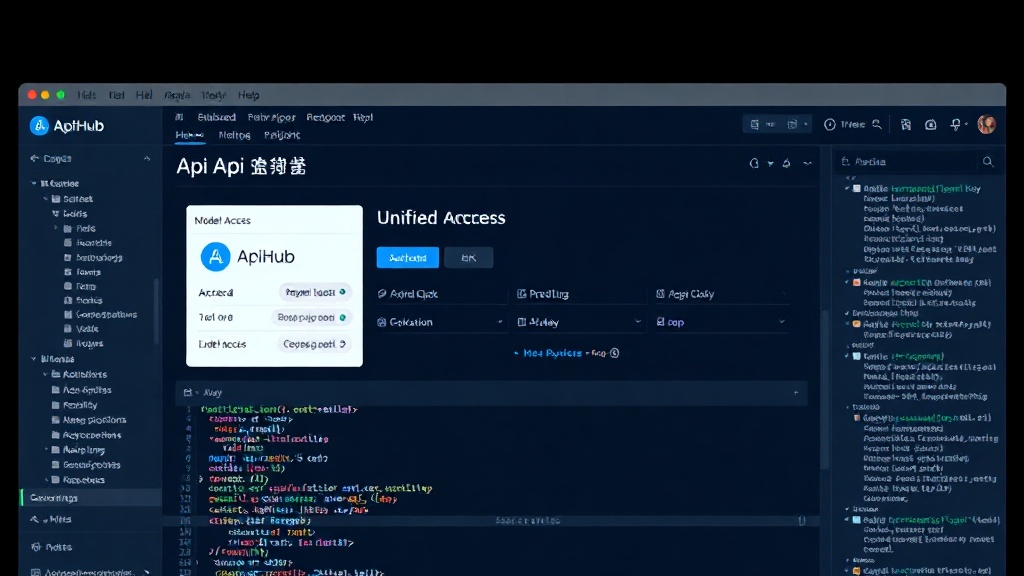
ApiHub’s value proposition centers on several key features designed to streamline the AI integration process:
- Single API Key: Eliminates the need to generate, store, and rotate multiple API keys for different Chinese AI providers.
- Standardized API Endpoints: Provides a consistent set of endpoints and request structures, simplifying integration logic.
- Unified Model Access: Offers access to a curated selection of popular and powerful Chinese AI models, including those from DeepSeek, Qwen, GLM, MiniMax, Doubao, and Hunyuan.
- Consistent Response Formats: Aims to normalize streaming responses and error handling, reducing the need for custom parsing and error management for each model.
- Simplified Billing and Usage Tracking: Consolidates usage data and billing information, providing a clearer overview of AI resource consumption across different models.
The benefits are immediate for developers. By abstracting away the complexities of individual model integrations, ApiHub allows developers to focus on building innovative applications rather than managing infrastructure and integration details. This is particularly impactful for startups and smaller development teams who may not have the resources to dedicate to extensive API management. The ability to quickly experiment with and deploy different models without significant code changes fosters agility and accelerates product development cycles.
The Growing Landscape of Chinese AI Models
China's AI industry has seen remarkable growth, producing sophisticated models that rival those developed in Western markets. Models like DeepSeek-V2, Qwen1.5, GLM-4, and others have demonstrated state-of-the-art performance across various benchmarks for natural language processing, generation, and understanding. However, accessibility for developers outside of China has been a persistent challenge.
Barriers to entry have historically included language differences, complex registration processes, and the aforementioned integration complexities. ApiHub directly addresses these issues by acting as an intermediary. It bridges the gap, making these advanced Chinese AI capabilities readily available to a global developer community. This not only democratizes access to cutting-edge AI but also encourages cross-border innovation and competition in the AI space.
The strategic importance of this cannot be overstated. As AI becomes more foundational to software development, having a diverse set of high-performing models readily accessible is critical for innovation. ApiHub’s focus on Chinese models fills a significant gap, providing developers with an expanded toolkit to build more capable and versatile AI-powered applications. The question now is how quickly ApiHub can onboard more models and ensure the reliability and performance parity developers expect from such a consolidation service.