
The Core Challenge: Rustc's Internal Complexity
Developing a Language Server Protocol (LSP) for any programming language is a significant undertaking. However, Rust presents a unique set of hurdles that make its LSP development particularly challenging. At the heart of this difficulty lies the Rust compiler itself, rustc. Unlike many other languages where compiler internals might be more amenable to external parsing or abstract syntax tree (AST) manipulation for IDE features, rustc is a deeply complex and monolithic piece of software. Its internal data structures and logic are not designed for easy external consumption by a separate process like an LSP server.
The LSP specification is designed to provide IDEs with features like code completion, diagnostics, go-to-definition, and refactoring. To achieve this, an LSP server typically needs to parse code, build an AST, perform semantic analysis, and understand the project's build configuration. For Rust, this means interacting with rustc or its underlying components. The compiler's internal representation of code, its type checking mechanisms, and its macro expansion process are all intricate. Extracting the necessary information for LSP features often requires deep dives into these internals, which are not stable APIs and can change significantly between compiler versions. This lack of stable, exposed APIs forces LSP developers to constantly adapt to internal compiler changes, akin to building on shifting sands.
Leveraging `rust-analyzer` and Its Architecture
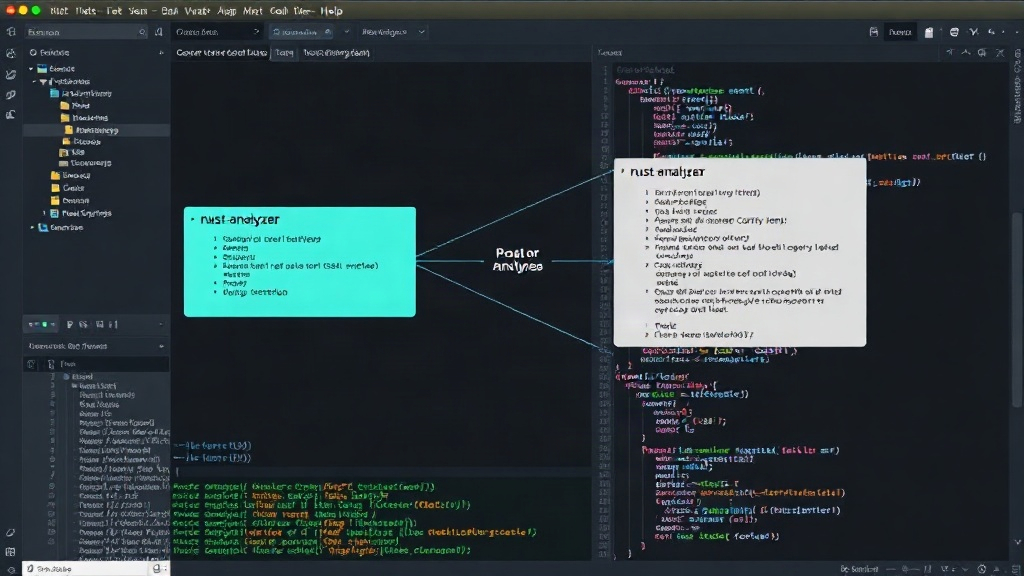
The de facto standard for Rust LSP is rust-analyzer. Its development journey highlights these challenges. Instead of directly trying to parse and interpret the output of rustc in real-time for every request, rust-analyzer has adopted a more sophisticated approach. It maintains its own representation of the code and project structure, often by leveraging parts of the Rust compiler itself or by processing information from build tools like Cargo.
One of the key architectural decisions in rust-analyzer is its heavy reliance on the Rust compiler's internal libraries. This allows it to access more detailed information than would be possible by simply running rustc as an external process and parsing its output. However, this also means that rust-analyzer is tightly coupled to the compiler's internal structure. When the Rust compiler team makes changes to how it represents code or performs analysis, the rust-analyzer team must often update their server to accommodate these changes. This is a constant game of catch-up, requiring significant engineering effort.
Furthermore, Rust's powerful macro system adds another layer of complexity. Macros transform code before compilation. An LSP server needs to understand the expanded code to provide accurate features. This requires either re-implementing macro expansion logic or finding ways to hook into the compiler's macro expansion process, both of which are non-trivial tasks.
Asynchronous Programming Demands
Modern LSPs are expected to be highly responsive. Users expect instant feedback as they type. This necessitates asynchronous programming. LSP servers must handle multiple requests concurrently without blocking the main thread. In Rust, this typically involves using asynchronous runtimes like Tokio or async-std.
Integrating asynchronous operations with the synchronous or multi-threaded nature of compiler operations can be a significant engineering challenge. For instance, a request for code completion might trigger a complex analysis that takes time. The LSP server needs to initiate this analysis without freezing the UI, potentially running it in a separate thread or an async task. Managing the lifecycle of these tasks, handling cancellations, and ensuring data consistency across concurrent operations adds substantial complexity to the development process. The inherent performance characteristics of Rust, while beneficial for the language itself, can also amplify the difficulty in optimizing these asynchronous operations for a real-time user experience.
The Ecosystem and Tooling Fragmentation
Beyond the compiler, the broader Rust ecosystem contributes to the difficulty. While Cargo is the standard build tool, projects can have complex build configurations, including custom build scripts, conditional compilation, and integration with C/C++ code via Foreign Function Interfaces (FFI).
An LSP server must understand these configurations to provide accurate context. For example, knowing which features are enabled or which target platform is being used is crucial for correct code analysis and diagnostics. This requires parsing Cargo.toml files, build scripts (build.rs), and potentially even external build systems. The diversity of project setups means that an LSP server must be robust enough to handle a wide range of configurations, often requiring heuristics and educated guesses when precise information is not readily available.
The surprising detail here is not the inherent difficulty of LSP development but the degree to which Rust's design choices—its focus on compile-time guarantees, its powerful macro system, and its internal compiler architecture—create a unique set of problems that differ significantly from those faced by LSPs for other languages.
What's Next for Rust IDE Support?
The continuous development of rust-analyzer demonstrates the community's commitment to overcoming these hurdles. By directly engaging with compiler internals and adopting sophisticated architectural patterns, the project has achieved remarkable success. However, the challenges remain. As rustc evolves, so too must the LSP server.
What nobody has addressed yet is the long-term sustainability of this development model. Relying on unstable compiler internals means that major compiler refactors could, in theory, break the LSP server entirely. The community will likely continue to invest heavily in maintaining this bridge, but the possibility of a more stable, external API for compiler introspection remains a distant hope. For developers, this means staying updated with rust-analyzer releases and being prepared for potential disruptions when the underlying compiler changes significantly. The effort poured into rust-analyzer is a testament to the Rust community's dedication, but it also underscores the inherent complexities of building advanced developer tools for such a powerful and intricate language.