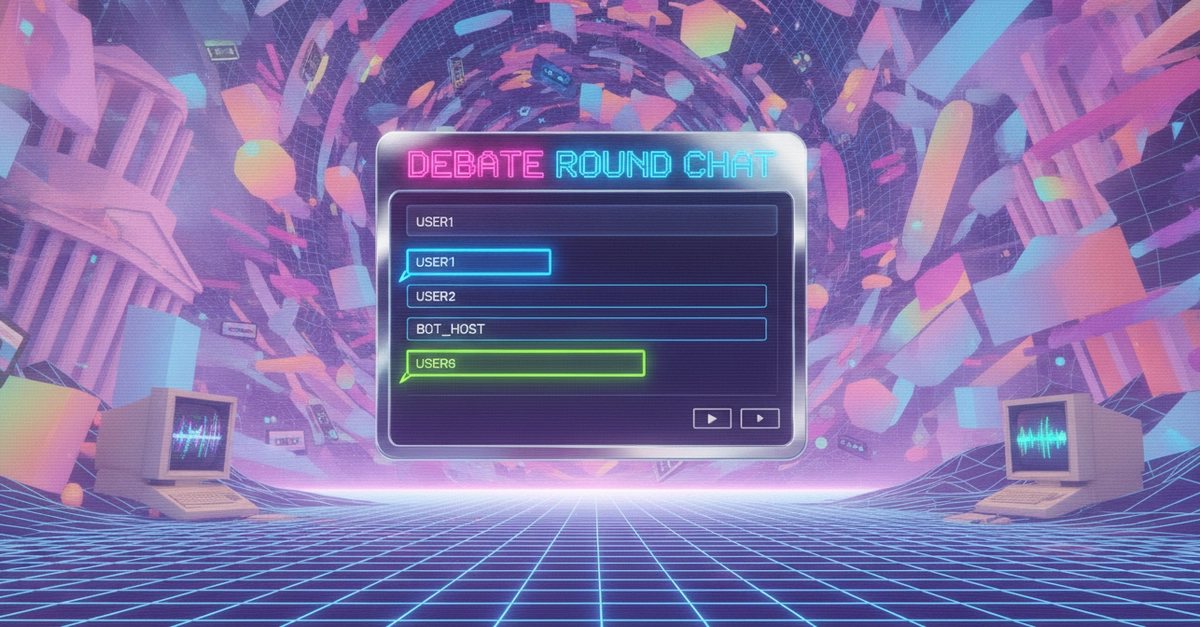
Introducing Round Chat: Bridging the Communication Gap in Debate Rounds
Competitive debate, particularly at higher levels, involves complex strategies, rapid evidence analysis, and constant communication between partners. Traditionally, this communication relies on whispered notes, quick glances, or tab-switching, all of which can disrupt focus and lead to missed information. Recognizing this friction, developer Claire Y. has introduced Round Chat, a browser extension designed to provide a seamless, floating communication channel specifically for debate partners. This tool aims to keep debaters connected without sacrificing their workflow during critical moments of a round.
Round Chat is more than just a simple chat application; it's a specialized utility built with the unique demands of debate in mind. It presents itself as a small, unobtrusive window that can overlay other browser tabs. This means a debater reading evidence on one tab and flowing arguments on another can still see messages from their partner in real-time. The core functionality is built around keeping partners synchronized, ensuring that crucial notes about arguments, evidence, or strategic shifts are instantly visible.

Core Features for Enhanced Debate Communication
The utility of Round Chat is segmented into three primary functions, each addressing a specific need within the debate environment:
Dedicated Speech Tabs
The main feature is the partner chat, intelligently divided into what the developer calls speech tabs. These tabs correspond to the standard speech categories in debate, such as Constructive speeches, Cross-Examination (CX), and the first Negative constructive (1NC). This organization is critical: a note about the constructive speech remains within the constructive tab, a note about a specific piece of evidence used in the 1NC stays with the 1NC tab, and so on. This segmentation prevents message clutter and ensures that context is preserved. When a partner sends a new message, tabs with unread communications are highlighted with a red dot, providing an immediate visual cue without requiring the user to actively check every tab.
Integrated Stopwatch
Beyond communication, Round Chat incorporates a practical timing tool. A stopwatch is embedded directly into the header of the chat window. This allows debaters to keep track of speech times without needing a separate timer application or device. In the high-pressure environment of a debate round, having essential tools consolidated into a single, accessible interface can be a significant advantage, reducing the cognitive load on participants.
Pop-Out Always-On-Top Window
Perhaps the most technically interesting feature is the ability to pop out the chat window. With a single click, Round Chat can transform into an always-on-top window. This functionality leverages Chrome's Document Picture-in-Picture API, a technology typically used for video playback but here repurposed for persistent chat. This ensures that the chat window remains visible above all other browser applications, providing constant access to partner communication without interfering with the primary debate workflow, such as flowing or reading evidence.
Technical Implementation and Broader Implications
Round Chat is built as a Chrome extension, making it accessible to a large segment of debaters who use the Chrome browser. The use of the Picture-in-Picture API is a clever application of existing web technologies to solve a niche problem. This approach means the tool is relatively lightweight and doesn't require complex installation or system-level permissions beyond what's standard for browser extensions.
The underlying architecture likely involves standard web technologies: HTML, CSS, and JavaScript for the frontend interface and Chrome extension APIs for functionality like tab management and the Picture-in-Picture mode. The chat itself could be implemented using WebSockets for real-time, bidirectional communication between partners, ensuring messages are delivered instantly. Data persistence for chat history within speech tabs would likely be handled using browser storage APIs.
The initial submission for the Sanity Challenge suggests a focus on 'Vibe-Code Something Strange,' indicating a desire for creative and perhaps unconventional applications of technology. Round Chat fits this brief by addressing a specific, underserved need within a particular community. Its success hinges on its ability to integrate smoothly into the existing debate workflow without introducing new distractions.
What remains to be seen is how Round Chat scales. While effective for two partners, the architecture for larger teams or tournament-wide communication would require different solutions. Furthermore, the adoption rate among debate communities will depend on the perceived value against the minimal friction of its use. Will debate coaches and organizations endorse such tools, or will they be seen as potential distractions from traditional methods?