
Beyond Official Support: ReBarUEFI Enables Resizable BAR
Resizable BAR (Base Address Register), a PCIe feature that allows the CPU to access the entire graphics card memory at once, is no longer exclusive to newer hardware. A project called ReBarUEFI has emerged, offering a way to enable this performance-boosting technology on a wide range of older Intel and AMD motherboards that never received official support. This development bypasses vendor limitations, potentially unlocking significant performance gains for gamers and professionals using previously incompatible hardware.
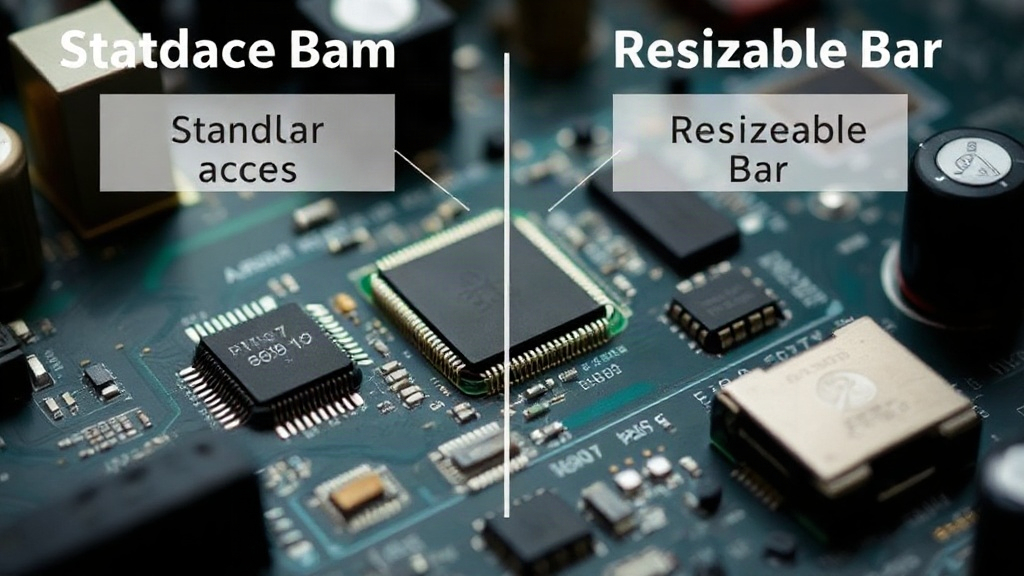
Resizable BAR, standardized as part of the PCI Express specification, allows the CPU to request access to the entire VRAM of a graphics card in a single chunk, rather than breaking it down into smaller 256MB regions. This reduces latency and can improve frame rates in games and accelerate certain professional workloads that are sensitive to memory access times. Historically, enabling Resizable BAR required explicit motherboard and GPU support, often tied to specific BIOS versions and hardware generations. ReBarUEFI challenges this by injecting the necessary functionality directly into the UEFI firmware.
How ReBarUEFI Works
The ReBarUEFI project operates by modifying the UEFI firmware of compatible motherboards. It essentially adds the necessary Option ROM code to the firmware that instructs the system to expose the GPU's memory as a single, large BAR. This is a complex undertaking, as it requires understanding the intricacies of UEFI boot processes and PCIe enumeration. The project's creator, xCuri0, has developed a method to patch existing UEFI binaries, making it feasible for users to flash their motherboards with the modified firmware.
The process typically involves extracting the existing UEFI firmware from a motherboard, patching it with the ReBarUEFI module, and then flashing the modified firmware back onto the motherboard. This is not a trivial task and carries inherent risks, as a failed BIOS flash can render a motherboard unusable. However, the project provides detailed instructions and community support to guide users through the process. The success of ReBarUEFI lies in its ability to trick the system into recognizing and utilizing the Resizable BAR feature, even when the hardware manufacturers did not intend for it to be supported.
Compatibility and Implementation
ReBarUEFI boasts impressive compatibility, supporting a wide array of Intel chipsets from the 400-series and older, as well as AMD chipsets from the 300-series and older. This broad support is a significant achievement, as it opens the door for users with systems that are several generations old to benefit from Resizable BAR. The project maintains a list of tested motherboards and provides general guidance for unsupported models, encouraging community contributions to expand its reach.
The implementation requires users to identify their motherboard's specific UEFI firmware version and often involves using specialized tools to extract and re-flash the BIOS. The ReBarUEFI project provides a Python script that automates much of the patching process once the firmware is extracted. Users then typically use their motherboard manufacturer's flashing utility or a hardware programmer for the final step. The success rate appears high, with many users reporting stable Resizable BAR implementations on hardware that was never officially certified for the feature.
Performance Implications and Considerations
The primary benefit of enabling Resizable BAR is a potential increase in gaming performance. In titles that are VRAM-bound or sensitive to memory latency, users can see frame rate improvements ranging from a few percent to over 10-15% in some cases. This can translate to a smoother and more responsive gaming experience. Beyond gaming, certain professional applications, particularly those involving large datasets or complex simulations, may also see performance uplifts.
However, it is crucial to understand that performance gains are not guaranteed and can vary significantly depending on the specific game, application, GPU, and CPU combination. Some applications may even see a slight performance decrease or exhibit instability. Users are advised to benchmark their systems before and after applying ReBarUEFI to assess the actual impact. Furthermore, the modified UEFI firmware is not officially supported by motherboard manufacturers, meaning users undertake this modification at their own risk. Stability and long-term compatibility remain key considerations for any user opting to use ReBarUEFI.
The Broader Context of Hardware Enablement
ReBarUEFI represents a fascinating trend in the PC hardware community: the power of enthusiasts and developers to unlock functionalities that manufacturers have deliberately restricted or overlooked. This project is akin to custom ROMs for smartphones or open-source firmware for routers; it empowers users to push the boundaries of their existing hardware. The fact that a feature like Resizable BAR, often touted as a reason to upgrade to newer hardware, can be retroactively enabled on older platforms raises questions about the artificial segmentation of hardware features by manufacturers.
This level of community-driven innovation highlights the ongoing demand for performance and feature parity across different hardware generations. It also underscores the limitations of proprietary control over hardware features. As ReBarUEFI continues to evolve, it may encourage other similar projects to emerge, further democratizing access to advanced PC technologies. The success of ReBarUEFI serves as a potent reminder that the capabilities of hardware are often greater than what vendors initially allow.