The Allure of Instant Code
The promise of AI-assisted development is intoxicating. Imagine feeding an AI a concept, a few requirements, and watching it churn out functional code in minutes, not hours. This is not science fiction; it's the rapidly evolving reality for many developers. The initial experience can be exhilarating: receiving a piece of code that accomplishes a task you might have spent half a day writing yourself. The AI handles the 'happy path' – the ideal scenario where everything works as expected – with impressive efficiency.
This speed from idea to working code is precisely where the immediate value of AI coding tools shines. It allows developers to rapidly prototype, explore ideas, and offload the more routine aspects of software creation. The feeling of accomplishment when a complex function is generated and passes basic tests is undeniable, pushing the boundaries of productivity and potentially accelerating innovation cycles.

When the Happy Path Ends
However, the honeymoon phase often ends abruptly when the first bug report lands. Users, by their nature, do not stick to the happy path. They poke, prod, and explore the boundaries of software in ways developers might not have explicitly anticipated. This is where the limitations of current AI code generation become starkly apparent. The AI, trained on vast datasets of code, excels at replicating common patterns and solving well-defined problems.
But what happens when an API needs to return something meaningful, and there's no obvious 'correct' answer? What about the edge cases, the unexpected inputs, the cascading failures? The AI-generated code might have elegantly handled the primary use case, but it often lacks the nuanced understanding required for robust error handling, graceful degradation, or complex business logic that deviates from the most frequent patterns. These are the moments where the AI falters, not because it's incapable of generating code, but because the decision of what *should* happen requires a level of contextual understanding, ethical consideration, or product-specific judgment that AI currently lacks.
The Human Element: Decision-Making and Nuance
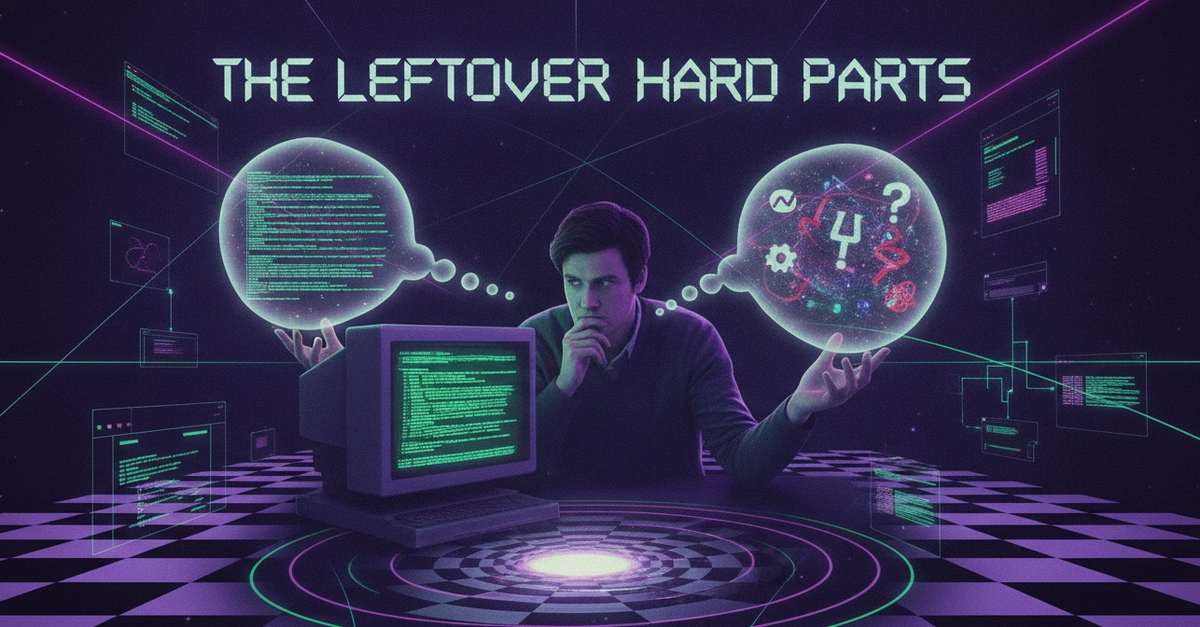
This is where the human developer's role transforms, rather than disappears. The AI provides the scaffolding, the foundational structure, but the architect remains indispensable. The developer is now tasked with the 'leftover hard parts': the complex decisions that AI cannot make. These aren't coding problems in the traditional sense; they are product, design, and even philosophical questions. Does the system retry? Does it return a default value? Should it log an error and crash gracefully? What is the acceptable performance trade-off for handling this obscure scenario?
Answering these questions requires a deep understanding of the product's goals, its users' needs, and the business context. It involves anticipating failure modes, considering security implications, and making judgment calls about user experience. For instance, if an AI generates code for a payment processing system, it might handle a successful transaction flawlessly. But what about a network interruption mid-transaction? What about a fraudulent attempt? The AI can't decide if a transaction should be flagged for review, automatically declined, or retried based on intricate risk assessment rules that are often fluid and context-dependent. This decision-making process is inherently human, relying on experience, intuition, and a holistic view of the system's purpose.
Reframing the Developer's Role
The rise of AI in coding doesn't negate the need for developers; it elevates their role. Instead of spending hours writing boilerplate code or debugging simple syntax errors, developers can focus on higher-level problem-solving. They become the critical thinkers, the decision-makers, and the guardians of system resilience and user experience. The AI acts as an incredibly powerful assistant, accelerating the mundane, but the human is still the one steering the ship, especially when uncharted waters appear.
This shift means developers need to hone different skills. Critical thinking, system design, debugging complex emergent behaviors, and understanding user psychology become even more paramount. The ability to effectively prompt AI tools, evaluate their output critically, and integrate it into a larger, well-reasoned system is the new superpower. The 'art' of programming, which often involves creative problem-solving and understanding implicit requirements, remains firmly in the human domain.
The Future of AI-Assisted Development
Looking ahead, AI models will undoubtedly improve, becoming more capable of handling a wider range of scenarios. They might even be trained on more context-aware data, allowing them to make more sophisticated decisions. However, the fundamental challenge of unforeseen circumstances and the need for human judgment will likely persist. Software systems operate in a complex, dynamic world, and anticipating every possible permutation of events is a task that may always require a human touch. The most effective development teams will be those that master the synergy between AI's speed and breadth, and human depth and critical reasoning. The leftover hard parts are not a bug in AI; they are the very essence of what makes software development a human endeavor.