The Dawn of Memory: Magnetic Cores and Early Computing
Random Access Memory, or RAM, is the unsung hero of modern computing. It’s the ephemeral workspace where our processors perform their calculations, holding data that needs to be accessed quickly. Yet, its history is often overlooked, overshadowed by the more tangible advancements in CPUs and storage. The journey of RAM began not with silicon, but with magnetism. In the 1950s, magnetic core memory was the state-of-the-art. This technology used tiny ferrite rings, threaded with wires, to store bits of information. Each ring, or 'core', could be magnetized in one of two directions, representing a 0 or a 1. To read data, current was sent through specific wires, and the resulting magnetic field change indicated the state of the core. These early memory systems were bulky, expensive, and slow by today's standards, but they were a monumental leap forward, enabling the first true computers to move beyond punch cards and paper tape for active data processing.
The core memory era, lasting roughly from the mid-1950s to the mid-1970s, was characterized by its mechanical complexity and the sheer physical space required. A single megabyte of core memory would have been the size of a small refrigerator. Despite these limitations, it was the first form of widely adopted random access memory, allowing computers to load and execute programs dynamically. This was a crucial step towards interactive computing, moving away from batch processing and paving the way for the personal computer revolution.
The Silicon Revolution: DRAM and SRAM Emerge
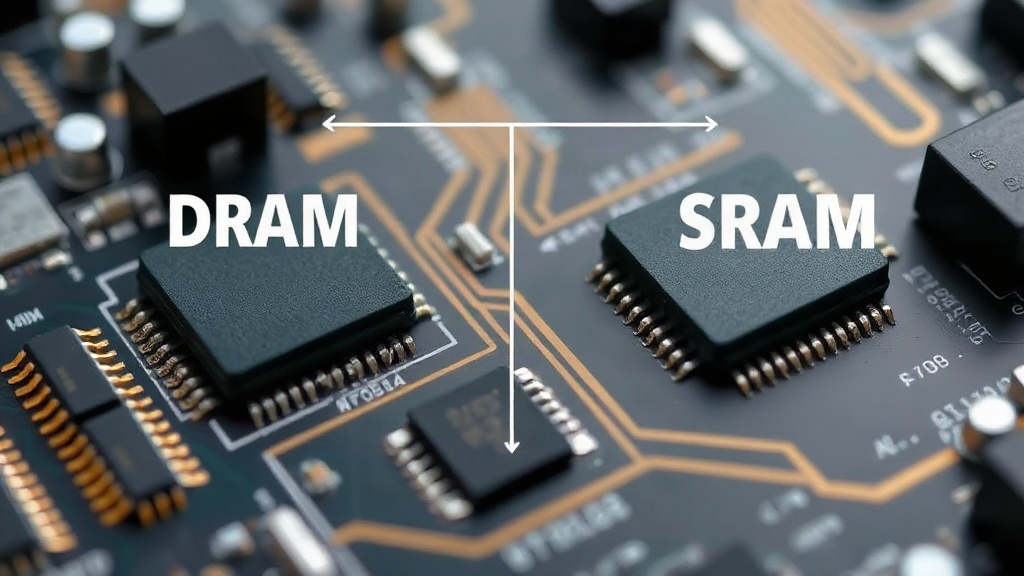
The true transformation of RAM began with the advent of semiconductor technology. The invention of the transistor and later the integrated circuit (IC) allowed for the miniaturization and mass production of memory components. Two primary types of semiconductor memory emerged: Dynamic Random Access Memory (DRAM) and Static Random Access Memory (SRAM). DRAM, developed by Robert Dennard at IBM in 1968, became the workhorse of the industry. It stores each bit of data in a tiny capacitor and a transistor. The 'dynamic' aspect comes from the fact that these capacitors leak charge over time, requiring the memory to be periodically refreshed to retain its data. This refresh cycle, while adding a slight overhead, allowed for incredibly high storage densities, making DRAM the cost-effective choice for main system memory. Think of DRAM like a leaky bucket that needs constant topping up to keep its contents.
SRAM, on the other hand, uses flip-flops – circuits that can maintain their state as long as power is supplied – to store data. Each bit requires multiple transistors (typically six). SRAM does not need refreshing, making it significantly faster than DRAM. However, this complexity means it is much more expensive and less dense. Consequently, SRAM found its niche in cache memory, the ultra-fast buffer located directly on or very close to the CPU, where speed is paramount. The distinction between DRAM and SRAM is fundamental to understanding modern computer architecture: DRAM for main memory, and SRAM for high-speed caches.
The Era of Expansion: From Megabytes to Gigabytes
As semiconductor manufacturing processes advanced, RAM capacity grew exponentially. The 1970s and 1980s saw the transition from kilobyte-sized RAM modules to megabyte-sized DIMMs (Dual In-line Memory Modules). Early personal computers like the Apple II and IBM PC came with as little as 16KB or 64KB of RAM. By the late 1980s and early 1990s, 1MB was standard, and by the late 1990s, 64MB and 128MB DIMMs were common. This massive increase in density was driven by innovations in DRAM technology, including the development of faster refresh mechanisms and more efficient cell designs.
The move to gigabytes per module in the 2000s and beyond was another seismic shift. This enabled more complex operating systems, larger applications, and more sophisticated multitasking. The architectural improvements during this period were not just about density but also speed and efficiency. Synchronous DRAM (SDRAM) became the standard, synchronizing data transfer with the system clock, leading to significant performance gains over older asynchronous DRAM. Subsequent generations, like DDR (Double Data Rate) SDRAM and its successors (DDR2, DDR3, DDR4, and now DDR5), doubled the data transfer rate with each iteration by transferring data on both the rising and falling edges of the clock signal. This relentless pace of improvement means that today's RAM is orders of magnitude faster and denser than what was available just a decade or two ago.
The Modern Landscape: DDR5 and Beyond
Today, DDR5 SDRAM represents the cutting edge of mainstream RAM technology. It offers higher bandwidth, improved power efficiency, and increased capacities compared to its predecessor, DDR4. Key innovations in DDR5 include on-DIMM power management (PMIC), which moves voltage regulation from the motherboard to the memory module itself, allowing for finer voltage control and better signal integrity. It also features dual 32-bit subchannels per module, enhancing memory access efficiency. These advancements are critical for modern workloads, from AI and machine learning to high-performance computing and immersive gaming, all of which are increasingly memory-bound.
The evolution of RAM is not just a story of Moore's Law applied to memory chips. It's a narrative of ingenious engineering solutions to fundamental physical challenges – managing electrical charge in microscopic capacitors, designing complex timing circuits, and optimizing signal pathways across billions of transistors. The demand for faster, denser, and more efficient memory continues to drive innovation, pushing the boundaries of physics and materials science. As we look to the future, concepts like High Bandwidth Memory (HBM), stacked 3D memory, and potentially even new memory paradigms are being explored to meet the insatiable appetite of next-generation computing. RAM, the forgotten history, remains a critical, ever-evolving frontier.