The Need for Advanced Device Models in Quantum Computing
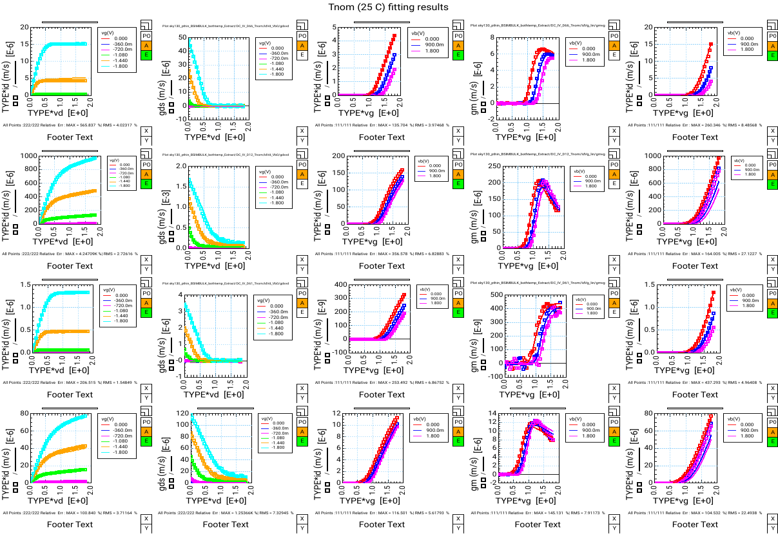
Quantum computing promises unprecedented computational power, but its realization hinges on the development of robust and scalable quantum hardware. A critical bottleneck in this development is the accurate modeling of the semiconductor devices that form the building blocks of quantum processors. These devices, often operating at extremely low temperatures (cryogenic), exhibit complex behaviors that traditional physics-based compact models struggle to capture comprehensively. This complexity arises from phenomena like quantum tunneling, charge trapping, and subtle material variations, all of which significantly impact device performance and coherence times – the very metrics that define a quantum computer's efficacy.
Extracting accurate and predictive compact models is essential for several reasons. Firstly, it enables circuit designers to simulate and optimize quantum circuits before fabrication, drastically reducing costly and time-consuming experimental iterations. Secondly, precise models allow for the identification and mitigation of noise sources and error mechanisms inherent in quantum systems, crucial for achieving fault tolerance. Finally, as quantum technologies mature, the need for standardized, high-fidelity device models becomes paramount for interoperability and broader industry adoption.
The traditional approach to device modeling relies on analytical equations derived from fundamental semiconductor physics. While effective for classical devices, these models often require significant simplification or empirical fitting when applied to novel quantum devices operating under extreme conditions. The inherent non-linearities, quantum mechanical effects, and temperature dependencies at cryogenic levels push the boundaries of these analytical frameworks, leading to models that are either overly complex, inaccurate, or lack predictive power for future device generations.
This is where Artificial Intelligence (AI), particularly deep learning techniques, enters the picture. AI offers a powerful, data-driven approach to learn complex relationships directly from experimental data or high-fidelity simulations. By training neural networks on extensive datasets of device characteristics under various operating conditions, AI can learn to predict device behavior with remarkable accuracy, even for phenomena that are difficult to express analytically.
The challenge, however, is not just about applying AI but about integrating it effectively with established semiconductor modeling practices. A purely data-driven, black-box AI model might lack the physical interpretability and extrapolation capabilities required for robust engineering design. This has led to the exploration of hybrid approaches that combine the strengths of both traditional physics-based modeling and AI.
Hybrid ANN Approach for Cryogenic Device Modeling
Researchers are developing hybrid Artificial Neural Network (ANN) approaches to address these shortcomings. This strategy aims to create advanced compact models that are both accurate and physically grounded, particularly for devices operating at cryogenic temperatures. The core idea is to leverage ANNs to capture the complex, non-linear, and temperature-dependent behaviors that are difficult to model using traditional analytical equations alone.
A typical hybrid model might involve an ANN that acts as a supplement to, or a replacement for, specific components of a traditional compact model. For instance, an ANN could be trained to model the leakage current in a superconducting qubit transmon, or the precise threshold voltage shift of a cryogenic transistor due to quantum confinement effects. The ANN learns these intricate relationships from a dataset of simulated or measured device characteristics across a range of temperatures, voltages, and other relevant parameters.
The advantage of this hybrid approach lies in its ability to maintain a degree of physical interpretability. By integrating the ANN within a known model structure, engineers can still understand the influence of different physical parameters. The ANN essentially learns the residual error or the complex emergent behavior that the traditional model cannot explain. This makes the resulting compact model more robust, easier to debug, and more trustworthy for design engineers.
Extracting these advanced models involves a rigorous process. It begins with collecting extensive device data, often generated through high-fidelity TCAD (Technology Computer-Aided Design) simulations or direct experimental measurements at cryogenic temperatures. This data serves as the training set for the ANN. The ANN architecture itself is carefully chosen and optimized, considering factors like the number of layers, neurons, activation functions, and the optimization algorithm used for training. Techniques such as transfer learning can also be employed, where a pre-trained ANN on classical device data is fine-tuned for specific quantum device characteristics.
One of the key challenges addressed by this AI-driven method is the behavior of semiconductor devices at cryogenic temperatures. At these low temperatures, quantum mechanical effects become more pronounced, and material properties can change drastically. Traditional models often fail to account for phenomena like reduced carrier scattering, increased mobility, and the onset of quantum interference effects. ANNs, however, can learn these complex dependencies directly from the data, providing a more accurate representation of device performance under these extreme conditions.
Furthermore, the hybrid ANN approach can also help overcome the limitations of existing compact models. Many current models are derived from simplified physical assumptions that may not hold true for advanced quantum devices. By using ANNs to learn from more comprehensive data, these new models can capture a wider range of operating regimes and device physics, leading to more accurate predictions for performance metrics such as on/off ratio, transconductance, and noise characteristics.
Implications for Quantum Application Development
The development of AI-driven, hybrid compact models for cryogenic quantum devices has significant implications for the entire quantum technology ecosystem. For researchers and engineers working on quantum hardware, these models enable faster design cycles and more reliable device characterization. They can simulate the behavior of complex quantum circuits with higher fidelity, allowing for better understanding of decoherence mechanisms and the development of more effective error correction strategies.
For quantum software developers, accurate device models translate into more predictable and performant quantum algorithms. Understanding the precise noise characteristics and operational limits of the underlying hardware is crucial for optimizing algorithm execution and achieving reliable quantum computations. This can lead to the development of more sophisticated quantum programming tools and compilers that can automatically adapt to the nuances of specific quantum processors.
The ability to accurately model quantum devices at cryogenic temperatures is also essential for scaling up quantum computers. As the number of qubits increases, the complexity of the control and readout circuitry grows exponentially. High-fidelity compact models are indispensable for designing these complex integrated systems, ensuring that the individual qubits can be controlled and measured with the required precision without introducing excessive noise or interference.
Moreover, this advancement in modeling could accelerate the development of specialized quantum applications. Whether it's for drug discovery, materials science, financial modeling, or cryptography, the performance and reliability of these applications will be directly tied to the quality of the quantum hardware. Advanced AI-driven models can help bridge the gap between theoretical quantum algorithms and their practical implementation on physical quantum computers.
The surprising detail here is not just the application of AI, but its specific integration within established physical modeling frameworks. Instead of a complete replacement, AI acts as a powerful enhancer, learning the physics that eludes traditional analytical methods. This synergy promises a faster path to robust, scalable quantum computing hardware.
What remains to be fully explored is how these AI-driven models will evolve as quantum hardware architectures become more diverse and complex. The ability of ANNs to generalize and adapt to entirely new device paradigms will be a key factor in their long-term utility.