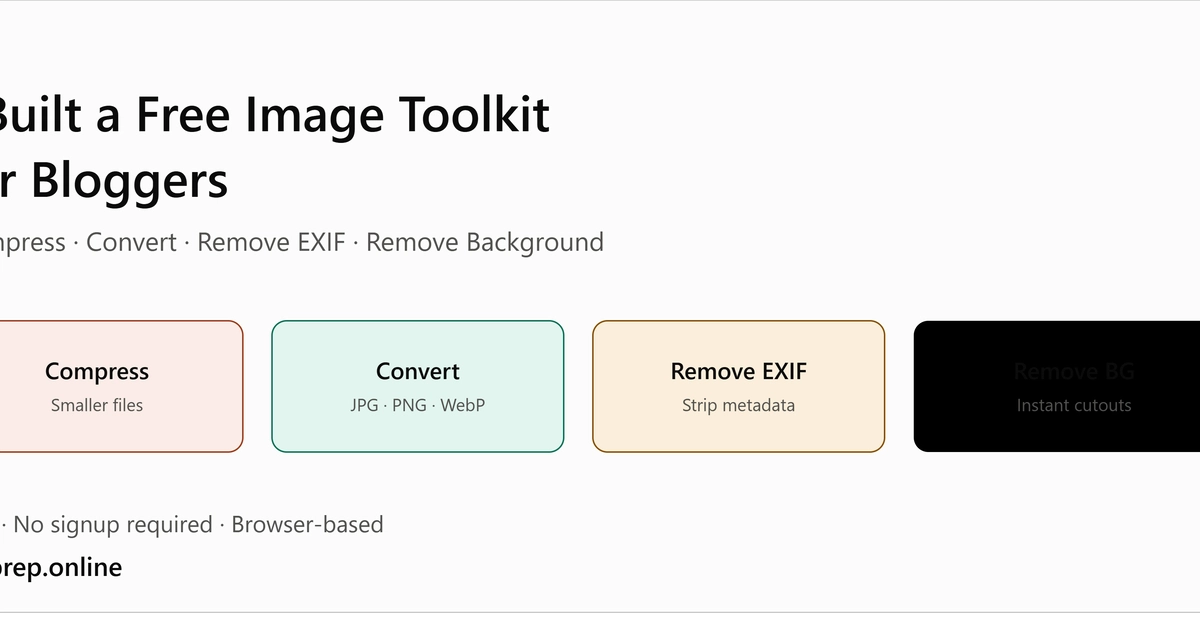
The Pain of Image Pre-Publication
For content creators, particularly bloggers, the process of preparing images before publishing a post can be a significant time sink. The developer behind PixPrep, who wished to remain anonymous but goes by the handle @cheap_spyder_56482a588c9c on dev.to, experienced this frustration firsthand. "Every time I wanted to publish, I'd end up bouncing between three or four different tools — one to compress the file size, another to convert formats, another to strip EXIF metadata, and yet another to clean up backgrounds," they explained. This fragmented workflow, involving multiple distinct applications or websites, consumed an estimated 10-15 minutes per post, a recurring inefficiency for any active blogger.
This daily friction sparked the development of PixPrep, a free, browser-based image toolkit designed to streamline this entire pre-publish workflow into a single, cohesive platform. The core value proposition of PixPrep is its consolidation of essential image manipulation tasks, eliminating the need to switch between various specialized tools.
Consolidated Image Workflow
PixPrep offers a suite of functionalities tailored to the needs of bloggers and web content creators:
- Compression: Reduces image file sizes significantly without a perceptible loss in visual quality. This is crucial for website loading speed and user experience.
- Format Conversion: Enables easy switching between common web image formats, including JPG, PNG, and the more efficient WebP.
- EXIF Data Removal: Strips hidden metadata (such as camera model, date, time, and location) from images. This enhances user privacy by preventing the unintentional disclosure of sensitive information.
- Background Removal: Provides instant background cleanup for images, creating clean cutouts suitable for product images, graphics, or profile pictures.
The developer specifically noted the quality of existing tools like TinyPNG, Squoosh, and Remove.bg, acknowledging their excellence in their respective niches. However, the driving motivation for PixPrep was to address the *entire* pre-publish workflow, offering a unified solution that bypasses the typical requirements of account creation or sign-ups common to many standalone services.

Why Browser-Based and No Signup?
The decision to build PixPrep as a browser-based application is strategic. It ensures accessibility – users can access the tool from any device with a web browser without needing to download or install any software. This approach also sidesteps the complexities of server-side processing for intensive tasks like background removal, delegating the computational load to the user's own machine. For the user, this translates to immediate usability and no waiting for uploads or downloads from external servers for every small adjustment.
Furthermore, the explicit choice to forgo signup requirements is a direct response to user friction. Many users, especially those performing quick, one-off tasks, are deterred by mandatory registration processes. By offering a completely free, anonymous service, PixPrep lowers the barrier to entry significantly. This makes it an attractive option for bloggers who need to quickly process an image before hitting publish, without the commitment of creating another online account.
The developer's personal experience highlights a common pain point: the time cost associated with inefficient workflows. PixPrep aims to reclaim that time by offering a single, intuitive interface that handles multiple essential image preparation steps. This focus on the complete pre-publish journey, from compression to background removal, is what sets PixPrep apart from single-function tools.
Implications for Content Creators
For bloggers and web publishers, PixPrep represents a valuable addition to their toolkit. The ability to perform multiple image optimizations in one go, directly within the browser and without any signup, promises to shave valuable minutes off their content creation schedule. This efficiency gain can be particularly impactful for those who publish frequently or manage multiple sites. The privacy aspect of EXIF data removal is also a subtle but important feature, aligning with growing user awareness around digital footprints.
The tool's immediate availability and free tier make it accessible to everyone, from hobbyist bloggers to professional content teams. While specialized tools might offer deeper customization or higher fidelity for specific tasks, PixPrep's strength lies in its convenience and comprehensiveness for the common, everyday image prep needs of web content creators.
What remains to be seen is how PixPrep will scale and evolve. As browser capabilities and user demands grow, the tool's ability to maintain performance and introduce new features without compromising its core principles of speed and accessibility will be key to its long-term success.