The Accidental Ubiquity of http_build_url()
In 2014, a developer named Jake Smith faced a common, yet surprisingly complex, problem in PHP: reliably parsing and manipulating URLs. The built-in functions for this task were, and to some extent still are, notoriously inconsistent. Smith, then a junior developer, patched together a solution. It wasn't intended to be a long-term, production-ready library. It was a temporary fix, a personal utility function to smooth over the rough edges of PHP's URL handling for a specific project. He shared it on GitHub, a common practice among developers.
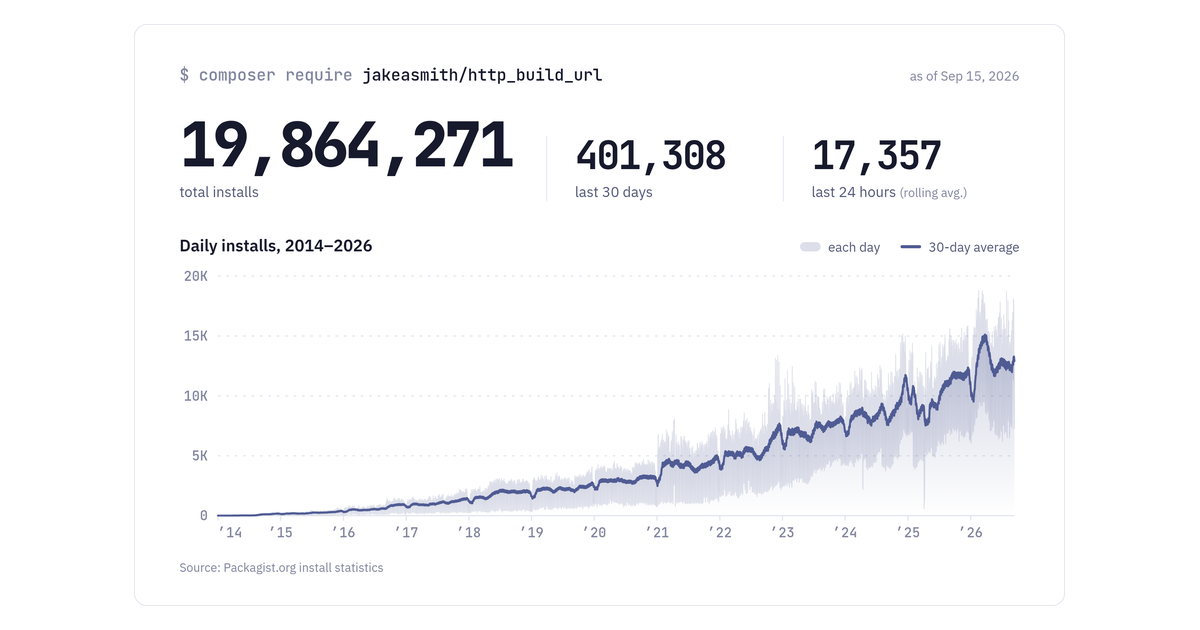
What happened next was entirely unexpected. This seemingly minor utility, `http_build_url()`, gained traction. Developers found it robust, predictable, and easier to use than the native alternatives. It solved a real pain point. Over the years, its usage ballooned. Package managers like Composer reported millions of installs. Today, it's estimated that nearly 20 million PHP installations rely on this decade-old, hastily written function. It became an almost invisible, yet critical, piece of infrastructure for a vast number of web applications.
Why Deprecate a 20 Million Install Library?
The decision to deprecate `http_build_url()` is not born out of a lack of utility, but precisely because of its success and the evolution of the PHP ecosystem. Smith himself, now a senior engineer at Cloudflare, points to several key reasons. Firstly, PHP itself has improved. Newer versions of PHP (specifically PHP 8.0 and later) introduced native `ValueError` exceptions for malformed URLs, providing a more robust and standardized error-handling mechanism. This reduced the need for a custom solution to catch and manage invalid URL inputs.
Secondly, the maintenance burden of a widely used, albeit small, library became significant. Keeping up with evolving security best practices, addressing edge cases reported by users, and ensuring compatibility across different PHP versions and environments required a non-trivial amount of effort. For a project that began as a temporary fix, this ongoing commitment grew unsustainable, especially as its core functionality was increasingly being addressed by the language itself.
The most compelling reason, however, is the implicit endorsement of the native PHP functions. While they may have had their quirks in 2014, the PHP core team has invested in making them more reliable and predictable. By deprecating his function, Smith is essentially signaling to the community that it's time to move on, to embrace the modern, native PHP capabilities that have matured over the past decade. It’s a testament to the language’s progress.
The Unanswered Question: Transition Path for Millions
Smith's announcement is clear: `http_build_url()` is being deprecated. He has provided a migration guide, recommending developers transition to PHP's native `parse_url()` and `http_build_url()` (the latter being a different function with a similar name, often causing confusion, but intended for building URLs from arrays). However, the sheer scale of its adoption presents a significant challenge. What happens to the thousands, perhaps tens of thousands, of projects that rely on this specific, third-party `http_build_url()`? The migration guide is helpful, but adoption is not guaranteed. Developers might be hesitant to refactor code that has worked for years, especially if the perceived benefit isn't immediately obvious or if they lack the resources for extensive testing.
The transition is not a simple find-and-replace. While the native functions cover much of the same ground, subtle differences in behavior or edge-case handling might exist. For applications where URL manipulation is critical to their core functionality, thorough testing will be paramount. This could involve significant engineering effort, particularly for older, legacy systems where developer resources might be scarce or focused on new feature development. The risk of introducing regressions, however small, is a valid concern for any production system.
A Concrete Analogy: The Beloved Old Bridge
Think of `http_build_url()` less like a tool and more like a beloved, slightly rickety old bridge that everyone in town uses. It was built quickly to get people across a tricky river years ago. It always worked, even if it creaked a bit. Now, the city has built a modern, multi-lane highway bridge right next to it. This new bridge is safer, faster, and built to current standards. The city council announces the old bridge is being closed next year. While everyone agrees the new bridge is better in theory, the townspeople face a dilemma: Do they all immediately switch to the new bridge, risking unexpected traffic jams on the new route as everyone learns it? Or do they keep using the old bridge until the last possible moment, hoping it doesn't collapse before they're forced to adapt? The deprecation of `http_build_url()` is the announcement of the old bridge’s closure. The challenge is ensuring everyone makes it across to the new structure smoothly and without incident.
The Path Forward for Developers
For developers currently using the `http_build_url()` library, the message is clear: start planning your migration. The library is now officially deprecated. While it will likely continue to function for some time, relying on it for new projects or continued development is a technical debt that will only grow. The primary recommendation is to transition to PHP's native `parse_url()` for parsing and its `http_build_url()` (often aliased as `build_url` in documentation to differentiate from the third-party one) for construction. The migration guide provided by Smith offers specific code examples and explanations for handling common use cases.
This situation is a potent reminder of the lifecycle of software components, even seemingly small ones. What starts as a temporary fix can become a foundational element. Its eventual deprecation, driven by the maturation of the language it serves, marks a significant moment for the PHP community. It’s an opportunity to modernize and leverage the built-in capabilities that have been refined over years of development and community feedback. The success of this deprecation will hinge on how effectively the community adopts the recommended native solutions.