The Compliance Conundrum in Container Orchestration
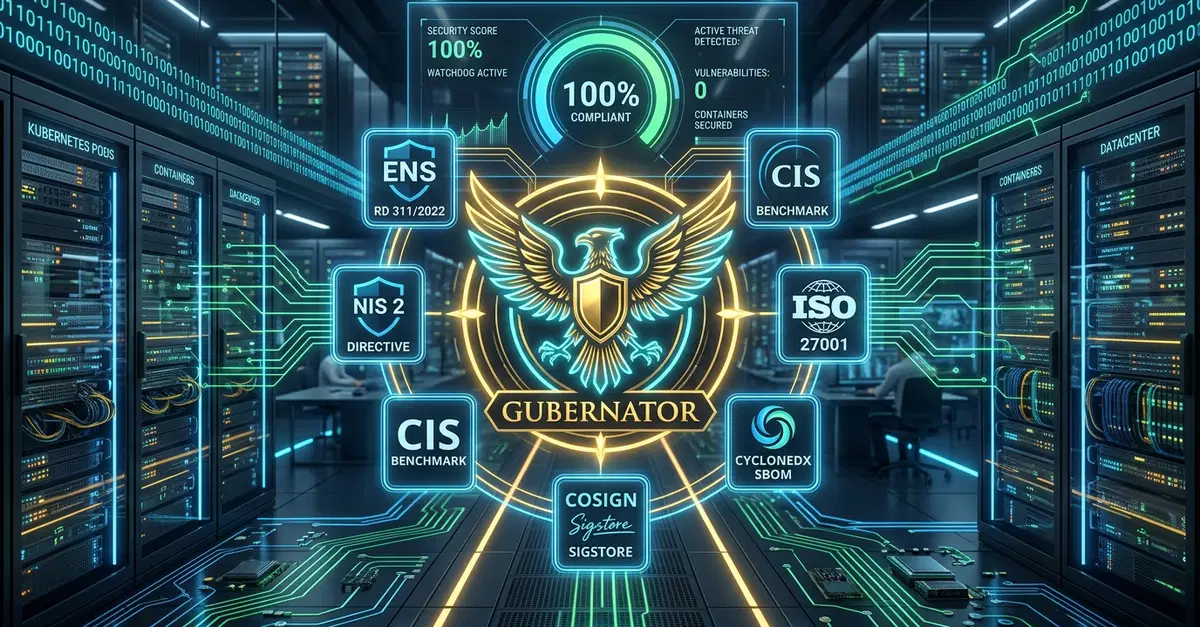
The container orchestration landscape has largely settled on Kubernetes as the de facto standard. However, Kubernetes, in its foundational design, is a powerful but unopinionated platform. It offers immense flexibility but arrives with a significant drawback: it is inherently devoid of built-in security and regulatory compliance features. Bringing a Kubernetes cluster into alignment with stringent standards such as Spain's Esquema Nacional de Seguridad (ENS), the European NIS 2 Directive, CIS Benchmarks, or ISO 27001 typically requires an intricate and often brittle assembly of over 15 third-party tools. These commonly include vulnerability scanners like Trivy, runtime security tools such as Falco, policy engines like Kyverno or OPA Gatekeeper, signing tools like Cosign, certificate management via cert-manager, identity solutions like Keycloak, logging agents like Fluentbit, and monitoring stacks comprising Prometheus, Grafana, and OpenTelemetry.
This fragmented approach leads to substantial technical debt, introduces operational fragility, and consumes considerable system resources just to maintain the control plane. The complexity of integrating, configuring, and continuously maintaining this patchwork of tools places a heavy burden on SecOps and platform engineering teams. The result is often a system that is difficult to audit, prone to misconfiguration, and slow to adapt to evolving compliance requirements.
Gubernator emerges as a direct challenge to this status quo. It positions itself not as another tool to bolt onto an existing Kubernetes cluster, but as a fundamentally different container orchestrator designed from the ground up with compliance as a core tenet. The platform's ambition is to eliminate the need for the extensive third-party toolchain that has become standard practice for achieving regulatory adherence in containerized environments.
Gubernator's Integrated Compliance Framework
Gubernator's core value proposition lies in its integrated approach to compliance. Instead of relying on external operators and custom configurations, Gubernator embeds the enforcement of key standards directly within its orchestration engine. This means that policies and controls for ENS, NIS 2, CIS Benchmarks, and ISO 27001 are not add-ons; they are fundamental aspects of how Gubernator manages containerized workloads.
The platform aims to abstract away the complexity of policy enforcement. For instance, achieving CIS Benchmark compliance on Kubernetes often involves detailed configuration of etcd, API server, controller manager, and kubelet settings, alongside network policies and RBAC. Gubernator intends to automate these configurations, ensuring that deployments adhere to the baseline security recommendations without requiring manual intervention for each setting. Similarly, for ISO 27001, which mandates controls across information security management, Gubernator focuses on aspects like access control, asset management, and incident management, integrating these into its operational model.
The NIS 2 Directive, a significant piece of European cybersecurity legislation, imposes stricter cybersecurity requirements on a broader range of organizations, including critical infrastructure and digital service providers. It emphasizes risk management, supply chain security, and incident reporting. Gubernator's built-in compliance features are designed to address these requirements by providing automated controls for security assessments, network segmentation, and logging, simplifying the path to NIS 2 adherence for organizations operating in the EU.
The Spanish ENS standard, which aims to ensure a minimum level of security in information systems, also presents a complex set of requirements. Gubernator's approach seeks to provide a unified control plane that can enforce the security principles mandated by ENS, covering aspects from risk management to incident response, all within the orchestrator itself.
Operational Simplicity and Resource Efficiency
The traditional Kubernetes compliance model, characterized by its reliance on a plethora of third-party tools, exacts a heavy toll on system resources. Each tool adds its own overhead in terms of CPU, memory, and storage, and contributes to the complexity of the control plane. Gubernator's integrated design aims to mitigate this by consolidating functionality. By building compliance directly into the orchestrator, Gubernator can potentially achieve greater resource efficiency. This is akin to having a single, highly optimized appliance that performs multiple functions, rather than a collection of separate devices each performing one task and requiring their own power and space.
This consolidation promises to reduce operational complexity significantly. Teams no longer need to manage the lifecycle, upgrades, and interdependencies of 15+ disparate tools. Instead, they interact with a single, unified platform. This simplification can lead to faster deployment times, easier troubleshooting, and a reduced learning curve for platform engineers and SecOps personnel. The reduction in operational overhead is a direct benefit, freeing up valuable engineering time and resources that can be redirected towards innovation rather than maintenance.
The Unanswered Question: Scalability and Ecosystem Integration
While Gubernator's promise of integrated compliance is compelling, a critical question remains: how does this approach scale, and how well does it integrate with the broader cloud-native ecosystem? Kubernetes' dominance is partly due to its vast ecosystem of compatible tools, services, and community support. Gubernator's departure from the standard Kubernetes architecture, even with its compliance focus, raises concerns about its ability to seamlessly integrate with existing CI/CD pipelines, observability stacks, and other cloud-native services that developers and operators have come to rely on. Will Gubernator offer compatible APIs or extensions that allow for smooth integration, or will it require organizations to adopt a more isolated, Gubernator-centric approach? The long-term viability and adoption of Gubernator will hinge on its ability to balance its unique compliance features with the practical integration needs of modern development and operations teams.
Market Implications and Future Outlook
Gubernator enters a market saturated with tools attempting to address Kubernetes' compliance shortcomings. Its disruptive potential lies in its architectural decision to bake compliance in, rather than bolt it on. This could represent a significant shift for organizations prioritizing regulatory adherence, particularly those in highly regulated industries or geographies like the EU with directives like NIS 2. By offering a simpler, more resource-efficient, and potentially more robust compliance posture out-of-the-box, Gubernator could carve out a niche by appealing to companies that find the current Kubernetes compliance tooling overwhelming and costly.
Competitors in the Kubernetes ecosystem, from managed Kubernetes providers to specialized security and compliance platforms, will need to assess Gubernator's impact. If Gubernator can deliver on its promise of simplified, integrated compliance without sacrificing performance or ecosystem compatibility, it could force a re-evaluation of how compliance is managed in containerized environments. The current model of assembling third-party tools, while common, is clearly not optimal. Gubernator's success could signal a future where compliance is an intrinsic property of the orchestration layer, rather than an external overlay.