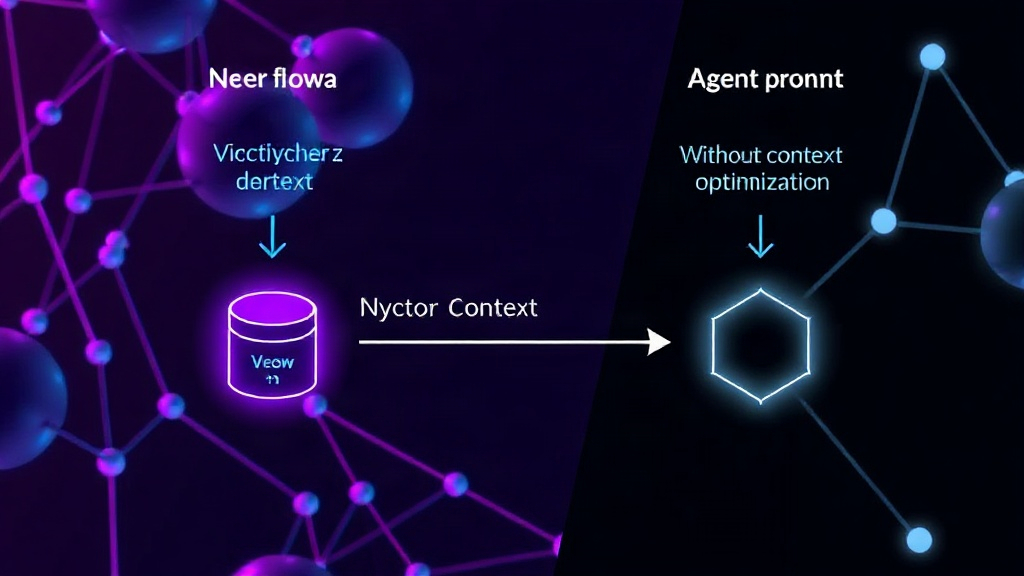
Autonomous agent pipelines face a critical scaling challenge: context inflation. Naive concatenation of vector search results, metadata, and scratchpad state into agent prompts can quickly exhaust API quotas and dilute model attention. One team reported draining a $600 API buffer in 42 minutes due to this problem, not from bugs like infinite loops, but from inefficiently handling 48,000 raw tokens per reasoning hop.
The Problem: Context Inflation and Cache Misses
Vector databases excel at retrieving relevant information, but simply dumping these unstructured similarity hits into an agent's system prompt is a recipe for disaster. This practice leads to several interconnected issues:
- Token Inflation: Each agent step adds more raw data to the prompt, rapidly increasing token counts.
- Cache Misses: Upstream model gateways rely on prompt caching for efficiency. When prompts become unique with each hop due to massive context injection, cache hit rates plummet, negating performance gains.
- Attention Dilution: Large, undifferentiated context windows force LLMs to work harder to identify the most critical information, potentially leading to degraded performance and increased hallucination.
- Cost Escalation: Higher token counts directly translate to higher API costs, making scaling prohibitively expensive.
The core issue is that vector databases are optimized for retrieval, not for the ongoing lifecycle management of agent memory and knowledge. When scaling beyond simple query-response systems, a more sophisticated approach to context is required.
Introducing OpenViking: A Structured Context Database
To combat these challenges, the team integrated volcengine/OpenViking, an open-source context database. OpenViking is designed to unify several key components of agent operation: agent memory, knowledge retrieval-augmented generation (RAG), and execution skills. It achieves this by organizing information into a structured, self-evolving hierarchy.
Unlike a standard vector database, OpenViking aims to manage the entire context lifecycle. This means it doesn't just store and retrieve; it actively structures and optimizes the information presented to the agent. The hierarchy allows for different types of information (e.g., long-term memory, short-term scratchpad, retrieved documents, tool definitions) to be managed distinctly, preventing the undifferentiated mass of tokens that causes inflation.
How OpenViking Optimizes Context
The integration of OpenViking addresses context inflation through several key mechanisms:
Cache-Aligned RAG
OpenViking's architecture is designed with prompt caching in mind. By structuring the context hierarchically and potentially pre-processing or summarizing retrieved information, it can generate more consistent and predictable prompt prefixes. This consistency increases the likelihood that upstream model gateways can effectively cache responses, significantly improving throughput and reducing latency. Instead of re-serializing 48,000 raw tokens each time, OpenViking can present a more distilled, cached-friendly representation of relevant knowledge.
Token Optimization
The structured hierarchy allows OpenViking to prioritize and condense information. For instance, ephemeral scratchpad state might be summarized or pruned if deemed less critical than core knowledge base entries. Document metadata can be transformed into more concise representations. This selective inclusion and transformation of data directly combats token inflation. The goal is to provide the agent with precisely what it needs, in the most compact form possible, for each reasoning step.
Unified Memory and Skills
OpenViking acts as a central hub for an agent's cognitive components. It stores not only retrieved knowledge but also the agent's internal memory and definitions of its available skills or tools. This unification simplifies the agent's architecture and ensures that the context provided to the LLM is comprehensive yet manageable. When an agent needs to access a piece of its memory or use a tool, OpenViking can fetch and format this information efficiently, contributing to the overall optimization.
The Impact on Agent Performance
The successful integration of OpenViking yielded significant improvements:
- Reduced API Costs: By drastically cutting down on unnecessary token usage, the cost per agent interaction decreased substantially.
- Improved Latency: Higher cache hit rates and more efficient context processing led to faster response times.
- Enhanced Reliability: The structured approach mitigated issues related to attention dilution and improved the consistency of agent outputs.
- Scalability: The pipeline could now handle more complex tasks and a higher volume of interactions without hitting resource constraints.
This case demonstrates that for agents to move beyond proof-of-concept and into production environments, managing the context lifecycle is as crucial as the retrieval mechanism itself. Vector databases are a piece of the puzzle, but a dedicated context database like OpenViking is essential for taming context inflation and achieving efficient, scalable autonomous agent systems.