
The Limits of the Prompt Box
The rapid advancement of artificial intelligence models, particularly large language models (LLMs), has captivated the public imagination. We marvel at their ability to generate human-like text, code, and even creative content. Yet, beneath the surface of these powerful engines lies a fundamental bottleneck: the interface through which we interact with them. For most users, the primary interaction method remains a simple text box. We type a prompt, hoping the AI understands our intent, and receive a response. This feels remarkably primitive when we consider the vast amount of contextual information a human uses to understand and execute a task.
Think about how you'd brief a colleague on a complex project. You wouldn't just type a sentence. You'd likely pull up relevant files, reference previous work, discuss deadlines, explain your preferences, show the current state of your software, provide examples, offer feedback on their ideas, and articulate the ultimate goal behind the request. This rich, multi-modal exchange of information allows for nuanced understanding and efficient collaboration. The current AI paradigm, largely confined to a text-based prompt, is akin to asking that colleague to perform the task based on a single, often ambiguous, sentence.
The disconnect is stark. We are pouring immense resources into improving the underlying AI models – making them smarter, more accurate, and more capable. But if the way we *tell* these models what to do is fundamentally limited, their potential remains constrained. The problem isn't necessarily that the AI *can't* understand or perform a complex task, but rather that our current interfaces don't provide the necessary information for it to do so effectively. It's like having a brilliant chef but only giving them a single ingredient and expecting a gourmet meal.
Beyond Text: Designing for Context
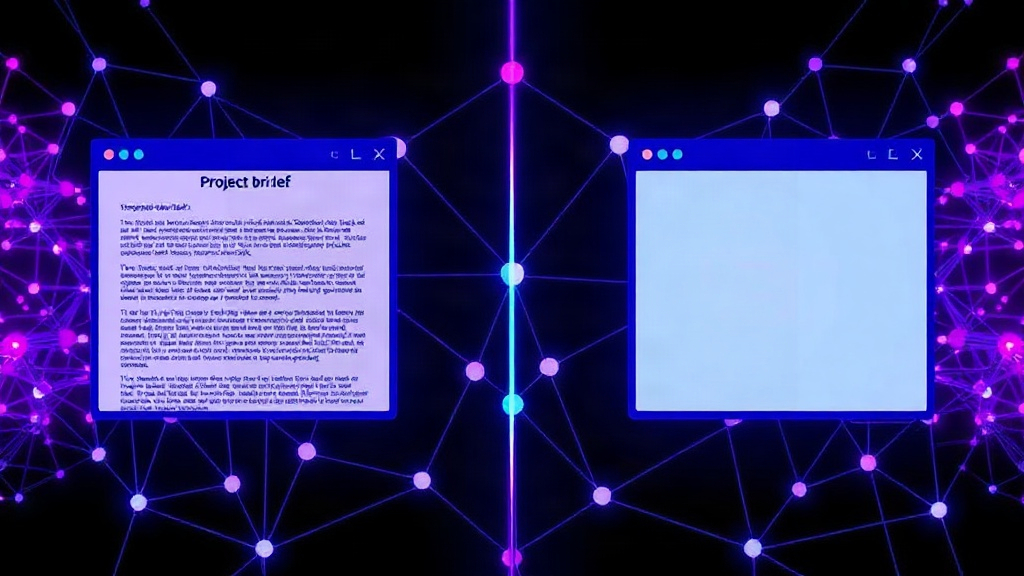
What would an AI interface look like if it were designed around the task, rather than around a chat box? Such an interface would need to move beyond linear text input and embrace the multi-faceted nature of human cognition and workflow. This means integrating various forms of input and context directly into the interaction loop.
Consider a developer needing to debug a piece of code. Currently, they might paste the code into an AI assistant, describe the error, and hope for a solution. An improved interface could allow the developer to directly highlight problematic code sections, attach relevant error logs, link to the project's repository, specify preferred coding standards, and even provide a live debugging session where the AI can observe variable states and execution flow in real-time. The AI wouldn't just be processing text; it would be actively participating in the debugging process with rich, dynamic context.
Similarly, a designer working on a marketing campaign could provide mood boards, brand guidelines documents, previous campaign assets, target audience demographics, and specific performance metrics. The AI could then generate copy, suggest visuals, or even create mockups that are deeply aligned with the project's holistic requirements. This is not about asking the AI to 'guess' what you want; it's about creating an environment where you can *show* the AI what you need, just as you would a human collaborator.
This shift implies a move towards more structured, interactive, and modality-rich interfaces. Instead of a single text field, imagine a workspace that includes:
- Contextual Panes: Dedicated areas for uploading files, linking documents, displaying code snippets, or embedding interactive elements.
- Dynamic Feedback Loops: Mechanisms for real-time annotation, refinement, and iterative guidance, allowing users to steer the AI's output as it's being generated.
- Preference Management: Systems that learn and store user preferences, project constraints, and stylistic requirements, so they don't need to be re-stated for every interaction.
- State Awareness: The ability for the AI to understand the current state of a user's work, whether it's a document, a software project, or a creative canvas.
This isn't a trivial engineering challenge. It requires deep thinking about user experience, data integration, and how to present complex information to both humans and AI in a coherent way. It demands a move from AI as a passive text generator to AI as an active, context-aware partner.
The Model vs. The Interface Debate
The discussion often frames this as a dichotomy: are we limited by the models, or by the interfaces? The reality is more nuanced. Superior models can achieve more with poor interfaces, but their true potential is unlocked by intuitive, context-rich interaction methods. Conversely, even the most advanced model will struggle to deliver optimal results if it's only ever given a fraction of the necessary information via a limited input channel.
The current focus on model scaling – making models larger and training them on more data – has yielded impressive results. However, it's akin to building a more powerful engine for a car with a steering wheel that only turns 10 degrees. The raw power is there, but its application is severely restricted. The interface problem is not about the AI's core intelligence, but about its ability to access and process the full spectrum of information that humans naturally use to define and solve problems.
What nobody has addressed yet is what happens to the thousands of developers who have built entire workflows around prompt engineering and the current chat-based paradigm. Will these skills become obsolete? How will existing applications and platforms that rely on text-in/text-out APIs adapt to a more context-aware AI interaction model? The transition could be as disruptive as the shift from command-line interfaces to graphical user interfaces.
Ultimately, the most significant leaps in AI utility may not come from a more powerful LLM, but from a more intelligent and comprehensive interface that allows us to effectively communicate our complex needs and leverage the AI's capabilities to their fullest extent. The problem is less about the AI's brain and more about its ears and eyes – and how we choose to communicate with it.