
The Challenge: Static Knowledge vs. Dynamic Information
Large Language Models (LLMs) are trained on vast datasets, imbuing them with extensive knowledge. However, this knowledge is inherently static. Once training concludes, the model’s understanding of the world is frozen at that point in time. This presents a significant limitation for applications requiring up-to-date information or the ability to react to rapidly changing circumstances. For instance, a model trained to navigate a city’s public transport system might know all the routes, but it wouldn’t know about a sudden station closure or a concert near a specific stop.
Traditional fine-tuning can incorporate new information, but it often requires retraining on large, curated datasets, which is resource-intensive and can lead to catastrophic forgetting, where the model loses previously acquired knowledge. This is where a novel combination of Continued Pretraining (CPT) and Retrieval-Augmented Generation (RAG) offers a compelling solution.
Continued Pretraining for Foundational Domain Mastery
Continued Pretraining (CPT) allows LLMs to ingest new, domain-specific knowledge in a more stable and generalized manner than standard fine-tuning. Instead of simply memorizing facts, CPT focuses on learning the underlying patterns and relationships within a new corpus. This process helps the model develop a robust, internalized understanding of the target domain. The goal is to create a model that doesn't just recall specific data points but truly grasps the structure and logic of the information.
An experiment detailed on teachmecoolstuff.com illustrates this effectively. The researcher used Unsloth, an optimization library for LLM training, to perform CPT on a Qwen 3.5 4B model. The specific domain chosen was a fictional subway system. The objective was for the model to learn the subway map well enough to provide accurate travel routes, including multiple transfers. The critical aspect here was to train the model on data that encouraged generalization rather than rote memorization. By exposing the model to the subway network through CPT, it developed a stable, internalized representation of the system's layout and connectivity.
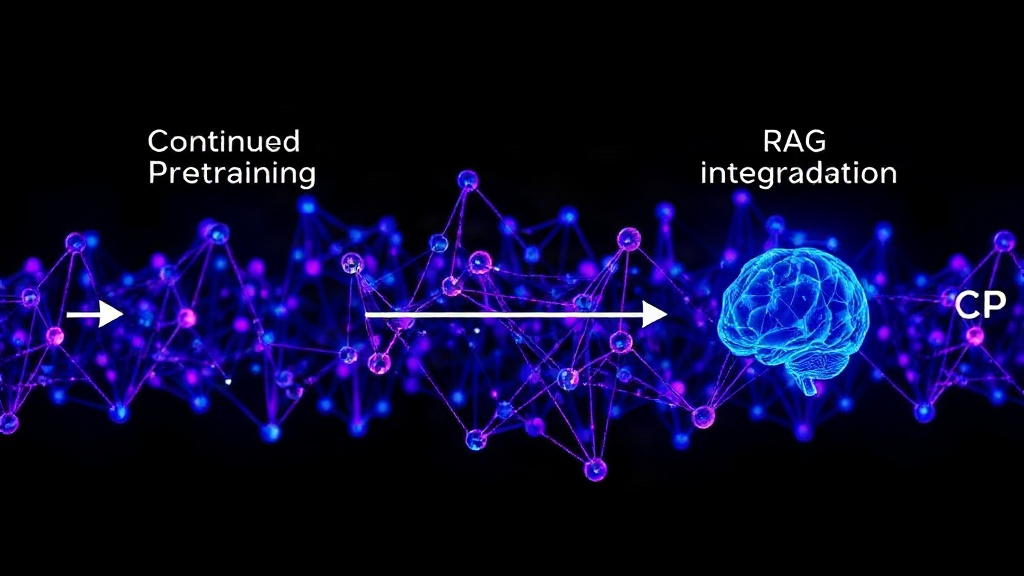
Retrieval-Augmented Generation for Dynamic Updates
While CPT builds a strong, static foundation, RAG introduces flexibility by connecting the LLM to external, dynamic data sources. RAG works by retrieving relevant information from a knowledge base in real-time and feeding it to the LLM as context for its response. This allows the model to access information that was not part of its original training data and, crucially, to access information that is constantly changing.
In the subway system example, after the Qwen model was stabilized with CPT, a RAG component was added. This RAG system was designed to access real-time travel announcements. For instance, if a station was temporarily closed due to an event, or if there was a concert near a particular station, the RAG system could retrieve this up-to-the-minute information. When a user queried the model for travel advice, the RAG system would first fetch any relevant dynamic announcements and then provide them to the LLM alongside the user’s query. The LLM would then use both its internalized subway map knowledge (from CPT) and the current, dynamic announcements (from RAG) to generate a comprehensive and accurate response.
Synergy and Benefits
The synergy between CPT and RAG is powerful. CPT ensures the LLM has a deep, generalized understanding of the core domain, making it less susceptible to hallucinations and more reliable for complex reasoning within that domain. RAG then acts as a dynamic information layer, allowing the model to stay current and informed about real-world events or data that changes frequently. This hybrid approach offers several advantages:
- Reduced Hallucinations: By grounding responses in retrieved factual data, RAG significantly reduces the likelihood of the LLM generating incorrect or fabricated information.
- Up-to-Date Information: RAG enables LLMs to access and incorporate the latest information without requiring costly retraining.
- Domain Specialization without Forgetting: CPT allows for deep specialization in a new domain without the catastrophic forgetting often associated with traditional fine-tuning.
- Efficiency: This combination can be more efficient than full retraining or fine-tuning for applications that need both deep domain knowledge and real-time data access.
- Flexibility: The system can adapt to new information sources or changes in data formats more easily by updating the RAG index rather than retraining the entire LLM.
Future Implications
This approach of combining CPT with RAG has broad implications across various industries. For example, customer support chatbots could leverage CPT to deeply understand product manuals and policies, while RAG could provide them with the latest customer service updates, troubleshooting guides, or even real-time stock availability. In the medical field, a CPT-trained LLM could possess a deep understanding of medical literature, with RAG providing access to the latest clinical trial results or patient-specific data. For developers building AI agents, this methodology offers a robust framework for creating systems that are both knowledgeable and responsive to the ever-changing real world.
The experiment, documented at teachmecoolstuff.com, serves as a practical proof-of-concept, demonstrating that this hybrid strategy is not just theoretical but achievable with current tools like Unsloth. It suggests a path forward for building more capable, adaptable, and reliable LLM-powered applications.