Nvidia Embraces Rust for GPU Development
Nvidia has officially announced CUDA-RUST, a project that enables native GPU programming using the Rust language. This move signals a significant shift in how developers can interact with Nvidia's powerful hardware, leveraging Rust's modern features for performance-critical applications. The initiative is split into two primary tracks, catering to different levels of developer experience and integration needs.
CUDA-RUST: The Two Tracks Explained
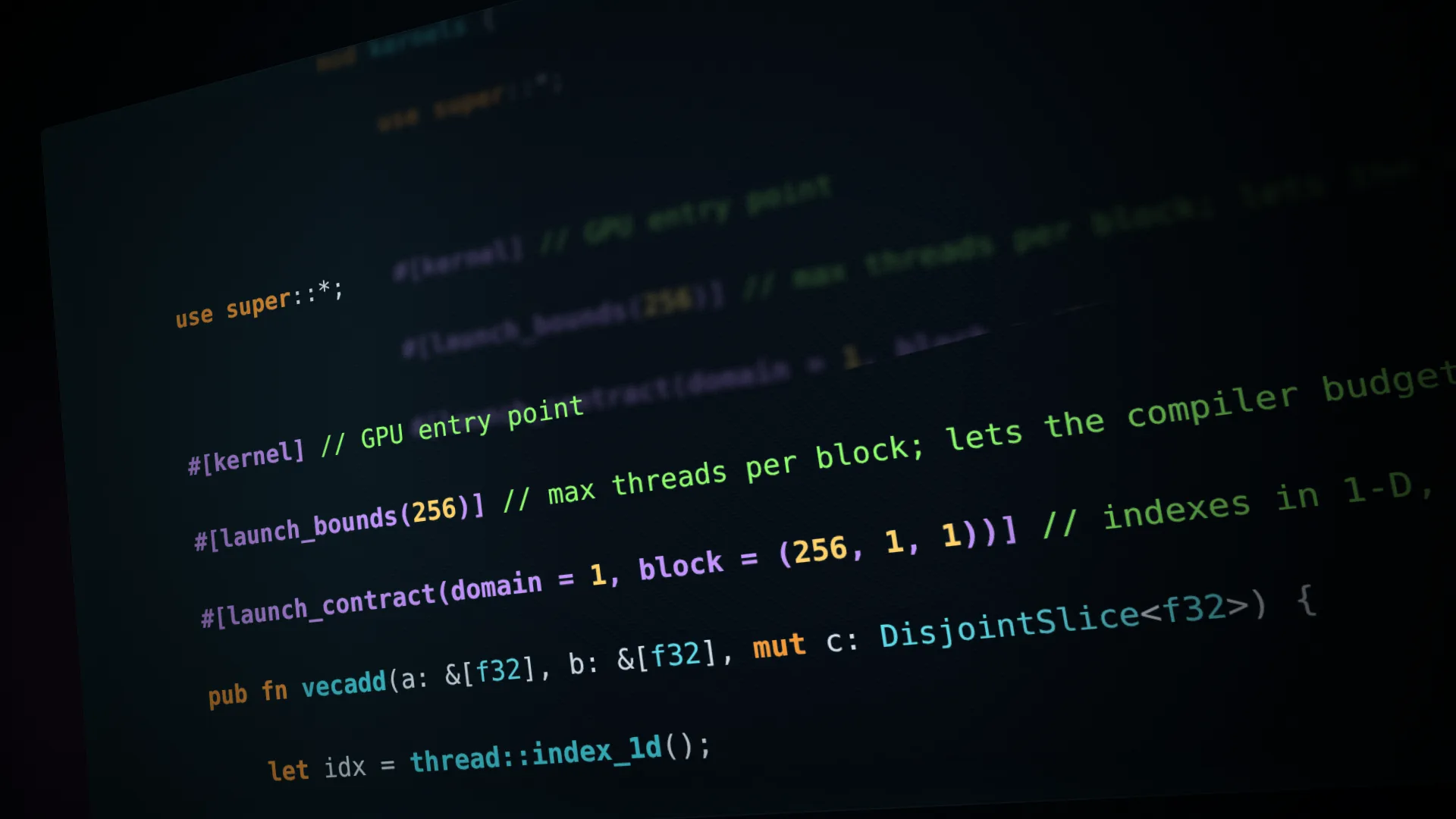
The first track, known as Rust for CUDA, is designed for developers who want to write GPU kernels directly in Rust. This offers the full power and safety guarantees of Rust, including its memory safety features, without the need for manual memory management or the risk of data races. This track aims to provide a familiar Rust experience for GPU development, making it more accessible to a broader audience of Rust developers. It allows for the creation of high-performance, reliable GPU code that can be compiled and deployed directly onto Nvidia hardware.
The second track, CUDA for Rust, is an alternative approach that allows developers to use Rust to call existing CUDA C/C++ libraries and kernels. This path is ideal for projects already heavily invested in the CUDA ecosystem or for developers who prefer to integrate Rust's safety into specific parts of their application while still leveraging existing CUDA codebases. This approach provides a Foreign Function Interface (FFI) layer, enabling seamless interoperability between Rust and CUDA C/C++ code. It’s a pragmatic solution for gradual adoption and for teams that need to maintain backward compatibility.
Why Rust for GPU Programming?
Rust has gained significant traction in the systems programming community due to its strong emphasis on memory safety and concurrency without a garbage collector. These characteristics are particularly appealing for GPU programming, where performance and reliability are paramount. Traditional GPU development, often relying on C or C++, can be prone to memory-related bugs and security vulnerabilities. Rust's compiler enforces strict rules that prevent common errors like null pointer dereferences, buffer overflows, and data races at compile time. This proactive approach can lead to more robust and secure GPU applications, reducing debugging time and the potential for costly production issues.
Furthermore, Rust's modern tooling, including its powerful package manager Cargo and extensive ecosystem of libraries, can streamline the development workflow. This can accelerate the pace of innovation for GPU-accelerated applications, from scientific simulations and machine learning to graphics rendering and high-performance computing. The ability to write safe, high-performance code directly on the GPU without resorting to less safe languages or complex interop layers is a compelling proposition for many developers.
Implications for the Ecosystem
The introduction of native Rust support by Nvidia is a notable development that could influence the broader GPU programming landscape. It provides a strong signal that Rust is maturing as a viable language for low-level, performance-critical domains. This could encourage other hardware vendors and platform providers to explore similar integrations, potentially leading to a more diverse and safer ecosystem for high-performance computing. For developers, it presents a new, powerful option for building the next generation of GPU-accelerated software. The choice between the two CUDA-RUST tracks offers flexibility, allowing teams to adopt Rust at a pace that suits their project's needs and their team's expertise.
The Rust for CUDA track, in particular, promises to lower the barrier to entry for Rust developers looking to harness GPU power. By abstracting away much of the complexity inherent in GPU programming and providing Rust's safety net, Nvidia is making GPU development more approachable. This could democratize access to high-performance computing, enabling a wider range of developers and smaller teams to build sophisticated GPU applications. The long-term impact on the developer community and the types of applications that can be built on Nvidia hardware remains to be seen, but the potential for increased innovation and reliability is substantial.
Referenced Sources
- verified