
The Challenge of Go's Flat Packages
Go's design philosophy often favors large, "flat" packages. This approach, while aiming to reduce import cycles and the overhead of managing numerous small packages, introduces its own set of challenges. When a single package encompasses multiple files, the visibility of declarations (variables, functions, types) is package-scoped. This means anything not explicitly exported (capitalized) is effectively internal to the entire package, not just the file it resides in. Developers aiming for stricter encapsulation within a file often resort to the internal/ directory pattern, which adds boilerplate and can become unwieldy.
The core issue is that Go lacks native file-scoped private visibility. If you declare a variable or function starting with a lowercase letter, it's private to the whole package. This forces developers to either export everything within a multi-file package, potentially exposing implementation details they intended to keep private, or to create new packages solely to achieve a desired boundary. Splitting a package can lead to import cycles, especially when interfaces are introduced to break these cycles, and every shared name must be exported. This increases the surface area of the API and makes refactoring more complex. Moving code between files within the same package is trivial, but moving it between packages breaks all importers.
Introducing declscope
The declscope linter, developed by Masanori P. Yamashita, aims to address this limitation by providing a way to enforce file-scoped private declarations. It acts as a static analysis tool that checks Go code for adherence to this new convention. By using declscope, developers can signal that certain declarations are intended for use only within the specific file they are defined in, even if the package itself is large and flat.
This is achieved through a simple convention: any non-exported declaration (starting with a lowercase letter) that is *not* used within its own file but *is* used by other files within the same package will be flagged by the linter. Essentially, declscope enforces that if a lowercase-prefixed identifier is used outside its defining file, it should be exported (capitalized) to signal its intended public use within the package.
Consider a scenario where you have a multi-file package. You might define a helper function or a configuration variable in one file that is only relevant to that file's internal logic. If another file in the same package accidentally (or intentionally) uses this lowercase-prefixed identifier, declscope will raise a warning. This encourages developers to either make such identifiers exported if they are truly meant to be part of the package's public API, or to ensure they are only referenced within their originating file.
How declscope Works
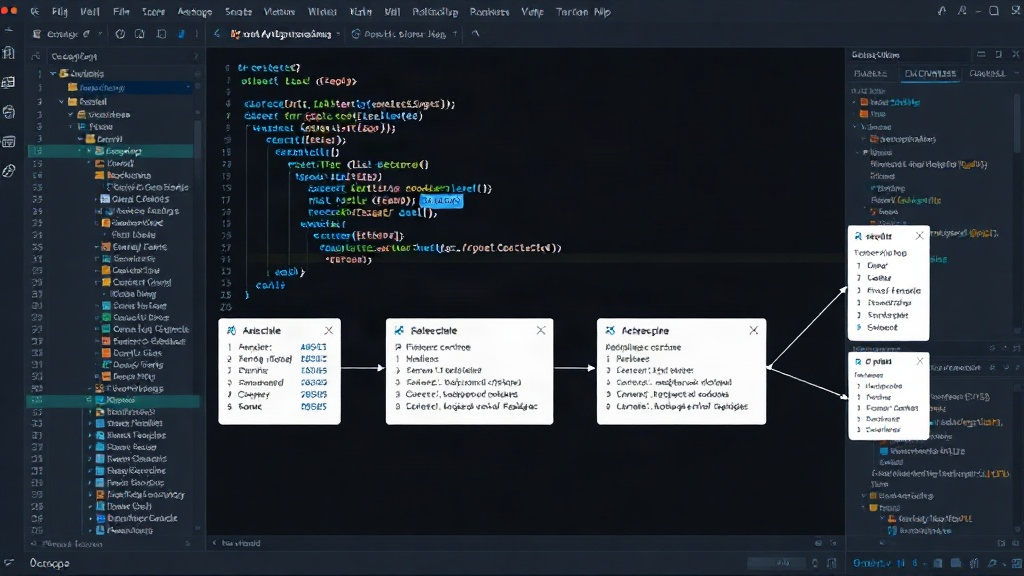
declscope operates by analyzing the Abstract Syntax Tree (AST) of Go source files. It identifies all declarations and their usage. For declarations with lowercase identifiers (which are by default private to the package), it checks if they are referenced by any other file within the same package. If a lowercase-prefixed identifier is used across files, declscope flags it as a potential violation. The linter's output guides developers to either:
- Export the declaration (rename it to start with an uppercase letter) if it's meant to be part of the package's public API.
- Ensure the declaration is only used within its own file. If it's truly internal to that file, its usage should be confined there.
This linter doesn't introduce new language features; it enforces a discipline. It helps maintain the intent behind lowercase identifiers in a flat package structure, preventing accidental leakage of internal implementation details across file boundaries. The tool is available as a standard Go linter, integrable into existing development workflows and CI/CD pipelines.
Benefits and Use Cases
The primary benefit of declscope is improved code clarity and maintainability in large Go packages. By enforcing file-scoped privacy, it:
- Reduces API surface area: Developers are less likely to inadvertently expose internal helper functions or variables.
- Enhances refactoring: It becomes safer to move code between files within a package, as unintended cross-file dependencies are highlighted.
- Clarifies intent: Lowercase identifiers are more reliably understood as strictly internal to their defining file, rather than to the entire package.
- Minimizes boilerplate: It offers an alternative to creating numerous small packages or relying heavily on
internal/directories purely for internal encapsulation within a larger module.
This linter is particularly useful for projects with large, multi-file packages where maintaining clear boundaries between implementation details becomes challenging. It supports the Go community's preference for fewer, larger packages while providing a mechanism to retain some of the benefits of smaller, more encapsulated modules.
The Future of Go's Package Model
While declscope offers a valuable solution for the current Go ecosystem, it also subtly highlights a perennial discussion point: the limitations of Go's package visibility rules in the context of modern, complex software development. The tool's existence suggests a persistent need for finer-grained control over visibility than the current language specification provides.
The question remains: will future versions of Go introduce native support for file-scoped private declarations? Such a feature could simplify codebases further and reduce the reliance on linters for enforcing this pattern. Until then, tools like declscope serve as essential aids for developers striving for robust, maintainable code within the established Go paradigms. The adoption of such linters signals a community actively seeking to enhance existing language features through tooling, bridging the gap between current capabilities and evolving development best practices.