Designing for an Unbuilt Sync Future
Building a notes application that prioritizes local-first operation, meaning all data resides on the user's device without immediate cloud synchronization, presents unique design challenges. Nookly, a new notes app developed in Flutter with a Drift/SQLite backend, tackles this by architecting its data layer with future sync capabilities in mind from day one. The core principle is to make sync a data-layer swap rather than a full application rewrite.
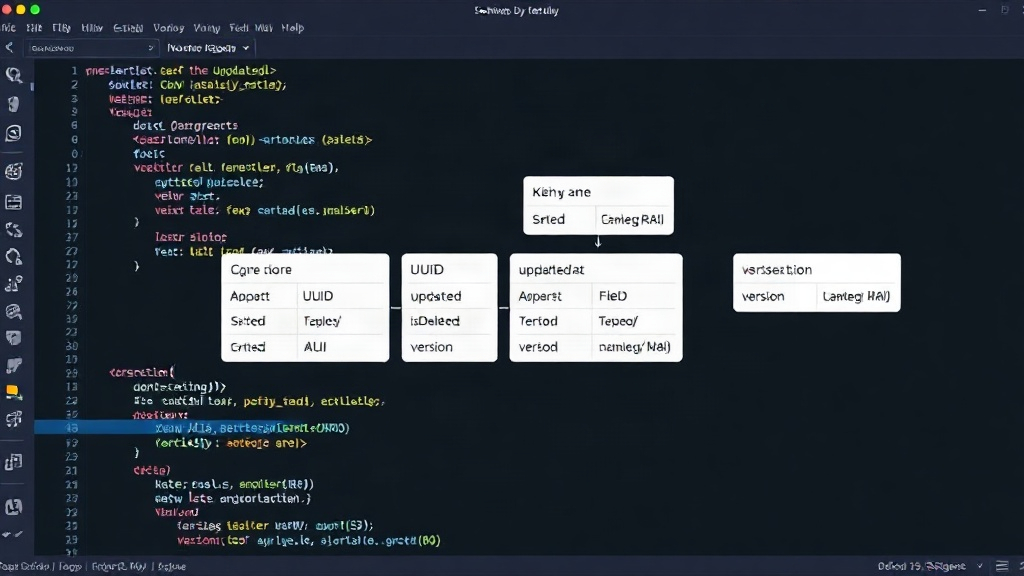
To achieve this, every table in Nookly's schema incorporates four essential fields: id (a UUID for unique identification across potential future sync environments), updatedAt (a timestamp for tracking modifications), isDeleted (a boolean flag for soft deletion, crucial for conflict resolution in sync), and version (a counter for optimistic concurrency control). This foundational structure ensures that when a sync mechanism is eventually implemented, the necessary metadata for merging changes and handling conflicts is already present. It's akin to designing a house with reinforced walls and extra wiring conduits, even if you don't plan to add a second story immediately. The infrastructure is there, ready for expansion.
Efficient Reordering with Fractional Indices
Handling user-generated content often requires dynamic reordering, such as drag-and-drop functionality for lists or pages. A naive approach would involve reindexing all subsequent items whenever one item is moved. For instance, if you move the third item in a list of 100 to the first position, you might renumber items 1 through 9 to 2 through 10. This becomes computationally expensive and slow as list sizes grow.
Nookly employs a more sophisticated technique: fractional indices. Instead of whole numbers, it uses floating-point numbers (or a similar representation that allows for intermediate values) to represent the order of items. When an item is moved between two existing items, its index is assigned a value between the indices of its new neighbors. For example, if an item is at index 5.0 and another at 6.0, and you want to place something between them, it could be assigned index 5.5. This method avoids mass reindexing and keeps the operation performant even with very long lists. It’s like assigning house numbers on a street where new houses can be built between existing ones (e.g., 12 Main St, 12.5 Main St, 14 Main St), rather than forcing a complete renumbering of the entire block.
SQLite FTS5 for Robust Search
Full-text search is a cornerstone feature for any notes application. Implementing this efficiently, especially within a local-first SQLite database, requires careful consideration. Nookly leverages SQLite's built-in Full-Text Search extension, FTS5. This powerful module is designed to index and query large volumes of text data quickly.
Crucially, Nookly avoids maintaining search indexes through application-level code. Instead, it relies on SQL triggers. These triggers are database-level procedures that automatically execute in response to specific data modification events (like inserts, updates, or deletes) on the main content tables. When new content is added or existing content is modified, the triggers automatically update the FTS5 index. This ensures that the search index is always in perfect sync with the primary data, preventing search results from becoming stale or inaccurate. This approach offloads the synchronization logic directly to the database, simplifying application code and improving reliability.
Zero-Tooling Landing Page
Shipping a product, especially an early-stage one, often involves a landing page to attract users and gather interest. The typical development workflow for a modern web page involves a complex build pipeline: JavaScript bundlers (Webpack, Vite), transpilers (Babel), CSS pre/post-processors (Sass, PostCSS), and various framework-specific tools (React, Vue). This can be a significant barrier, especially for solo developers or small teams focused on core product development.
Nookly’s approach to its landing page is radically simple: a single HTML file named index.html. This file contains all the necessary HTML structure, CSS styling (using Tailwind CSS directly within the HTML via JIT compilation or CDN), and JavaScript logic (potentially using React, also integrated directly). There are no separate build steps, no package managers beyond what might be implicitly handled by a CDN, and no complex configuration. The entire landing page is delivered as a static file. This strategy drastically reduces the overhead associated with deployment and maintenance, allowing the developer to focus on content and user acquisition rather than build tooling. It’s the equivalent of packing a single, well-organized suitcase for a trip instead of hiring a logistics team to manage multiple trunks and shipping containers.
Broader Implications
The engineering decisions behind Nookly offer valuable lessons for developers building local-first applications or seeking to minimize development overhead. Designing for future sync by embedding essential metadata into the database schema is a pragmatic approach that defers complexity. Using fractional indices for reordering provides a scalable solution for UI interactions. Leveraging database triggers for search index management simplifies application logic. Finally, the zero-tooling landing page demonstrates that a modern, functional web presence doesn't always require a complex build system, making it accessible for developers prioritizing speed and simplicity.