
AI Agents Need Their Own Financial Plumbing
The burgeoning world of autonomous AI agents, capable of performing tasks from booking travel to managing complex workflows, faces a fundamental bottleneck: payments. Today, these agents operate within human-defined financial systems, often requiring cumbersome intermediaries or manual approvals. Natural, a one-year-old startup, has raised $30 million in Series A funding to build the financial infrastructure specifically designed for these autonomous entities.
The company's ambition is nothing short of taking on Stripe, the dominant player in online payment processing. However, Natural isn't just aiming to replicate Stripe's functionality for a new user base; it seeks to fundamentally reinvent financial transactions for a world where software, not humans, initiates and manages the majority of commerce. This means creating systems that can handle programmatic payments, real-time settlement, and complex conditional logic inherent in AI-driven operations.
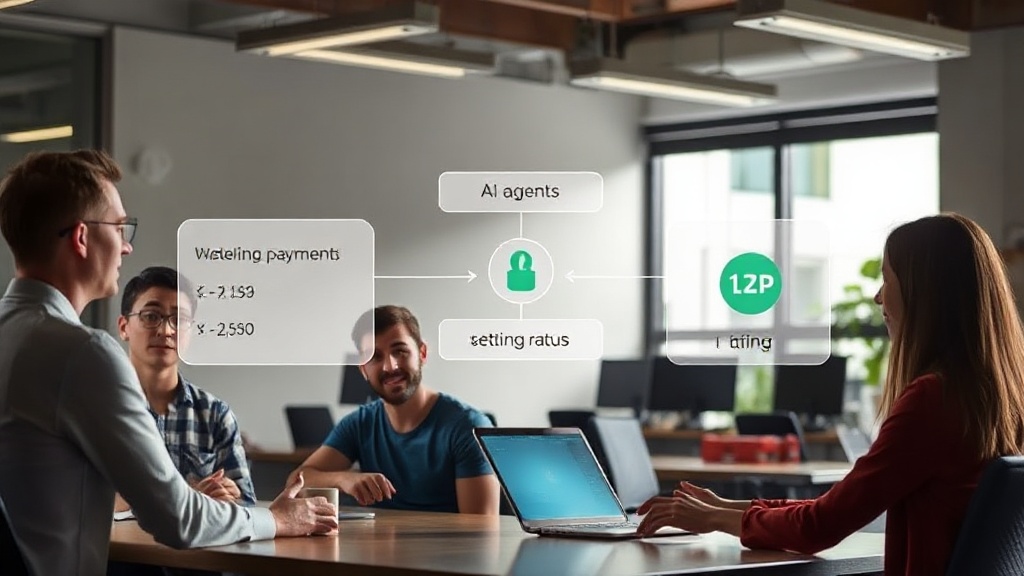
Think of it less like a credit card terminal and more like a self-executing escrow service for digital entities. Natural's platform is being built to understand and execute financial agreements based on AI agent actions and predefined rules. This could range from an AI agent automatically paying for cloud computing resources as it scales its operations, to a fleet of agents settling inter-agent service fees without human intervention.
The Problem with Human-Centric Payments for AI
Current payment systems, while robust for human-to-human or business-to-consumer transactions, are ill-suited for the scale, speed, and programmatic nature of AI agents. Manual authorization, static payment limits, and human-readable terms of service create friction. An AI agent performing thousands of micro-transactions per hour would quickly overwhelm existing systems and compliance frameworks. Natural's approach focuses on abstracting these complexities away, providing APIs and SDKs that allow developers to embed financial capabilities directly into their AI agent architectures.
The implications are vast. Imagine AI agents that can autonomously negotiate and pay for data access, subscribe to premium AI models, or even invest capital based on predefined strategies. This requires a payment system that is secure, auditable, and capable of handling high-frequency, low-value transactions with minimal latency. Natural's co-founder and CEO, [CEO Name - Placeholder], stated in a press release, "We are building the financial operating system for the age of AI. Today's payment infrastructure was built for people, not for intelligent agents that operate at machine speed."
Stripe's Dominance and Natural's Challenge
Stripe has built an empire on making online payments accessible and developer-friendly for businesses. Their success lies in abstracting away the complexities of traditional banking and card networks. Natural aims to do the same for AI agents, but the challenges are different. AI agents don't have bank accounts in the traditional sense, nor do they have credit scores. Their financial interactions are governed by code, and their trust is based on verifiable execution rather than identity verification in the human sense.
Natural's strategy appears to be a two-pronged approach: first, building a robust backend capable of programmatic financial transactions, and second, providing developer tools that abstract this complexity. This mirrors Stripe's successful developer-first strategy. However, Natural must also navigate regulatory landscapes that are still evolving around autonomous systems and digital assets. The $30 million in Series A funding, led by [Lead Investor Name - Placeholder] with participation from [Other Investor Name - Placeholder], signals strong investor confidence in Natural's vision and its ability to tackle this complex market.
The Future of Autonomous Commerce
What nobody has fully addressed yet is the long-term economic model for a world where AI agents are significant economic actors. Natural's success could pave the way for entirely new business models, where AI agents act as independent contractors, service providers, or even autonomous businesses. This raises questions about economic distribution, taxation of AI-driven profits, and the very definition of commerce.
For developers building AI agents, Natural offers a glimpse into a future where financial operations are as seamless as API calls. It means less time spent wrestling with payment gateways and more time focusing on agent intelligence and utility. The company's focus on security and auditability will be paramount, as the potential for misuse in an autonomous financial system is significant. As AI agents become more sophisticated and capable of independent action, the need for specialized financial infrastructure like Natural's will only grow. The challenge for Natural will be to scale its technology and adoption faster than the rapid evolution of AI itself, while outmaneuvering incumbents who may eventually seek to capture this emerging market.