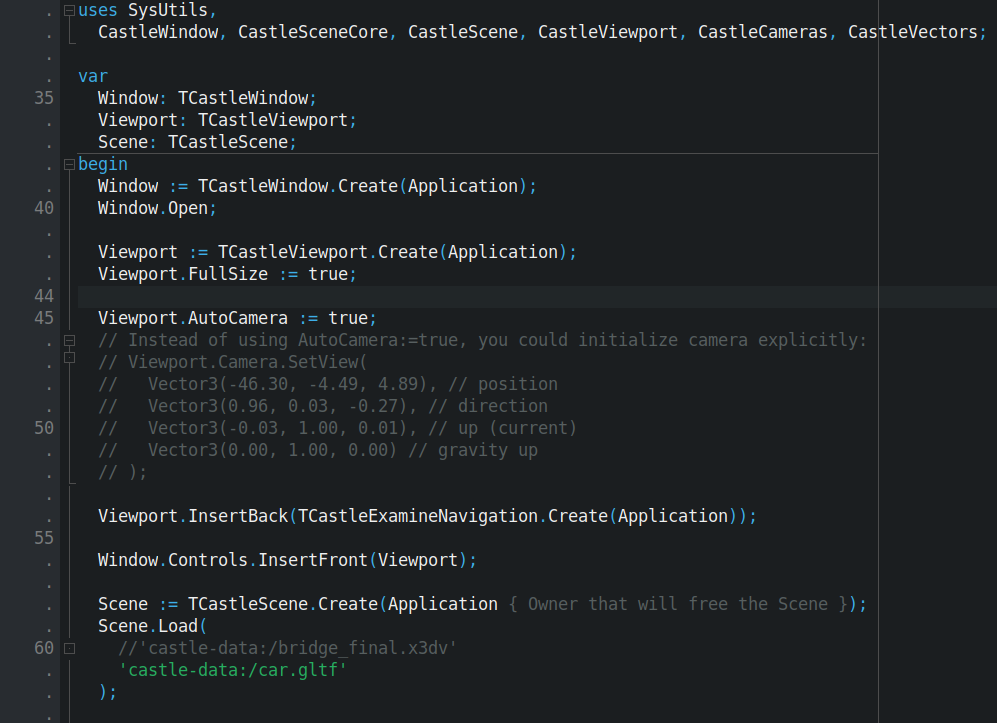
Beyond Nostalgia: Object Pascal's Modern Renaissance
Object Pascal, a language often associated with the Delphi era, is experiencing a significant resurgence, not as a relic of the past, but as a potent, modern programming language. The Castle Game Engine project, a free and open-source cross-platform game engine, is at the forefront of this revival. Their detailed introduction to Modern Object Pascal aims to demystify the language for developers familiar with C++, C#, Rust, and other contemporary languages, highlighting its strengths and accessibility.
The core message is clear: Modern Object Pascal is not your grandfather's Pascal. It has evolved dramatically, incorporating features that modern developers expect. This isn't about clinging to legacy; it's about leveraging a language that offers robust type safety, excellent performance, and a clear, readable syntax, now enhanced with features that compete directly with contemporary languages.
Key Modern Features of Object Pascal
Castle Game Engine's documentation emphasizes several key advancements that make Object Pascal a compelling choice:
Type Safety and Expressiveness
Object Pascal boasts strong static typing, which helps catch many errors at compile time rather than runtime. This inherent safety is a significant advantage for building reliable software. The language's syntax is designed for clarity, reducing ambiguity and making code easier to read and maintain. Features like generics, introduced in newer versions, allow for more flexible and reusable code, akin to C++ templates or C# generics.
Performance Parity
Contrary to outdated perceptions, Object Pascal compilers generate highly optimized native code. The performance is often comparable to C and C++, making it suitable for performance-critical applications like game development. The Castle Game Engine leverages this by targeting multiple platforms with native compilation, ensuring smooth performance across desktop, mobile, and even web (via WebAssembly).
Modern Language Constructs
The language has embraced modern programming paradigms. Features such as anonymous methods (closures), interfaces, and robust exception handling are standard. Properties provide a clean way to encapsulate data access, offering a more object-oriented approach than simple public fields. The introduction of records with methods and constructors further enhances its object-oriented capabilities.
Interoperability and Ecosystem
A crucial aspect for adoption is interoperability. Object Pascal allows for easy integration with C libraries, which is vital for leveraging existing codebases and system APIs. While the ecosystem might not be as vast as Java or Python, it is actively growing, particularly within the game development community around Castle Game Engine. The availability of community-contributed libraries and tools continues to expand.
Bridging the Gap for Contemporary Developers
The Castle Game Engine's introduction is strategically designed to resonate with developers coming from other backgrounds. For C++ programmers, the explicit memory management (though often automatic with reference counting for objects) and strong typing offer a potentially safer development experience. C# developers will find familiar object-oriented concepts, properties, and a managed runtime feel, albeit with native compilation.
Rust developers, accustomed to strict compiler checks and memory safety, might appreciate Object Pascal's compile-time error detection and predictable performance. The language's readability is often cited as a major plus, requiring less boilerplate than some other languages. Think of it less like a cryptic puzzle and more like a well-written instruction manual that guides you clearly through the process.
Castle Game Engine: A Practical Playground
The Castle Game Engine itself serves as a powerful testament to Modern Object Pascal's capabilities. It's a feature-rich, cross-platform 2D and 3D game engine that supports a wide array of platforms including Windows, macOS, Linux, Android, iOS, and WebAssembly. This broad support, coupled with its performance, makes it an attractive proposition for indie developers and small studios.
By using Object Pascal as its primary development language, Castle Game Engine demonstrates that the language is not only viable but highly effective for building complex, performant applications. The engine's documentation and community actively encourage new users, providing resources tailored to those transitioning from other languages. This practical application is key to showcasing the language's modern relevance.
Why Now? The Market Context
In a landscape dominated by Python for scripting, JavaScript for web, and C++/C# for game development, the re-emergence of a language like Object Pascal might seem surprising. However, the demand for efficient, reliable, and maintainable code is perennial. Developers are increasingly looking for languages that offer a balance of performance, safety, and developer productivity.
The rise of open-source projects like Castle Game Engine also plays a crucial role. These projects provide a modern, compelling use case and a supportive community, lowering the barrier to entry for developers who might otherwise dismiss Object Pascal. The focus on cross-platform development further aligns it with current industry trends, where deploying to multiple devices and operating systems is standard practice.
The Future of Object Pascal
The trajectory of Modern Object Pascal, as championed by projects like Castle Game Engine, suggests a future where it is recognized not just for its historical significance but for its contemporary strengths. Its combination of type safety, performance, and evolving language features positions it as a serious contender for new projects, especially in areas like game development, system utilities, and performance-sensitive applications. Developers looking for an alternative that offers a blend of the familiar and the modern might find Object Pascal a surprisingly powerful and productive choice.
What remains to be seen is the extent to which larger commercial entities will embrace Modern Object Pascal beyond niche applications. While its presence in game engines is strong, its broader adoption in enterprise software or general-purpose application development will depend on continued investment in tooling, libraries, and developer education. The momentum generated by active open-source communities is a strong start.