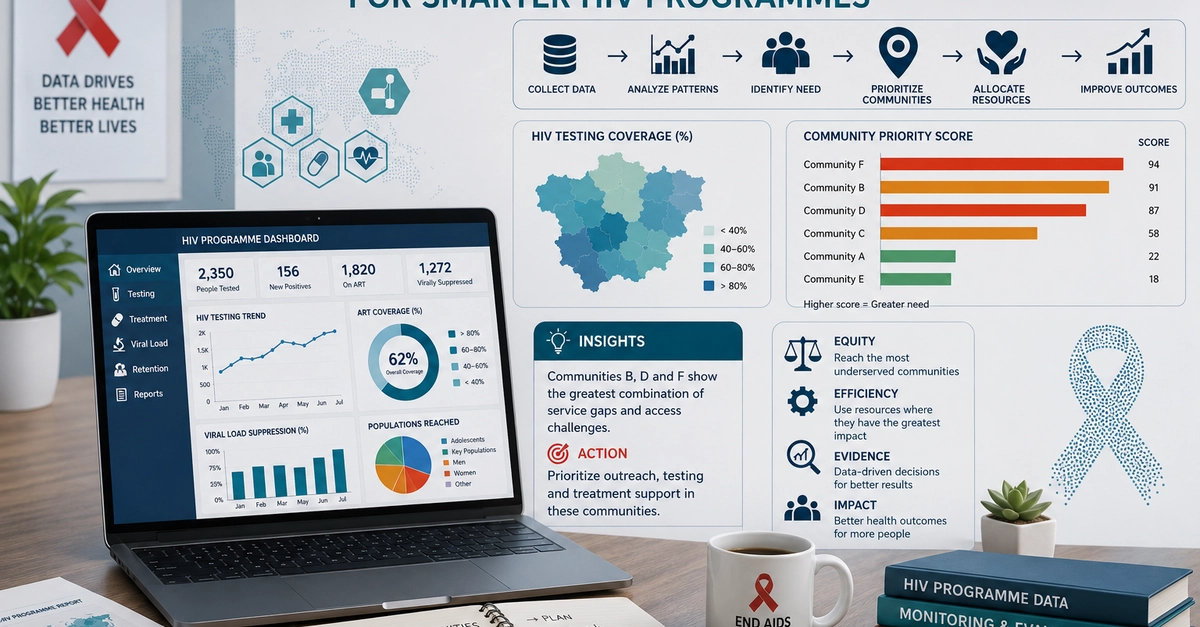
The Challenge: Scarce Resources, High Need
Healthcare Non-Governmental Organizations (NGOs) working on HIV and AIDS programmes often face a stark reality: limited resources. Funding, healthcare workers, testing kits, transportation, outreach teams, and community programmes are finite. This scarcity creates a critical question: how can these organizations ensure their limited capacity serves those with the greatest need, rather than spreading resources thinly across all communities?
Distributing resources equally might seem equitable on the surface, but it fails to address the varying levels of HIV-related service gaps or the intensity of need across different geographical areas. An evidence-based approach is essential for maximizing impact.
Machine Learning as a Solution
Machine Learning (ML) offers a powerful solution to this allocation problem. Instead of relying on broad assumptions or equal distribution, ML algorithms can analyze historical programme data to identify specific communities experiencing significant service gaps or higher burdens of need. This data-driven approach allows for the prioritization of resources based on concrete evidence, ensuring that limited assets are directed where they can make the most difference.
ML can move beyond simple demographic data. By analyzing patterns in past program performance, patient outcomes, testing rates, treatment adherence, and even socioeconomic factors correlated with HIV vulnerability, ML models can predict which communities are likely to benefit most from targeted interventions. This predictive capability is key to proactive resource management.
How ML Identifies Greatest Need
The core of using ML in this context involves training models on historical data. This data might include:
- Programme Uptake and Reach: Which communities have historically low engagement with testing, treatment, or prevention services?
- HIV Prevalence and Incidence: Where are infection rates highest or increasing most rapidly?
- Treatment Adherence and Outcomes: In which communities do patients struggle most with adherence to antiretroviral therapy (ART), leading to poorer health outcomes?
- Socioeconomic Factors: Are there correlations between poverty, lack of education, or limited access to transportation and higher HIV burden or service gaps?
- Geographic and Infrastructure Data: Does distance to clinics, availability of public transport, or local infrastructure impact service delivery?
Once trained, these models can process current data to generate a 'need score' or 'priority level' for each community. This score could represent a composite of factors, such as the estimated number of undiagnosed individuals, the percentage of the population not on treatment, or the projected increase in new infections without intervention.

Beyond Simple Allocation: Optimizing Interventions
The application of ML extends beyond merely identifying which communities need resources. It can also help optimize the *type* of resources allocated. For example:
- Testing Campaigns: If a community shows a high prevalence of undiagnosed cases but low testing rates, increased funding for mobile testing units or community outreach might be prioritized.
- Treatment Support: If a community has high rates of individuals diagnosed but not on treatment, resources might be directed towards adherence support programs, peer counseling, or improved access to clinics.
- Prevention Programmes: Communities with high incidence rates might benefit from targeted awareness campaigns, condom distribution, or pre-exposure prophylaxis (PrEP) outreach.
This nuanced approach allows NGOs to tailor their interventions based on the specific challenges identified by the ML model for each community. It’s about deploying the right tool, to the right place, at the right time.
The Human Element and Ethical Considerations
While ML provides powerful analytical capabilities, it's crucial to remember that it is a tool guided by human expertise. Data analysts and programme managers within the NGO must:
- Ensure Data Quality: ML models are only as good as the data they are trained on. Inaccurate or incomplete data will lead to flawed recommendations.
- Interpret Results Critically: ML outputs should not be blindly followed. Programme managers must use their on-the-ground knowledge and understanding of local contexts to validate and refine the model's suggestions.
- Address Bias: Historical data can reflect existing societal biases. It is essential to actively look for and mitigate any biases in the data or the model that could lead to inequitable resource distribution, even unintentionally. For instance, if historical data undercounts needs in marginalized populations due to access barriers, the model might perpetuate this undercounting.
- Maintain Transparency: While the algorithms may be complex, the rationale behind resource allocation decisions should be as transparent as possible to stakeholders, including community leaders and beneficiaries.
The goal is not to replace human judgment but to augment it with data-driven insights. This partnership between human expertise and machine intelligence can lead to more effective and equitable HIV programmes.
The Future of Resource Allocation in Public Health
As ML tools become more sophisticated and accessible, their application in public health resource allocation is poised to grow. This approach moves away from a one-size-fits-all strategy towards a more dynamic, evidence-based model. By embracing ML, NGOs can significantly enhance their ability to combat HIV by ensuring that every dollar, every hour of healthcare worker time, and every testing kit is deployed where it can have the most profound impact, ultimately bringing us closer to controlling the epidemic.
The fundamental advantage is shifting from reactive, broad-stroke distribution to proactive, precisely targeted interventions. This is not just about efficiency; it's about effectiveness in saving lives and improving community health outcomes.