The Illusion of Free AI Visibility Scores
In the race for digital prominence, AI visibility scores have emerged as a seemingly effortless metric. These scores, often offered freely by various platforms, promise to quantify a brand's presence across generative AI search results. They aggregate data points to present a single, digestible number. However, this simplicity masks a critical fragility: the score is only as reliable as the methodology behind it, and without transparency, it becomes an unverified assertion. For developers, founders, and marketers, treating these scores as gospel is a dangerous oversight. The core issue lies in the reproducibility of the score itself. If you cannot replicate the process or understand the inputs, the output is effectively meaningless.
An AI visibility score typically aims to summarize a brand's presence within a curated set of AI-generated answers. The trap is that the definition of this set—the specific questions asked, the AI engine used, the date of the query, the session state, the retrieval mode, and the rules for counting a 'hit'—are all integral to the metric. Strip away these inputs, and the number becomes irreproducible and untrustworthy. This article outlines a six-check audit process, manageable by hand, designed to verify the evidence supporting any given AI visibility score. The goal isn't to estimate your entire market, but to determine if a dashboard's headline number warrants further investigation.
Building the Audit Framework
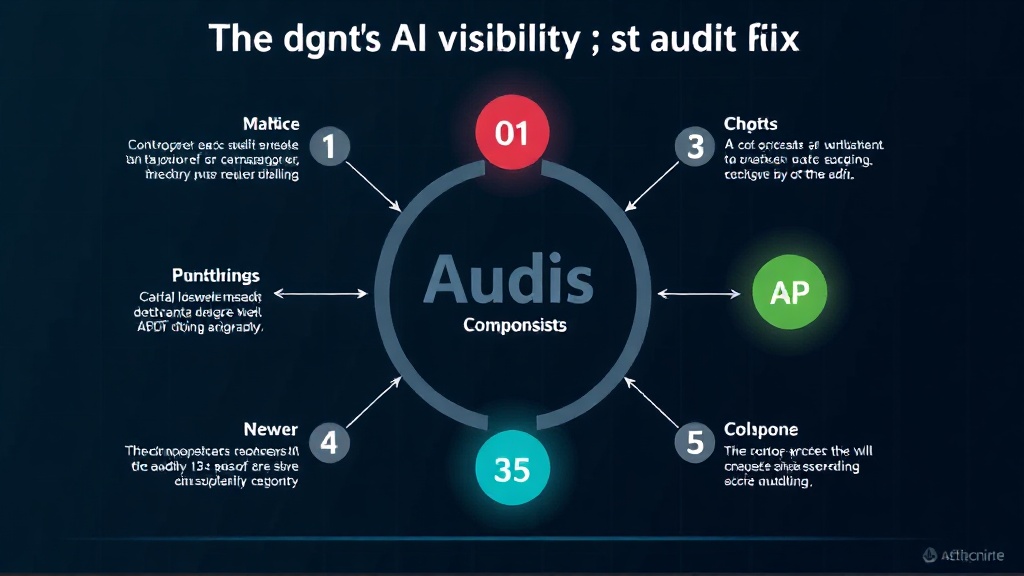
The fundamental principle of auditing any score, especially one derived from complex AI systems, is to treat it like any other test result. A test result is a snapshot of performance under specific conditions. If those conditions are not documented and reproducible, the result has limited value. For AI visibility scores, this means dissecting the components that contribute to the final number. The six manual checks focus on ensuring that the score is auditable, meaning you can inspect the prompt, the AI engine, the raw answer, the date of the query, and the denominator (how the score is calculated or normalized).
This audit process is not about forcing agreement between different AI surfaces or trying to achieve a perfect match. Instead, it's about gathering raw data to understand the variability and the basis for the score. The workflow involves taking three distinct buyer questions, running each through two different AI surfaces, and meticulously recording the six raw answers. This approach helps to build a control set that can be stored as plain data, allowing for direct comparison with any tool's output. This method provides a tangible basis for evaluating the claim made by a visibility score.
The Six Manual Checks
To effectively audit an AI visibility score, you need to implement a structured verification process. The following six checks ensure that the underlying data supporting the score is transparent and reproducible:
1. Inspect the Prompt
The prompt is the instruction given to the AI. Its wording, structure, and any contextual information provided fundamentally shape the AI's response. For an AI visibility score to be auditable, you must know precisely what prompt was used to generate the data. If the prompt is hidden or vague, it's impossible to understand why a particular answer was returned. The audit requires you to document the exact prompt, including any parameters or constraints applied.
2. Identify the Engine
Different AI models and search engines have distinct capabilities, biases, and data sources. A score generated from Google's AI Overviews will likely differ from one generated by Perplexity or Bing Chat. Transparency about the specific AI engine used for each query is crucial. The audit must record which engine (e.g., GPT-4, Claude 3, Gemini) and which interface (e.g., specific website, API endpoint) produced the answer.
3. Examine the Raw Answer
The 'raw answer' refers to the unedited, complete output from the AI, before any scoring or aggregation. This includes the text, any cited sources, images, or other multimedia elements. Reviewing the raw answer allows you to see the direct output and assess its relevance, accuracy, and completeness. The audit process involves capturing and storing these raw answers verbatim.
4. Record the Date
AI models are constantly updated, and search engine results change dynamically. The date on which a query was run is a critical piece of metadata. A score generated today might be invalid tomorrow due to model updates or shifts in search engine ranking factors. The audit requires you to log the exact date and, ideally, the time of each query to ensure reproducibility and understand temporal context.
5. Understand the Denominator
The 'denominator' refers to the total pool of potential results or the basis against which a brand's presence is measured. For example, if a score claims 50% visibility, what is the 100%? Is it all possible search results for a given query? Is it a predefined list of competitor websites? Without understanding the denominator, the percentage is meaningless. The audit needs to clarify what constitutes the total set of results being considered.
6. Verify Session State and Retrieval Mode
Advanced AI systems often maintain session state, meaning previous interactions can influence subsequent answers. Similarly, retrieval modes (e.g., 'real-time search' vs. 'knowledge base lookup') significantly alter the output. For a score to be auditable, these factors must be controlled and documented. The audit should aim to understand if personalization, session history, or specific retrieval settings were active and how they might have impacted the results.
From Raw Data to Actionable Insight
By performing these six checks, you move beyond blind acceptance of a score. You build a verifiable dataset. This dataset can then be used to:
- Compare Tools: Directly contrast the outputs of different AI visibility scoring tools using your controlled queries.
- Identify Bias: Detect potential biases in specific AI engines or prompts by observing consistent patterns in the raw answers.
- Inform Strategy: Use the audited data to refine SEO strategies, content creation, and prompt engineering efforts.
Treating the AI visibility score as a test result, rather than an inherent property of your brand, shifts your perspective. It becomes a piece of evidence that requires scrutiny. If a dashboard's headline number lacks sufficient evidence from these manual checks, it signals that further investigation is needed before any strategic decisions are made based upon it. This methodical approach empowers developers and marketers to navigate the often-opaque world of AI-driven analytics with confidence.
The Unanswered Question of Standardization
While this six-check method provides a robust way to audit individual scores, a significant challenge remains: the lack of industry-wide standardization for AI visibility metrics. Each platform defines its own parameters, leading to disparate scores that are difficult to compare apples-to-apples. What happens to market analysis and competitive benchmarking when every tool measures 'visibility' through a unique, proprietary lens? This absence of a common framework leaves users to perform extensive due diligence for every score they encounter, a task that is both time-consuming and prone to error. The industry needs a consensus on what constitutes an auditable AI visibility score, defining the essential inputs and methodologies that all tools should adhere to, or at least clearly disclose.