The Peril of the Premature MVP
The mantra "Just build an MVP" echoes through software development. On the surface, it’s sound advice: build the smallest possible version, launch quickly, gather feedback, and iterate. However, a common, dangerous misinterpretation has taken root. Many developers equate "minimum viable product" with a system stripped bare of essential qualities. This often translates to removing architecture, ignoring security, skipping tests, hardcoding values, and pushing code into production with reckless abandon.
The outcome is predictable and devastating. Six months later, the product might be technically live, but it’s practically dead. Every new feature introduces regressions. Database migrations become high-stakes gambles. Customer requests necessitate complex workarounds. The codebase devolves into a tangled mess of individually sensible but collectively nonsensical decisions. The team’s energy shifts from product improvement to wrestling with a fundamentally unstable system.
This isn't a viable product; it's a ticking time bomb. It’s the software equivalent of building a house on sand. You can put furniture in it, but the first strong wind will bring it down.
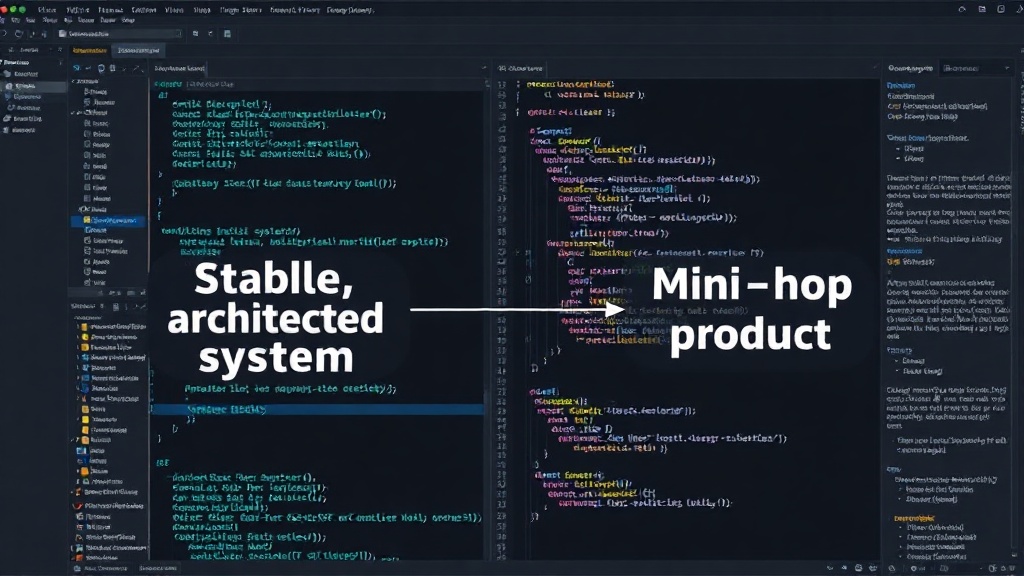
Introducing the Minimum Viable System (MVS)
A more robust approach is the Minimum Viable System (MVS). The MVS acknowledges that while speed to market is critical, it cannot come at the expense of foundational integrity. It’s about shipping early, but critically, shipping *quality* early. This means building a system that is not just functional for its initial purpose but also architecturally sound, secure, testable, and maintainable from day one.
Think of it less like a quick sketch and more like a well-drafted blueprint for a sturdy, expandable building. The MVS prioritizes establishing a solid foundation upon which future growth can be reliably built. It’s about making deliberate, forward-thinking decisions, even in the earliest stages.
Core Principles of the MVS
Implementing an MVS requires a shift in mindset and a commitment to specific practices:
1. Foundational Architecture
Even for the simplest product, a basic architectural pattern should be established. This doesn't mean over-engineering, but rather choosing a structure that supports future scalability and maintainability. Whether it's a simple layered architecture, a microservices approach, or a domain-driven design, the key is to have a coherent structure that separates concerns. This prevents the codebase from becoming a monolithic tangle where changes in one area inevitably break others. A well-defined architecture acts as the skeleton of your system, providing shape and support.
2. Security by Design
Security cannot be an afterthought. The MVS integrates security considerations from the outset. This includes implementing secure coding practices, using appropriate authentication and authorization mechanisms, validating inputs rigorously, and protecting sensitive data. For early-stage products, this might mean leveraging secure-by-default libraries or frameworks and performing basic security reviews. Ignoring security in the name of speed is akin to leaving the doors and windows of your house wide open.
3. Comprehensive Testing
A system without tests is a system without confidence. The MVS mandates a testing strategy from the beginning. This typically includes unit tests for individual components, integration tests to verify interactions between components, and potentially end-to-end tests for critical user flows. Automated testing provides a safety net, allowing developers to refactor and add features with the assurance that they aren't breaking existing functionality. It’s the alarm system for your software house.
4. Maintainable Code
Code should be written with the next developer in mind – and that next developer might be you, six months from now. This means adopting clear naming conventions, writing concise and readable functions, using comments judiciously to explain *why*, not *what*, and adhering to established coding standards. Avoiding hardcoding values, opting for configuration files or environment variables, makes the system adaptable without requiring code changes for every minor adjustment. Maintainable code is like a well-organized toolbox; everything is easy to find and use.
5. Incremental Deployment
The MVS supports an iterative release process, but with a crucial difference: each increment is a stable, tested, and secure release. This is often achieved through continuous integration and continuous deployment (CI/CD) pipelines. CI/CD ensures that code changes are automatically built, tested, and deployed to production in small, manageable batches. This reduces the risk associated with each deployment and allows for rapid feedback loops. It's like adding a new room to your house, ensuring each addition is structurally sound before moving on.
The Long-Term Advantage
While adopting an MVS might require a slightly higher upfront investment in time and discipline compared to the "ship it all" MVP approach, the long-term benefits are substantial. Teams working with an MVS experience fewer regressions, faster feature development cycles, reduced technical debt, and higher developer morale. The system remains adaptable and robust, capable of supporting sustained growth and evolving market demands.
The critical question for any startup or product team is not whether they can ship fast, but whether they can ship *sustainably*. The MVS provides the framework for achieving both. It transforms the initial launch from a risky gamble into the first step of a predictable and manageable product evolution. Shipping early is important, but shipping junk is a death sentence.