The Dev.to Landscape: A Sea of Unread Content
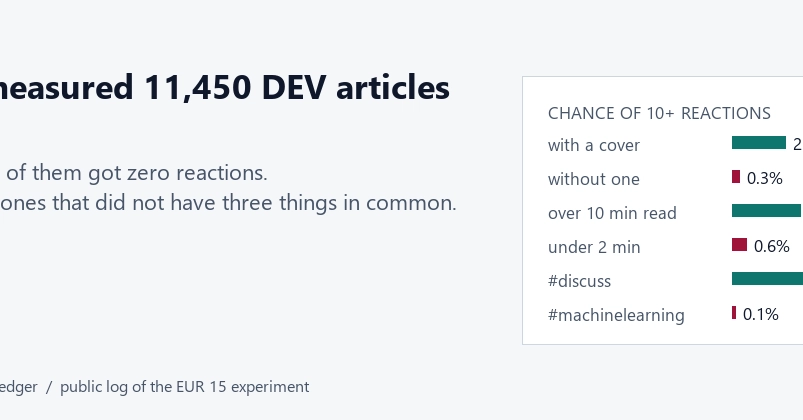
A recent deep dive into Dev.to’s public API has uncovered a stark reality for content creators on the platform: the vast majority of articles fail to garner any engagement. Out of 11,450 articles analyzed, which had been live for at least 72 hours, a staggering 78% received zero reactions. This data point serves as a critical baseline, suggesting that any strategy aiming to break through the noise must overcome this significant hurdle.
The data collection involved querying the API across 20 different tags, fetching 100 articles per page for 12 pages each. After deduplicating by article ID, the dataset was filtered to include only articles that had been published for at least three days. This rigorous filtering ensures that the analysis reflects posts with ample time to gain traction, making the zero-reaction statistic even more telling.
The platform’s public API, accessible without authentication, was used to gather the raw data. Scripts for data collection and analysis are publicly available, encouraging transparency and further exploration by the community. The author’s initial anecdote, where changing tags, adding cover images, and observing a jump in reads from 2 to 45, serves as a personal, albeit statistically insignificant (n=3), illustration of how minor tweaks can impact visibility.
Identifying the Traits of Engaging Content
While the majority of content languishes in obscurity, a subset of articles does manage to capture reader attention. The analysis identified several common characteristics among these more successful posts. These are not definitive rules, but rather patterns that correlate with higher engagement.
Title Clarity and Intrigue: Titles that are direct, clearly state the value proposition, and perhaps pose an intriguing question or promise a solution tend to perform better. Vague or overly technical titles often fail to attract clicks. The anecdote of improving post visibility by changing tags and adding cover images directly points to the importance of discoverability and initial visual appeal.
Technical Depth and Practicality: Articles that offer tangible, actionable advice or deep technical dives into specific problems are more likely to resonate. Content that helps developers solve a real-world problem, debug a common issue, or understand a complex concept in a clear manner stands out. Tutorials, how-to guides, and detailed explanations of new technologies or frameworks frequently fall into this category.
Unique Perspectives or Case Studies: While many articles cover common topics, those that bring a unique perspective, a personal experience, or a detailed case study of a project often gain traction. Sharing lessons learned from a project, especially those involving challenges and resolutions, provides valuable insights that readers appreciate.
Visual Aids and Formatting: The inclusion of relevant visuals, code snippets formatted correctly, diagrams, and well-structured paragraphs significantly improves readability. An article that is easy to scan and digest is more likely to hold a reader’s attention. The author’s anecdote specifically mentions adding cover images, underscoring the importance of the initial presentation.
Timeliness and Relevance: Content related to currently trending technologies, frameworks, or industry discussions can attract more readers. However, the analysis suggests that evergreen content with practical, long-term value also performs well, provided it is well-presented and solves a clear problem.
Community Engagement Signals: While the study focused on reactions, the underlying assumption is that these reactions stem from readers finding value. Therefore, content that sparks discussion, answers common questions, or provides a novel solution to a widespread problem is more likely to be engaged with. The median article, however, fails to even reach this initial stage of sparking a reaction.
Implications for Dev.to Creators
The findings present a clear challenge for anyone looking to share knowledge on Dev.to. The platform, while open to all, is highly competitive, with a substantial amount of content failing to reach an audience. This suggests that simply publishing an article is not enough; creators must be strategic about their content and its presentation.
Focusing on the common traits of successful articles can help creators improve their chances of engagement. This includes crafting compelling titles, ensuring technical accuracy and practical value, incorporating visual elements, and potentially aligning content with current developer interests where appropriate. The low engagement rate for the majority of articles underscores the need for creators to understand their audience and what kind of content truly resonates within the developer community on the platform.
The author’s own experience, while anecdotal, serves as a practical demonstration. A few well-chosen tweaks—better tags, a strong cover image—can dramatically alter an article’s performance. This suggests that discoverability and initial appeal are paramount in a crowded content ecosystem. For creators aiming to build a following or share their expertise, understanding these dynamics is crucial for moving beyond the 78% that receive no attention.
Ultimately, the analysis provides a data-driven perspective on content performance on Dev.to. It highlights that while the barrier to entry is low, the barrier to engagement is high. Creators who invest time in understanding these success factors are more likely to see their valuable technical insights reach the audience they deserve.