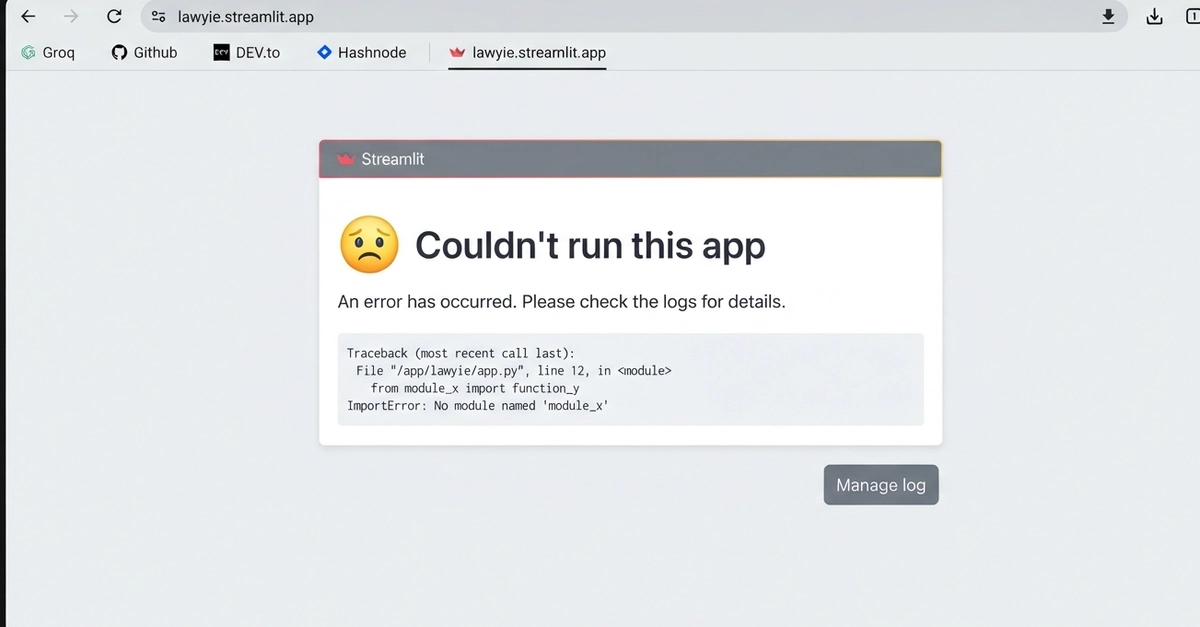
The Silent Crash: A Launch Day Nightmare
Every founder envisions a flawless launch: a smooth deployment, immediate user influx, and a celebration of hard work. For Lawyie, an intelligent legal infrastructure platform designed for Africa, the launch began with this dream. However, the reality quickly devolved into a crisis. Moments after deployment, the application screen went blank with a stark message: "Error running app." There were no visible code errors, no logical flaws immediately apparent. It was a silent failure, occurring at the most critical juncture – the public debut.
As the lead architect at Sunverse AI, the immediate shift was from creation to crisis management. The logs from Streamlit Cloud revealed a cryptic traceback: TypeError: GZipResponder.__init__() missing 1 required keyword-only argument: 'thread_minimum_size'. This error wasn't an AI hallucination or a data leak; it was the symptom of a deeper, systemic problem: an infrastructure war waged in the dependency layers.

Unpacking the Dependency Conflict
The root cause of the crash was a conflict stemming from versioning issues in the Python ecosystem, specifically related to the requests library and its underlying dependencies. The GZipResponder class, part of the httpx library, had recently been updated. This update introduced a new keyword-only argument, thread_minimum_size, to its constructor. However, the version of httpx being used by Lawyie’s dependencies had not yet caught up to this change.
The problem was exacerbated by the fact that Lawyie was utilizing several AI and data processing libraries. These libraries, each with their own complex dependency trees, implicitly relied on different versions of core Python packages. When deployed, the environment resolved these dependencies, but the resolution process favored a version of httpx that was incompatible with other packages in the stack. This created a situation where a core component expected an argument that was simply not present in the installed version, leading to the TypeError.
This scenario is a stark reminder of the fragility inherent in modern software development, particularly in the rapidly evolving AI landscape. Libraries are constantly updated, often with breaking changes, and managing these updates across a complex application stack is a significant challenge. For a launch-day scenario, this translates directly into lost momentum and user trust.
The Path to Resolution: Debugging and Pinning
The immediate priority was to restore service. The debugging process involved systematically analyzing the traceback and identifying the precise point of failure. Since the error pointed to GZipResponder and httpx, the investigation focused on the versions of libraries that directly or indirectly depended on httpx.
The solution involved a multi-pronged approach. First, the team identified the specific libraries causing the conflict. This often requires careful examination of the dependency graph, sometimes using tools like pipdeptree to visualize the relationships between installed packages. Once the culprits were identified, the next step was to implement version pinning. Version pinning is the practice of specifying exact versions of dependencies in a project's requirements file (e.g., requirements.txt or pyproject.toml). This ensures that the same versions are installed consistently across different environments, preventing unexpected updates from breaking the application.
In this case, the team needed to find a version of httpx that was compatible with all other dependencies, or alternatively, update the conflicting dependencies to versions that supported the newer httpx. The latter is often preferred for security and feature reasons, but it can also introduce new compatibility issues. The crucial step was to explicitly define the desired version of httpx and any related libraries in the project's dependency management file. This prevented the dependency resolver from picking an incompatible version during deployment.
Lessons for Building in Public
This incident, while stressful, offered invaluable lessons for Sunverse AI and other startups building in public. The first is the critical importance of robust dependency management. For AI projects, which often rely on a vast array of specialized libraries, this is non-negotiable. Thorough testing of dependency resolution and version compatibility in staging environments before production deployment is essential. This includes simulating the production environment as closely as possible to catch these