
Introducing Kubit: A New Approach to Product Analytics
Kubit has launched, introducing a product analytics platform designed to provide insights into both agent actions and user behavior. The core promise of Kubit is to help businesses understand how their agents' activities correlate with end-user engagement and outcomes, enabling optimization of workflows and product experiences. This is particularly relevant in industries where human-in-the-loop processes are common, such as customer support, sales enablement, and internal tooling, where the efficiency and effectiveness of agents directly impact customer satisfaction and business results.
The platform positions itself as a tool to move beyond traditional product analytics, which often focus solely on user-facing metrics. Kubit seeks to add a layer of understanding by integrating agent-side data, creating a more holistic view of the product ecosystem. This dual focus allows for the identification of bottlenecks, areas of friction, and opportunities for improvement that might be missed by analyzing user behavior in isolation.
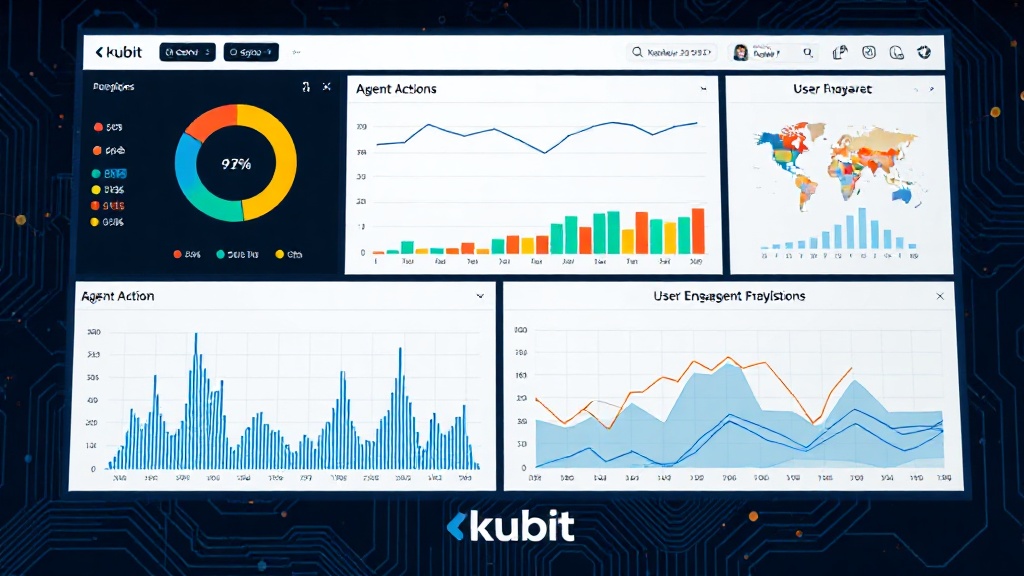
Bridging the Agent-User Divide
In many digital products, particularly those involving complex workflows or personalized interactions, agents play a crucial role. These agents might be customer support representatives, sales development representatives (SDRs), or even internal power users who leverage the product to perform specific tasks. Their actions—whether it's how they handle a customer query, configure a setting, or initiate a sales outreach—can have a profound impact on the end-user's experience and the ultimate success of the interaction.
Kubit's platform aims to capture and analyze this agent-specific data. By understanding what agents are doing, how they are using the product's features, and the time they spend on various tasks, businesses can begin to map these actions to user outcomes. For example, a support agent who takes a specific sequence of actions might resolve a customer issue faster, leading to higher customer satisfaction scores. Conversely, an agent struggling with a particular workflow might lead to longer resolution times and frustrated users.
The challenge Kubit addresses is the often-siloed nature of data collection. User analytics tools typically focus on the user's journey, while internal operational tools might track agent activity. Kubit's value proposition lies in its ability to unify these data streams. Think of it less like two separate conversations happening in different rooms and more like a single, continuous dialogue where you can see both sides of the exchange and understand how one influences the other.
Key Features and Benefits
While specific feature details are emergent, the core benefit Kubit offers is the ability to optimize agent actions based on user behavior. This can translate into several key advantages:
- Workflow Optimization: Identify inefficient agent workflows and streamline them to reduce task completion time and improve accuracy.
- Agent Training and Enablement: Pinpoint areas where agents may need additional training or better tools by observing their interaction patterns and success rates.
- Product Improvement: Discover how specific agent actions or tool usage patterns correlate with positive or negative user outcomes, informing product development priorities.
- Customer Experience Enhancement: Ensure that agent interactions are consistently contributing to a positive customer experience by understanding the impact of different agent behaviors.
- Performance Benchmarking: Establish benchmarks for agent performance based on successful user outcomes, allowing for better performance management.
The platform's focus on actionable insights means it's not just about collecting data, but about transforming that data into tangible improvements. By providing a clear link between agent effort and user results, Kubit empowers businesses to make data-driven decisions that enhance both operational efficiency and customer satisfaction.
Market Context and Future Implications
The broader market for product analytics has seen significant growth, with tools like Amplitude, Mixpanel, and Pendo dominating the user-centric analytics space. However, there's a growing recognition that user behavior is not solely driven by the product's UI/UX but also by the human interactions that often accompany it. This is especially true for B2B SaaS products, enterprise software, and any service that involves a direct human element in its delivery or support.
Kubit enters this landscape by carving out a niche that acknowledges the critical, yet often unquantified, role of agents. As companies increasingly rely on sophisticated customer engagement strategies and internal operational efficiencies, the ability to analyze and optimize the 'agent layer' becomes a competitive differentiator. The surprising detail here is not the emergence of a new analytics tool, but its specific focus on the agent-user dynamic, a crucial but often overlooked aspect of product interaction.
What nobody has addressed yet is what happens to the thousands of developers who built on older, user-centric analytics APIs. Will Kubit offer migration paths or integrations that bridge these worlds, or will it require a complete overhaul of existing data infrastructure? The success of platforms like Kubit may hinge on their ability to integrate seamlessly into existing data stacks rather than demanding a complete rip-and-replace.
For businesses, adopting a tool like Kubit could mean shifting their analytical focus from purely reactive user metrics to proactive optimization of human-assisted workflows. This could lead to a more robust understanding of their product's true value chain and a more agile approach to improving both internal operations and external customer experiences.