The Challenge: Rebuilding a Live Site with AI
Migrating a live website is rarely a seamless process. Typically, posts detailing such migrations gloss over the inevitable breakage. This account, however, focuses on the unexpected accessibility regression encountered during a 1:1 rebuild of a Jimdo site on the Neleto platform, and crucially, how targeted AI prompts resolved it. The objective was to replicate a functional Jimdo one-pager using Claude and Neleto's MCP connector without manual coding or direct page builder intervention. The initial migration was swift and visually appealing, but synthetic testing revealed a significant accessibility flaw. Fortunately, a few corrective prompts were all that was needed to achieve near-perfect performance metrics.
Baseline Performance: A Solid Jimdo Foundation
The starting point was a standard Jimdo-built one-page website. Before any migration efforts began, a baseline of its performance was established using Lighthouse. The initial Lighthouse report for the desktop version, captured on June 10th, indicated respectable scores, serving as a critical benchmark against which the Neleto version would be measured. While the exact scores are not provided in full for the initial Jimdo site, the implication is that it was performing adequately for its purpose, setting a reasonable target for the Neleto rebuild.

The Migration Process: AI-Assisted Rebuilding
The core of the migration involved leveraging Neleto's MCP connector and Claude, an AI model, to reconstruct the Jimdo site. This process bypassed traditional manual coding and direct manipulation of page builder interfaces. The MCP connector acts as a bridge, enabling Neleto to interpret and translate existing website structures and content. Claude's role was to guide this translation and content generation process, effectively acting as an automated developer. The initial pass resulted in a visually identical replica of the Jimdo site, appearing functional and aesthetically aligned with the original. This speed and fidelity in the first iteration highlight the potential of AI-driven migration tools.
The Unexpected Hurdle: An Accessibility Regression
Despite the apparent success of the initial AI-driven migration, a critical issue emerged during the Lighthouse audit of the Neleto-built site. The audit flagged an accessibility regression, a decline in the site's adherence to accessibility standards compared to the original Jimdo version. This was particularly surprising because the visual replication was deemed successful, and the process did not involve direct manual coding where such errors might typically be introduced. The specific nature of the regression isn't detailed, but it pointed to a flaw in how the AI interpreted or generated content related to accessibility features, such as semantic HTML, ARIA attributes, or keyboard navigation. This unexpected outcome underscores a common challenge in AI-generated code: while it can mimic form, it may not always capture the nuanced functional and compliance requirements of web standards.
Resolution: Targeted Prompts for Perfection
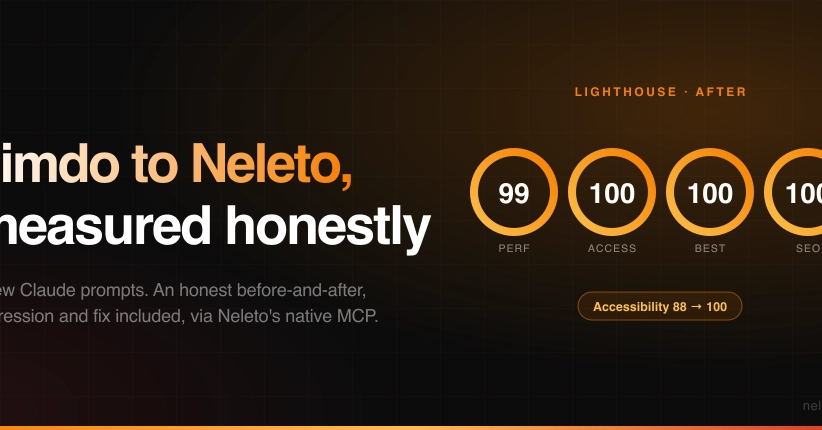
The breakthrough came with the application of just two follow-up prompts to Claude. These prompts were specifically designed to address the accessibility regression identified by Lighthouse. The precision required to correct such issues without a full manual code review is a testament to the advanced capabilities of modern AI models and the sophisticated design of the Neleto platform. The first prompt likely focused on identifying the specific accessibility failure, and the second on providing the correct implementation. The success of this targeted approach is significant: it demonstrates that complex web development issues, even those related to accessibility, can be iteratively refined through natural language instructions. The result of these corrective prompts was dramatic: the Neleto site achieved near-perfect Lighthouse scores across all categories – 99 for performance, 100 for accessibility, 100 for best practices, and 100 for SEO. This outcome validates the power of prompt engineering in web development and migration scenarios.
The Broader Implications: AI in Website Migration
This migration case study offers a compelling glimpse into the evolving landscape of website management and development. The ability to migrate a site '1:1' using AI prompts, with minimal human intervention, signals a potential paradigm shift. For businesses relying on older or proprietary website builders like Jimdo, this offers a pathway to modern, performant platforms like Neleto without the traditional high costs and complexities of a manual rebuild. The process highlights the importance of robust synthetic testing, like Lighthouse audits, even when relying on AI, as subtle issues can still arise. Furthermore, it emphasizes the growing significance of prompt engineering as a core skill for developers and site owners interacting with AI-powered tools. The near-perfect scores achieved not only validate the Neleto platform's capabilities but also set a new benchmark for what can be expected from AI-assisted web migrations. The question that remains is how scalable this approach is for more complex websites with dynamic content and intricate user interactions.