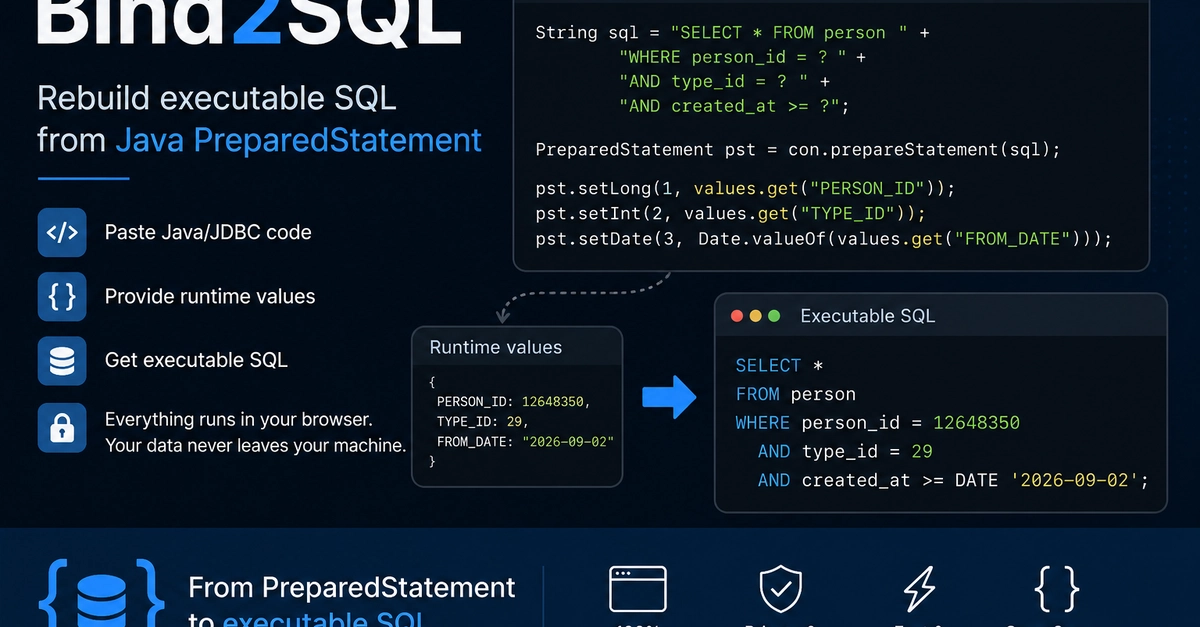
The Pain of Manual PreparedStatement Construction
Working with Java and JDBC often involves constructing SQL queries using PreparedStatement. This is a crucial security practice to prevent SQL injection vulnerabilities. However, the manual process of defining the SQL string, creating the statement, and then binding each parameter can become tedious, repetitive, and error-prone, especially for complex queries or when dealing with dynamic query building.
Consider a common scenario: selecting users based on multiple criteria. The code might look like this:
String sql = "SELECT * FROM users WHERE id = ? AND status = ?";

PreparedStatement pst = con.prepareStatement(sql);

pst.setLong(1, userId);
pst.setString(2, userStatus);
This snippet demonstrates the basic structure. However, as the number of parameters grows, or when conditions are optional, the code can quickly become unwieldy. Developers find themselves manually tracking parameter indices (1, 2, 3...) and ensuring the correct setXXX method is used for each data type. This boilerplate code consumes valuable development time and increases the risk of subtle bugs, such as off-by-one errors in parameter indexing or type mismatches.
The core problem is that the SQL string and the parameter binding logic are separated. The developer must maintain synchronization between the placeholder positions in the SQL and the order in which parameters are set. This becomes particularly challenging when building queries dynamically, where clauses might be added or removed based on user input or application state. Rebuilding the entire SQL string and re-binding all parameters for each modification is inefficient and prone to errors.
Introducing a More Elegant Solution
The author of the source article proposes a more streamlined approach to bypass the manual, index-based parameter binding. The key insight is to leverage a helper method that encapsulates the logic for building the PreparedStatement and setting its parameters, based on a structured representation of the query and its arguments.
Instead of manually writing:
String sql = "SELECT * FROM users WHERE id = ? AND status = ?";
PreparedStatement pst = con.prepareStatement(sql);
pst.setLong(1, userId);
pst.setString(2, userStatus);
The goal is to achieve something akin to:
List<Object> params = Arrays.asList(userId, userStatus);
PreparedStatement pst = QueryHelper.buildPreparedStatement(con, "SELECT * FROM users WHERE id = ? AND status = ?", params);
This QueryHelper.buildPreparedStatement method would take the SQL string and a list of parameters. Internally, it would iterate through the list, inferring the appropriate setXXX method based on the parameter's type and setting the value at the correct index. This abstracts away the manual index tracking and type selection, significantly reducing the amount of boilerplate code developers need to write and maintain.
The benefits are immediate: reduced code volume, fewer opportunities for indexing errors, and improved readability. It's like having a personal assistant who knows exactly how to set each parameter for you, without you needing to give them step-by-step instructions for every single one.
Implementation Details and Considerations
Implementing such a helper method involves a few key steps. First, the method needs to accept the Connection, the SQL query string, and a collection of parameter values. A List<Object> is a natural fit for the parameters, as it can hold values of various types.
Inside the helper method, a loop iterates through the parameter list. For each object, the code determines its runtime type. A series of if-else if statements or a switch-case structure on the object's class can be used to map Java types to the corresponding PreparedStatement.setXXX methods:
Integermaps tosetIntLongmaps tosetLongStringmaps tosetStringDoublemaps tosetDoublejava.sql.Datemaps tosetDatejava.sql.Timestampmaps tosetTimestampjava.util.Datemight require conversion tojava.sql.Timestamporjava.sql.DateBooleanmaps tosetBoolean
The loop counter (starting from 1 for JDBC) serves as the parameter index. The method then calls the appropriate setXXX method on the PreparedStatement instance. This process continues until all parameters in the list have been set.
A crucial aspect to consider is handling null values. If a parameter object is null, the helper method should intelligently call the appropriate setNull method. This requires knowing the SQL type of the parameter, which adds complexity. A common approach is to use a wrapper object or a separate list of SQL types alongside the parameter values.
Another consideration is the performance overhead. While this approach dramatically reduces boilerplate, the type checking and method invocation within the loop might introduce a small performance penalty compared to direct, manual calls. For most applications, this overhead is negligible and far outweighed by the gains in developer productivity and code maintainability. However, in extremely performance-critical sections of code, manual binding might still be preferred.
Error handling is also vital. The helper method should catch potential SQLExceptions that might occur during parameter setting and re-throw them, or wrap them in a more specific application exception. It should also handle cases where the number of parameters provided does not match the number of placeholders in the SQL string.
Beyond Basic Binding: Dynamic Queries
The real power of such a helper method emerges when dealing with dynamic query construction. Imagine a search form where users can specify filters for name, email, creation date range, and active status. Manually building the PreparedStatement for all possible combinations of these filters would lead to an explosion of conditional logic and duplicated SQL strings.
With a helper, the process becomes much cleaner. You can build a base SQL query and a list of parameters. Then, based on user input, you conditionally append `AND` clauses to the SQL string and add the corresponding values to the parameter list. For example:
StringBuilder sqlBuilder = new StringBuilder("SELECT * FROM users WHERE 1=1"); // Start with a tautology for easy AND appending
List<Object> params = new ArrayList<>();

if (userName != null) {
    sqlBuilder.append(" AND name LIKE ?");
    params.add("%" + userName + "%");
}
if (userEmail != null) {
    sqlBuilder.append(" AND email = ?");
    params.add(userEmail);
}

PreparedStatement pst = QueryHelper.buildPreparedStatement(con, sqlBuilder.toString(), params);
This pattern significantly simplifies the logic for building complex, multi-condition queries. The QueryHelper handles the parameter binding, regardless of how many conditions were dynamically added. This approach not only reduces code but also makes the query logic easier to understand and debug. The developer focuses on defining the conditions and their corresponding values, rather than wrestling with SQL syntax and parameter indices.
What nobody has addressed yet is the potential for this abstraction to obscure underlying SQL performance characteristics or to mask subtle data type incompatibilities that might only surface under specific database configurations. While convenient, understanding the default type mappings and potential edge cases becomes critical for robust implementation.
Conclusion: Reclaiming Developer Time
Manually managing PreparedStatement parameters is a low-level, error-prone task that offers little intellectual reward. By abstracting this process into a reusable helper method, developers can reclaim significant time and reduce the cognitive load associated with JDBC operations. This approach leads to cleaner, more maintainable code and fewer bugs related to SQL parameter binding. It’s a practical improvement that directly addresses a common pain point in Java database development, allowing engineers to focus on business logic rather than tedious boilerplate.