The Problem: Chat is a Black Hole of Information
A three-year-old Telegram group chat is a vast repository of knowledge, yet it remains largely inaccessible. Buried within its messages are answers to practical questions: the exact timeframe for a tax office inquiry, the replacement for an outdated form, or recommendations for accountants. Telegram's native search functionality is limited; it can find specific words you already know but cannot answer complex questions that require synthesizing information across multiple messages and dates. This makes years of accumulated group wisdom effectively unreadable and unusable for practical problem-solving.
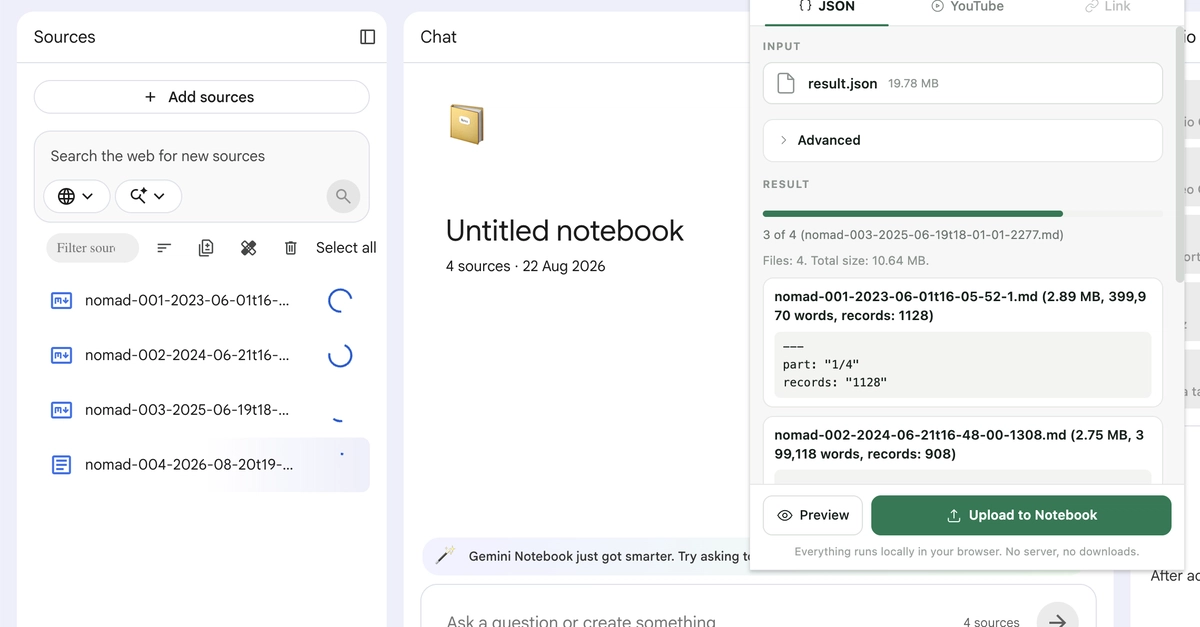
The solution involves extracting this chat history, transforming it into a structured document format, and then feeding it into an AI-powered reading and querying tool. While the outline of this process is straightforward – export, parse, ingest – the practical implementation involves several nuanced challenges. These include handling the specific data formats and potential pitfalls encountered during parsing, and crucially, ensuring the data ingestion process is both efficient and idempotent, meaning it can be run multiple times without adverse effects.
Two Clients, Two Export Formats
The ability to export chat history from Telegram is not universally available across all clients, and the formats differ. Telegram Desktop, a desktop application available since 2018, offers users the option to export their chat history in either JSON or HTML format. These formats are relatively structured and can be parsed programmatically. JSON, in particular, is a common data interchange format that can be easily processed by most programming languages.
However, the native Telegram client for macOS presents a different scenario. This client, distinct from the cross-platform desktop application, does not offer a direct export feature for chat history in the same way. This means users relying solely on the macOS native app are currently unable to generate the raw data files needed for this pipeline. This discrepancy highlights a critical first step in the process: identifying which client is being used and ensuring the correct export method is employed, or that users are directed to use the Telegram Desktop client for the export operation.
Parsing Challenges: Traps in the Data
Extracting data from any messaging platform is rarely a clean, one-step process. Telegram's chat exports, while functional, present specific parsing challenges. One significant hurdle is the handling of different message types. Beyond simple text messages, chats often contain media attachments (images, videos, documents), stickers, voice messages, and system messages (e.g., user joining/leaving, chat being renamed). A robust parser must be able to identify, categorize, and appropriately handle each of these message types. For instance, a parser might choose to ignore media files or extract their metadata, depending on the end goal.
Another common trap is dealing with message formatting and metadata. Telegram messages can include rich text formatting (bold, italics, code blocks), inline links, and mentions. The export format needs to preserve this information where relevant. Furthermore, message timestamps, sender IDs, and reply chains are crucial for reconstructing the conversation's context. Inconsistencies or missing data in these fields can lead to errors or misinterpretations. For example, if a message is edited or deleted, the export might reflect the change in a way that requires careful handling to avoid data corruption. The sequential nature of messages also means that ensuring the correct order is maintained during parsing is vital; a scrambled timeline renders the data useless.
Building the Pipeline: Ingestion and Idempotency
Once the chat history is exported and parsed into a usable format, the next phase is ingesting this data into a system capable of sophisticated querying. The goal is to transform a linear stream of messages into a knowledge base that can answer natural language questions. Tools like NotebookLM, which are designed for document analysis and summarization, are well-suited for this task.
The design problem here is not just about getting the data in, but how to pack it efficiently and make the process repeatable. Packing refers to how the parsed messages are structured into documents for the AI tool. This might involve grouping messages by day, by sender, or by topic, creating discrete units that the AI can process effectively. Simply dumping thousands of raw messages into a single document would overwhelm most AI models and lead to poor performance. The key is to create logical chunks that retain conversational context.
Making the second run idempotent is critical for any data pipeline. In this context, it means that if the pipeline is run again (perhaps to incorporate new messages or fix a parsing error), it should not duplicate data or create new errors. This requires careful state management. For instance, the pipeline needs to track which messages have already been processed and indexed. If new messages are detected, only those should be added. If the pipeline needs to re-process existing data, it must ensure that the old data is correctly updated or replaced, rather than appended, to maintain data integrity. This is often achieved by using unique identifiers for each message and employing upsert (update or insert) operations in the data store.
Beyond the Technical: The Value of Queryable History
The technical challenges of exporting, parsing, and ingesting Telegram chat data are surmountable with careful engineering. The real value lies in unlocking the collective intelligence stored within these conversations. For teams, communities, and even personal networks, a three-year chat history represents a significant, albeit latent, knowledge base. The ability to ask questions like "What was the consensus on X tool three months ago?" or "Who recommended a good plumber around last summer?" transforms ephemeral conversations into a persistent, queryable asset.
This approach moves beyond simple keyword search. It enables users to discover insights, recall forgotten recommendations, and leverage the shared experience of the group. It’s about making the implicit knowledge within a community explicit and actionable. The success of this pipeline, despite its technical intricacies, underscores a broader trend: the growing need to make unstructured digital communication more accessible and useful.