The Silent Bug: Lost Events in Event-Driven Systems
A particularly insidious bug plagues event-driven architectures: publishing a message to Kafka for data that never actually makes it into the database. This isn't a crash or an error; the Kafka message is sent, and the consumer processes it, only to find the corresponding data missing. Depending on your retry and error handling, this can lead to silent data inconsistencies that persist for extended periods before detection.
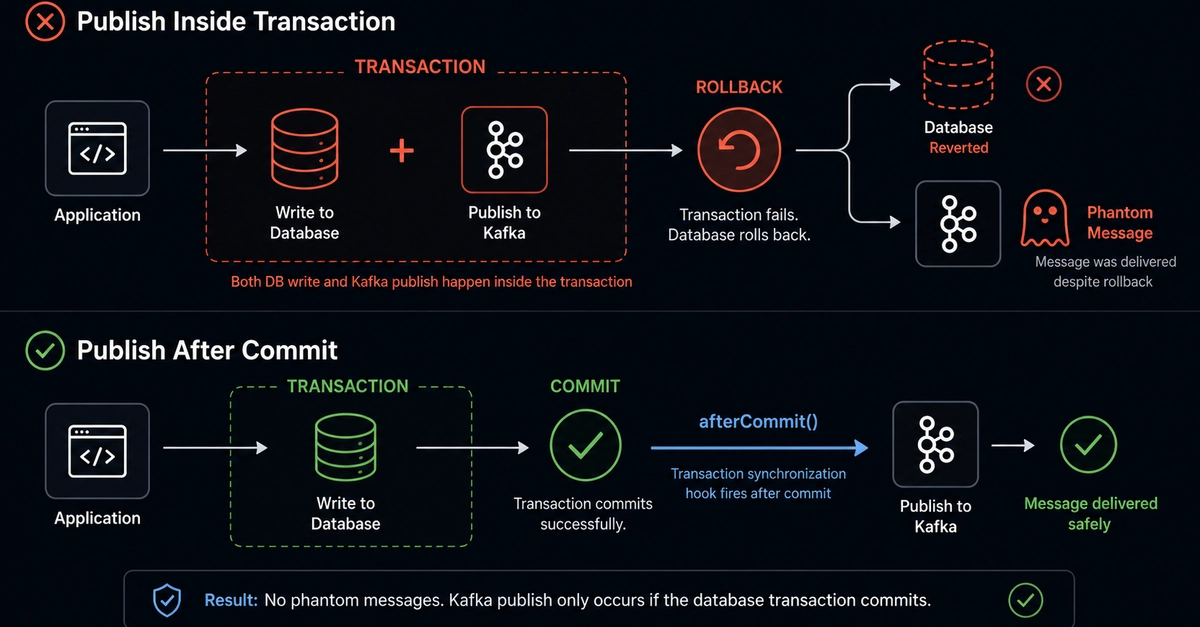
The root cause is often the intuitive, yet flawed, approach of publishing to Kafka within the same transactional method that writes to the database. While seemingly atomic, this creates a race condition where the Kafka message can be sent before the database transaction commits. If the transaction subsequently fails and rolls back, the Kafka message will have already been consumed, pointing to non-existent data.
Consider a typical e-commerce scenario: an order is placed. The system should update inventory, charge the customer, and then notify downstream services via Kafka. If the Kafka message is published before the database transaction commits, and the payment processing fails mid-transaction, the database rollback occurs. However, the Kafka message has already been dispatched. A fulfillment service might receive this message, attempt to retrieve order details, and find nothing, leading to order processing errors or customer service headaches.
This class of bug is notoriously difficult to catch in development. Unit tests might pass if they don't specifically test for transactional rollback scenarios involving external message queues. Integration tests might also miss it if their error handling is not robust enough to simulate the exact failure mode.
The Flawed Intuition: Publishing Inside the Transaction
The natural inclination for developers is to group all related operations within a single transactional boundary. This often means including the Kafka publish call within the same @Transactional annotated method that handles database writes. The code might look something like this:
@Transactional
public void createOrder(final Order order) {
    orderRepository.save(order);
    kafkaTemplate.send("order-events", OrderMapper.toEvent(order));
}
In this pattern, both the database save and the Kafka send are intended to be part of the same unit of work. However, transactional boundaries in many frameworks (like Spring Data JPA) typically only guarantee atomicity for operations managed by the transaction manager, which usually pertains to database operations. Sending a message to Kafka is an external call. The JVM might execute the kafkaTemplate.send() call before the database transaction's commit phase begins. If the database transaction fails during commit (e.g., due to a constraint violation, deadlock, or an external service failure during commit), the transaction rolls back. The database state is reverted, but the Kafka message has already been sent. The consumer receives a message for an order that no longer exists in the database, or never existed in the first place.
This leads to a state where the system's internal view (Kafka messages) is out of sync with its source of truth (the database). Consumers might initiate workflows, send notifications, or trigger further actions based on this phantom event, causing cascading failures and data corruption that are hard to trace back to the original, seemingly atomic, operation.
The Robust Solution: Post-Transaction Publishing
The reliable way to prevent this bug is to decouple the Kafka message publishing from the database transaction. This is achieved by publishing the message after the database transaction has successfully committed. This pattern ensures that a message is only sent if the data it refers to is durably stored.
Several mechanisms can implement this:
- Transactional Outbox Pattern: This is the most robust and widely recommended solution. It involves writing the event to be published into an “outbox” table within the same database transaction as the business data. After the main transaction commits, a separate process (or thread) monitors this outbox table. It reads committed events and publishes them to Kafka. Once published successfully, the event is marked as sent or deleted from the outbox table. This guarantees that an event is only published if the primary transaction succeeded.
- Spring's Transaction Synchronization: For applications using Spring, the
TransactionSynchronizationManagercan be leveraged. You can register a callback that executesafterCommit(). This callback can then trigger the Kafka message publishing. This approach keeps the logic within the same application but still ensures the message is only sent after a successful commit. - Message Queueing within the Database: Some databases offer built-in queuing mechanisms or extensions that can be used. The principle remains the same: the message is staged and only dispatched after the transaction commits.
Let's illustrate the Transactional Outbox pattern conceptually:
public class OrderService {
    private final OrderRepository orderRepository;
    private final OutboxRepository outboxRepository;

    public OrderService(OrderRepository orderRepository, OutboxRepository outboxRepository) {
        this.orderRepository = orderRepository;
        this.outboxRepository = outboxRepository;
    }

    @Transactional
    public void createOrder(final Order order) {
        orderRepository.save(order);

        final OutboxEvent event = OrderMapper.toOutboxEvent(order);
        outboxRepository.save(event);
    }
}

public class OutboxPublisher {
    private final OutboxRepository outboxRepository;
    private final KafkaTemplate<String,Object> kafkaTemplate;

    public OutboxPublisher(OutboxRepository outboxRepository, KafkaTemplate<String,Object> kafkaTemplate) {
        this.outboxRepository = outboxRepository;
        this.kafkaTemplate = kafkaTemplate;
    }

    public void processOutbox() {
        final List<OutboxEvent> events = outboxRepository.findUnpublishedEvents();
        for (final OutboxEvent event : events) {
            try {
                kafkaTemplate.send(event.getTopic(), event.getPayload());
                outboxRepository.markAsPublished(event.getId());
            catch (Exception e) {
                // Log error, implement retry strategy, or dead-letter queue
            }
        }
    }
}
The createOrder method now saves the order and then saves the event to an outbox table, both within the same transaction. A separate scheduled job or a background listener (OutboxPublisher) polls the outbox table for unpublished events, sends them to Kafka, and marks them as published. This ensures that only events corresponding to successfully committed orders are ever sent.
Beyond the Transaction: Ensuring Event Delivery
The Transactional Outbox pattern is a powerful tool for achieving exactly-once processing semantics at the producer side. It ensures that an event is published if and only if the primary business transaction commits. However, it's crucial to remember that this pattern addresses producer-side guarantees. Delivering messages reliably to Kafka and ensuring consumers process them exactly once still requires careful configuration and implementation on the Kafka broker and consumer sides, including idempotent producers and consumer offset management.
The benefit of this pattern is not just avoiding silent bugs but also providing a clear audit trail. The outbox table serves as a reliable log of all events that were intended to be published, even if Kafka was temporarily unavailable. This makes debugging and recovery significantly easier.
What nobody has addressed yet is the operational overhead of managing the outbox table and the separate publishing process. While robust, it adds complexity compared to the naive approach. Developers must weigh this increased complexity against the severe risks of silent data corruption in production.
For any system where data integrity is paramount, especially in financial or e-commerce domains, adopting a post-transactional publishing strategy like the Transactional Outbox pattern is not an optimization; it's a necessity. The occasional extra step in development is a small price to pay for the peace of mind that your event streams accurately reflect your committed business state.