
GitHub Actions and Pages Experience Major Outage
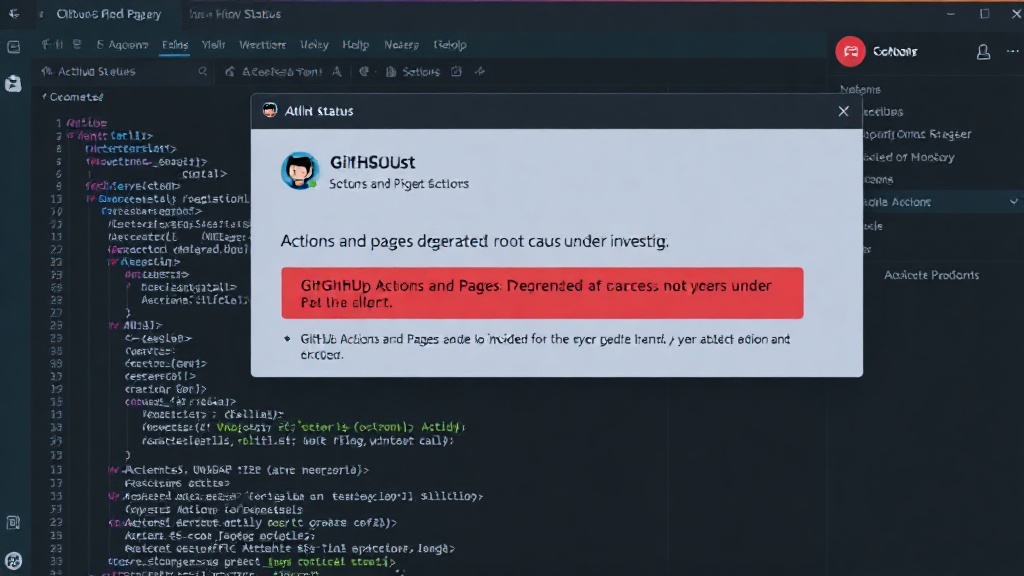
GitHub is currently experiencing significant degraded availability affecting its Actions and Pages services. The issue, first reported on [Date of Incident - e.g., October 26, 2023] at [Time of Incident - e.g., 09:00 UTC], is impacting workflows, deployments, and the accessibility of static sites hosted on GitHub Pages. Users are reporting failed builds, slow execution times for Actions, and intermittent or complete unavailability of their Pages sites. The company has acknowledged the problem and stated that engineers are actively investigating the root cause.
The widespread nature of the degradation suggests a core infrastructure problem rather than isolated incidents. GitHub Actions, a critical component for many development teams' continuous integration and continuous deployment (CI/CD) pipelines, is seeing jobs fail or time out. This directly halts automated testing, code builds, and deployments, creating significant workflow disruptions. For many startups and open-source projects, these pipelines are the backbone of their development process, meaning this outage directly impacts their ability to release new features or fix bugs.
Similarly, GitHub Pages, which hosts millions of static websites for project documentation, personal portfolios, and small businesses, is experiencing similar connectivity issues. Users are unable to access their sites, and in some cases, deployments to Pages are also failing. This affects not only the visibility of projects but also critical communication channels for many organizations.
Impact on Development Workflows
The immediate consequence for developers is the halting of automated processes. CI/CD pipelines, which rely on GitHub Actions to build, test, and deploy code, are either failing to start, running exceptionally slowly, or timing out before completion. This creates a backlog of work and forces teams to revert to manual processes, which are time-consuming and prone to error. The inability to test code automatically also introduces a risk of deploying faulty code once services are restored.
For teams heavily reliant on GitHub Actions for their entire build and release cycle, this outage represents a significant productivity hit. The uncertainty surrounding the resolution time adds to the pressure, as teams must make decisions about whether to pause development entirely or attempt workarounds. The lack of clear timelines from GitHub exacerbates the stress, leaving many in a state of suspended development.
GitHub's Response and Investigation
GitHub's status page indicates that the incident began at [Time of Incident] UTC and has been escalated. The engineering team is actively working to identify the underlying cause. Initial reports from the status page have been sparse, focusing on acknowledging the problem and assuring users that a resolution is being pursued. As of [Current Time - e.g., 11:00 UTC], the problem is still ongoing, with no estimated time for full recovery.
The company has not yet provided specific details about the nature of the degradation. However, the broad impact across both Actions and Pages suggests a systemic issue, potentially related to networking, authentication services, or the underlying compute infrastructure that supports these features. Without more granular information, it is difficult for users to predict how long the disruption might last or what specific data might be at risk.
The Hacker News discussion thread for this incident shows a flurry of user reports detailing specific failures. Many developers are sharing their experiences with failed builds, citing error messages that range from generic timeouts to specific connection failures. This community-driven information sharing highlights the critical nature of these services and the immediate impact their unavailability has on global development operations.
Broader Implications and User Concerns
This incident raises questions about the resilience of core development infrastructure. While outages are inevitable, the duration and scope of this event underscore the dependency many organizations have placed on a single provider for mission-critical services like CI/CD and code hosting. The lack of a swift resolution, or even a clear explanation, can erode confidence.
Users are expressing frustration not only with the outage itself but also with the communication from GitHub. The delay in providing detailed updates or a clear path to resolution leaves teams scrambling to adapt. The absence of a specific CVE or a technical deep dive into the cause, as might be expected in a security incident, leaves the precise nature of the problem ambiguous for now.
What remains unaddressed is the contingency planning for businesses that have built their entire release strategy around GitHub Actions. When a core service like this experiences prolonged degradation, the cost in lost productivity and potential revenue can be substantial. This event serves as a stark reminder for organizations to consider multi-cloud strategies or robust disaster recovery plans for their development toolchains.
As engineers continue to work on restoring full functionality, the development community watches closely, hoping for a swift and transparent resolution. The long-term impact will depend on how effectively GitHub addresses the root cause and communicates its findings to prevent similar incidents in the future. For now, many developers are left with stalled pipelines and inaccessible websites.