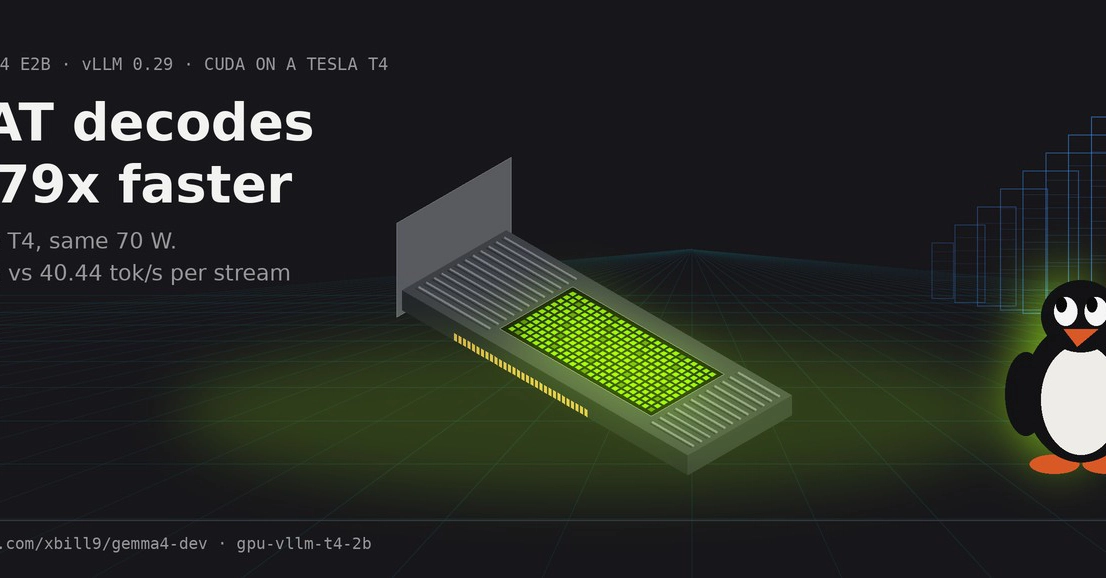
Performance Leap with Quantized Gemma 4 on Tesla T4
Deploying large language models (LLMs) like Google's Gemma 4 on consumer-grade or older enterprise hardware presents a persistent challenge. The trade-off between model accuracy and inference speed is a constant balancing act. However, recent benchmarks on a Tesla T4 GPU reveal a significant performance uplift when using Quantization Aware Training (QAT) weights compared to standard bf16 precision. The specific configuration tested involved the google/gemma-4-E2B-it model in bf16 and its QAT counterpart, google/gemma-4-E2B-it-qat-w4a16-ct, which uses int4 weights.
The hardware in question is a single Tesla T4 GPU, a Turing-based accelerator with compute capability 7.5 and 15360 MiB of memory, operating within a 70 W power envelope. These GPUs, while no longer cutting-edge, are still prevalent in many cloud environments and on-premises setups, making performance improvements on them highly relevant. The tests were conducted on a Google Compute Engine VM where the T4 was already attached, simplifying the setup process by eliminating the need for additional hardware provisioning. The primary goal was to determine the fastest running checkpoint for Gemma 4 on this specific GPU.
The results are striking: the QAT weights achieved a decode speed 1.79 times faster than the bf16 weights. This substantial improvement suggests that for certain inference tasks, particularly those with memory or computational constraints, leveraging QAT can unlock significantly higher throughput without a proportional loss in output quality. The development of Python MCP tools, designed to streamline the management of vLLM hosted deployments, played a crucial role in facilitating these comparative benchmarks.
Understanding Quantization Aware Training (QAT)
Quantization is a technique used to reduce the memory footprint and computational cost of neural networks by representing weights and activations with lower precision data types, such as 4-bit integers (int4) instead of 16-bit floating-point numbers (bf16). This compression allows models to fit into smaller memory spaces and speeds up calculations, as integer arithmetic is generally faster than floating-point operations.
Quantization Aware Training (QAT) takes this a step further. Instead of quantizing a pre-trained model (Post-Training Quantization or PTQ), QAT simulates the quantization process *during* the training or fine-tuning phase. This means the model learns to adapt to the reduced precision, often mitigating the accuracy degradation that can occur with PTQ. In essence, QAT helps the model become more robust to the effects of quantization, leading to models that are both smaller, faster, and often retain accuracy closer to their higher-precision counterparts.
For Gemma 4, the -qat-w4a16-ct variant signifies that the weights are quantized to 4-bit integers (w4) and activations to 16-bit integers (a16), with the 'ct' likely referring to a specific calibration or training method. This approach contrasts with the standard google/gemma-4-E2B-it model, which likely uses bf16 (bfloat16) for its weights and activations, a format offering a good balance of range and precision for deep learning tasks.
The Role of vLLM and Tesla T4
The inference framework used, vLLM, is a high-throughput and memory-efficient inference engine for large language models. vLLM employs techniques like PagedAttention to manage attention KV caches, which significantly reduces memory waste and allows for higher batch sizes and thus greater throughput. Its efficiency is critical when deploying models on hardware with limited resources, such as the 70 W Tesla T4.
The Tesla T4, with its Turing architecture, was designed for inference workloads and AI acceleration. While it lacks the raw power of newer generations like Ampere or Hopper, its efficiency and widespread availability make it a compelling choice for cost-sensitive deployments. The fact that QAT weights can yield a nearly 1.8x speedup on this hardware underscores the importance of optimizing models for specific inference engines and hardware capabilities.
The Python MCP tools mentioned in the source material are designed to abstract away much of the complexity involved in setting up and managing such deployments. By providing a simplified interface, these tools enable developers to quickly iterate on different model configurations and hardware settings, accelerating the process of finding optimal performance parameters. This is particularly valuable when exploring the benefits of techniques like QAT, which might otherwise require deep expertise in model training and optimization pipelines.
Implications for LLM Deployment
The nearly twofold increase in decode speed for Gemma 4 on a Tesla T4 using QAT weights has significant implications for LLM deployment strategies. For organizations and individuals relying on T4s or similar hardware for inference, this means:
- Increased Throughput: More requests can be processed per second, leading to better user experience and lower operational costs per inference.
- Reduced Latency: For real-time applications, faster inference translates directly to lower response times.
- Wider Accessibility: Models that were previously too slow or memory-intensive for older hardware may now become viable.
- Cost Savings: By achieving higher performance on existing hardware, the need for more expensive, newer GPUs can be deferred or eliminated.
The surprising detail here is not merely the performance gain itself, but the magnitude of the improvement on hardware that might be considered legacy. It highlights that sophisticated quantization techniques, when paired with efficient inference engines like vLLM, can unlock substantial performance gains that were previously underestimated for these GPU architectures. This suggests that the pathway to efficient LLM deployment on a broader range of hardware is through intelligent model optimization and tailored inference solutions.
Future Considerations
While these benchmarks are promising, it's important to consider the potential impact of QAT on model accuracy. The source material does not detail the specific accuracy metrics for the Gemma 4 E2B QAT variant. Comprehensive evaluation would require testing against standard accuracy benchmarks (e.g., MMLU, HellaSwag) to ensure that the 1.79x speedup does not come at an unacceptable cost to the model's reasoning or generative capabilities.
Furthermore, the effectiveness of QAT can be model-specific and hardware-dependent. While highly beneficial for Gemma 4 on a Tesla T4, the same quantization strategy might yield different results on other models or different GPU architectures. Continued research and benchmarking across a wider array of models and hardware will be crucial for establishing best practices in LLM quantization and deployment.